














Literary elements might sound like a term reserved for English class, but you actually encounter them every day.
Every time a songwriter compares heartbreak to a storm, that’s a metaphor.
Every time a thriller drops a subtle clue about the ending in chapter 1, that’s foreshadowing.
Every time a narrator describes the smell of fresh bread wafting through a kitchen, that’s imagery.
Literary elements are writing techniques that help authors create deeper meaning and keep readers engaged. This guide covers 21 essential literary devices with clear definitions, examples from classic and modern literature, and actionable tips for using each one in your own book.

These devices aren’t reserved for prize-winning novelists. They’re tools every author can (and should) use, regardless of book genre. And once you understand how literary devices work, you’ll start spotting them everywhere: in speeches, screenplays, and even advertisements.
So now let’s break down what literary elements are and why they matter for your book. Then we’ll walk you through a complete list of 21 literary devices with definitions and examples you can reference while you write.
What are literary elements?
Literary elements (also called literary devices) are specific writing techniques that go beyond literal meaning to convey emotion and immerse readers in a story. They are the techniques that separate flat, forgettable writing from prose that stays with a reader long after they close the book.
According to Purdue University’s Online Writing Lab (OWL), literary elements and devices help readers “appreciate, interpret, and analyze a literary work” by adding layers of meaning beneath the surface of the text.
Some schools of thought separate “literary elements” from “literary techniques.” In these instances, literary elements refer to the large-scale building blocks of a story (plot, character, setting, theme), while literary techniques are tools applied at the sentence level (metaphors, alliteration, irony).
In everyday writing discussions, however, (and throughout this guide) the terms overlap.
The most widely recognized literary elements include metaphors, similes, personification, imagery, symbolism, alliteration, and foreshadowing.
But that’s only the beginning.
There are dozens of literary devices that are available to you, ranging from everyday techniques like hyperbole to more advanced tools like anaphora and epistrophe that show up in famous speeches and poetry.
Why should authors use literary elements?
Authors who master literary elements create stronger emotional connections with readers and produce more memorable, publishable books. Literary devices are what separate functional writing from literature that people return to again and again.
Here’s specifically what they do for your writing:
They show instead of tell. The most common writing advice is “show, don’t tell.” Literary elements are how you do it. Instead of writing “she was sad,” you use imagery:
“Her hands shook as she pressed the letter against her chest, the ink already smeared by tears she didn’t remember crying.”
They create emotional resonance. Devices like personification, metaphor, and nostalgia draw readers into the emotional world of your characters and make them care about what happens next.
They make complex ideas accessible. Symbolism, allegory, and analogy help you communicate abstract themes without lecturing your audience.
They improve pacing and rhythm. Techniques like anaphora, alliteration, and epistrophe add musicality to your prose, controlling how fast or slow a reader moves through your sentences.
They make your writing memorable. The right metaphor or piece of foreshadowing can become the defining moment of your entire book. Lines with literary elements are usually the line readers quote, share, and remember.
Whether you’re learning how to write a book for the first time or polishing your 5th manuscript, these tools will elevate your writing across every writing style.
A complete list of 21 literary elements with definitions and examples
From Shakespeare to Toni Morrison, from J.K. Rowling to Kristin Hannah, the greatest authors rely on literary elements to create stories that resonate across generations.
Here are 21 of the most powerful literary devices, each with a definition, examples, and practical tips for your own writing.
1. Allusion
An allusion is an indirect reference to a person, event, place, or work of art outside the current text. Allusions call on shared cultural knowledge. When you reference something your reader already knows, you instantly add a layer of meaning without spelling it out.
An easy way to remember this: think of the verb “allude.” When you allude to something, you’re nodding toward it without explaining.
Example: With a deep frown on his face as he stormed through the Christmas market, Johnny looked like a real Scrooge.
The reader instantly pictures a grumpy miser because of the reference to Dickens’ A Christmas Carol. No lengthy description is needed.
Author tip: Allusions work best when they reference something your target audience will recognize. A literary fiction reader might appreciate a nod to Greek mythology, while a thriller reader might connect with a famous crime or headline.
If you need to explain the allusion, it probably isn’t right for your audience.
2. Alliteration
Alliteration is the repetition of the same consonant sound at the beginning of words that appear close together in a sentence or phrase. It adds rhythm, makes phrases memorable, and is one of the most common literary elements found in everyday life – from book titles to brand names.
Classic examples in book titles: Pride and Prejudice, The Great Gatsby, Sense and Sensibility, Of Mice and Men.
Example from Edgar Allan Poe’s “The Raven”:
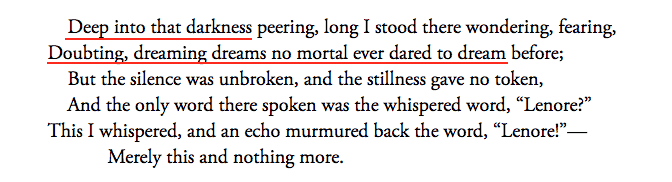
Author tip: Alliteration shines in chapter titles, character names, and key phrases you want readers to remember. In prose, use it sparingly. A little goes a long way before it starts to feel forced.
3. Anaphora
Anaphora is the repetition of a word or phrase at the beginning of successive sentences or clauses. It builds emphasis and emotional momentum, which is why it appears in many famous speeches and pivotal book passages.
Example from Charles Dickens’ A Tale of Two Cities:
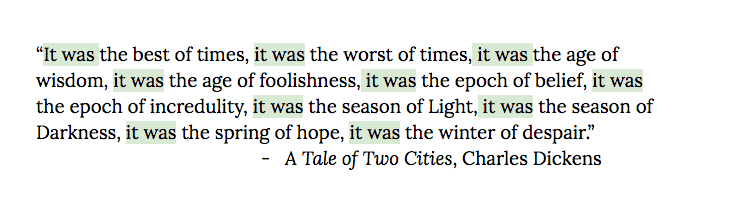
Example from Martin Luther King Jr.: The repeated phrase “I have a dream” is one of the most recognized uses of anaphora in the English language.
Author tip: Anaphora is powerful in climactic scenes, internal monologues, and any moment where you want emotional intensity to build. It’s also effective in nonfiction for driving home a central argument.
4. Diction
Diction refers to the specific word choices a writer makes to convey tone, character, and setting. The exact words you select shape how readers perceive your characters and the world of your story.
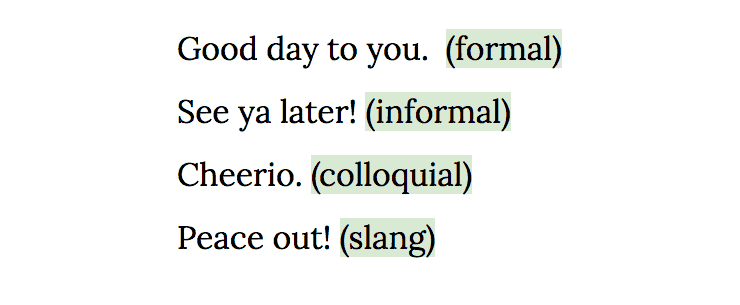
There are 4 main types of diction:
Formal diction uses sophisticated vocabulary and proper grammar. Think courtroom dramas, period pieces, or academic characters.
Informal diction mirrors casual, everyday conversation, creating warmth and familiarity in contemporary fiction and memoirs.
Colloquial diction uses regional expressions specific to a community or area. It adds authenticity to dialogue and grounding a story in a specific place and time.
Slang diction uses trendy, newly coined, or subculture-specific language. It is most common in YA fiction and contemporary novels.
Author tip: Diction should match your genre, your target audience, and each character’s unique voice. A hardboiled detective shouldn’t speak the same way as a Regency-era duchess. Inconsistent diction is one of the fastest ways to break a reader’s immersion.
5. Euphemism
A euphemism is a milder or more indirect expression used in place of something blunt or uncomfortable. It lets authors address difficult topics like death, bodily functions, or violence with more tact or even dark humor.
Example: A doctor might refer to a “negative patient outcome” instead of saying a patient died. A character might say someone “passed away” or “is no longer with us.”
Author tip: Euphemisms reveal character. How a person avoids uncomfortable truths tells the reader as much about them as what they say directly. They’re also valuable in memoir writing when navigating sensitive topics.
6. Epistrophe
Epistrophe is the repetition of a word or phrase at the end of successive clauses or sentences. It’s the mirror image of anaphora and is equally effective for creating rhythm and emphasis.
Example from Abraham Lincoln’s Gettysburg Address: “…government of the people, by the people, and for the people, shall not perish from the earth.”
Author tip: Epistrophe draws the reader’s attention to the repeated word, making it the anchor of the passage. Use it when you want a specific concept or emotion to resonate after the sentence ends.
7. Flashbacks
A flashback is a scene that transports the reader to an earlier event in time, providing backstory or emotional context. Flashbacks are among the most popular literary elements in both books and film because they let you reveal the past without front-loading your opening chapters with exposition.
Common reasons to use flashbacks:
- Provide context about a character’s past that explains their present behavior
- Increase suspense by revealing information at a strategic moment
- Create emotional contrast between “then” and “now”
Example: In Disney’s Tangled, Rapunzel has a pivotal flashback when she spots the sun symbol on her tower ceiling. It triggers a recovered memory of her real parents that drives the rest of the story.
Author tip: Flashbacks work best when they’re earned. Use them when the past event is directly relevant to the present conflict. If backstory can be revealed through dialogue or action in the present, that’s usually the stronger choice.
Learn more about structuring your story’s timeline in our guide on how to outline a book.
8. Foreshadowing
Foreshadowing is a technique where the author plants hints or clues about events that will happen later in the story. When done well, foreshadowing creates a sense of anticipation. It gives you that satisfying payoff of everything clicking into place after a twist or climax.
Example: A character mentioning an old well in chapter 2 that becomes the setting for the climax in chapter 20. Or a seemingly throwaway line of dialogue that takes on new meaning after a plot twist.
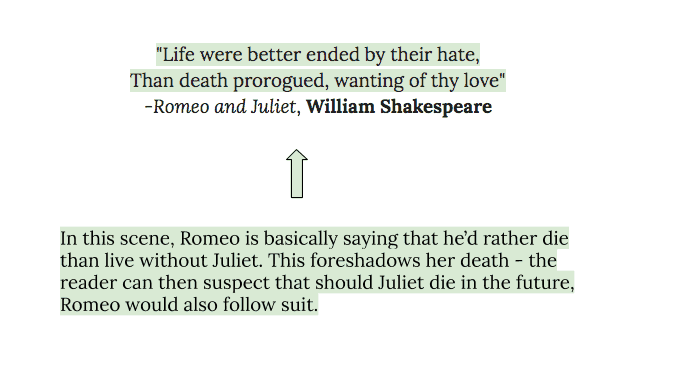
Author tip: Foreshadowing rewards attentive readers and makes your story feel tightly plotted. Plant subtle details (a description, an object, an offhand comment) early on that pay off later.
Keep Chekhov’s Gun in mind: if you introduce a detail, it should matter.
9. Hyperbole
Hyperbole is an extreme exaggeration used for emphasis, humor, or dramatic effect. It is not meant to be taken literally. Hyperbole is one of the most intuitive literary elements because most people use it naturally in everyday speech.
Examples:
- “I’m so hungry, I could eat a whole cow.”
- “She’s told that story a million times.”
- “He waited an eternity for her reply.”
Author tip: Hyperbole is a natural fit for first-person narrators and dialogue that reflects how people actually talk. It’s also great for comedic writing, and can even add personality to nonfiction. Use it when you want the reader to feel the intensity of a moment, not when you’re presenting facts.
10. Imagery
Imagery is descriptive language that appeals to the reader’s 5 senses (sight, sound, smell, taste, and touch) to create a vivid, immersive reading experience. It’s the primary tool for “showing” rather than “telling,” and it’s what makes readers feel like they’re physically inside your story.
The 5 types of imagery:
Visual imagery paints a picture: “The sunset bled orange and purple across the horizon.”
Auditory imagery creates sound: “The floorboards groaned under his weight.”
Olfactory imagery evokes smell: “The toasty smell of fresh tortillas filled the kitchen.”
Gustatory imagery suggests taste: “The lemon was so sour it made her whole face pucker.”
Tactile imagery conveys touch: “The wool blanket scratched against her bare arms.”
Author tip: Imagery is especially powerful when establishing the setting of a story. Rather than telling readers a room is “old and dusty,” describe the cobwebs stretching between the bookshelves and the faint smell of mildew seeping from the walls. Engaging multiple senses in a single passage creates the most immersive effect.
11. Juxtaposition
Juxtaposition is when a writer places two contrasting elements side by side to highlight their differences or surprising similarities. The contrast sharpens the emotional impact of both elements.
Example: In The Godfather, director Francis Ford Coppola juxtaposes a baptism scene with a series of murders. The sacred ritual against the brutal violence makes both scenes more powerful than either would be alone.
Author tip: Juxtaposition works at every scale, from contrasting 2 words in a sentence to alternating between storylines in a novel. Use it when you want readers to feel the tension between opposing forces, themes, or emotional states.
12. Motif
A motif is a recurring element that appears throughout a story to reinforce its central themes. Unlike a one-time symbol, a motif repeats and evolves, weaving itself through the narrative to deepen meaning over time. It could be a symbol, a phrase, or an idea.
Example from literature: The recurring “green light” in F. Scott Fitzgerald’s The Great Gatsby functions as a motif representing Gatsby’s longing, ambition, and the impossibility of recapturing the past.
Example from film: In many Disney fairy tales, the motif of the older female villain (the wicked stepmother in Cinderella, the sea witch in The Little Mermaid) reinforces themes of jealousy and the fear of aging.
Author tip: Choose a motif that connects to your book’s central theme. Introduce it early, then let it resurface at key moments throughout the story. The reader may not consciously notice the repetition, but it creates a powerful sense of cohesion and depth.
13. Metaphor
A metaphor is a direct comparison between two unlike things (without using “like” or “as”) that suggests they share a meaningful quality. Metaphors are among the most widely used literary elements in all of literature, compressing vivid meaning into just a few words.
Example: “That woman is a devil in disguise.”
The speaker isn’t saying the woman is literally a devil. The metaphor instantly communicates deception and danger far more efficiently than a literal description.
Author tip: The strongest metaphors are specific and fresh. Avoid clichés (“heart of gold,” “time is money”) and instead create comparisons unique to your story’s world and characters.
14. Simile
A simile is an explicit comparison between two unlike things using the words “like” or “as.” While metaphors imply the comparison, similes spell it out, making them slightly more accessible and often more visual.
Example: “His face was as red as a tomato.”
Example from film: “Life is like a box of chocolates. You never know what you’re gonna get.” – Forrest Gump
Author tip: Similes are excellent for helping readers picture something unfamiliar by comparing it to something they already know. The key is originality. Avoid worn-out comparisons and create similes that feel specific to your story.
15. Personification
Personification gives human characteristics, emotions, or behaviors to non-human things. It’s a simple but surprisingly powerful device that makes writing more vivid and relatable.
Examples:
- “The trees whispered to one another in the night.”
- “Time waits for no one.”
- “The snow whirled and danced across the sky.”
Author tip: Personification works in virtually every genre. Use it to bring settings to life or make abstract ideas (time, death, fate) feel tangible and immediate.
16. Onomatopoeia
Onomatopoeia is a word that phonetically imitates the sound it describes. It stimulates the reader’s auditory imagination, making action scenes and nature descriptions more immersive.
Examples: buzz, splash, crack, sizzle, hiss, thud, murmur, rustle, ding-dong, whoosh.
Author tip: Onomatopoeia adds energy to prose and engages a sense that’s often underused in writing – hearing. It’s especially effective in children’s books!
17. Oxymoron
An oxymoron combines two contradictory words into a single phrase to create a thought-provoking or surprising effect. The built-in tension draws attention and often reveals a deeper truth about the subject.
Examples: “bittersweet,” “deafening silence,” “awfully good,” “living dead,” “organized chaos.”
Author tip: Oxymorons are effective in poetry, titles, and dialogue where you want to capture a complex emotion in just two words. A character described with “cruel kindness” or a setting with “beautiful destruction” communicates more than a full paragraph of explanation.
18. Paradox
A paradox is a statement that appears contradictory on the surface but reveals a deeper truth upon reflection. Unlike an oxymoron (which operates at the word level), a paradox works at the sentence or idea level.
Example: “Keep your friends close, and your enemies closer.”
It seems contradictory. Why keep enemies close? But the underlying truth is strategic: understanding your opponents gives you an advantage.
Author tip: Paradoxes make strong opening lines and character dialogue that reveals wisdom. They engage the reader’s mind and invite deeper thinking about the themes of your story.
19. Symbolism
Symbolism is when an object, character, color, or setting represents something beyond its literal meaning. It’s one of the most powerful literary elements because it lets authors communicate complex themes without stating them directly.
Example from literature: In Nathaniel Hawthorne’s The Scarlet Letter, the letter “A” worn by Hester Prynne symbolizes adultery and shame. By the end, it ultimately represents resilience.
Everyday examples: A dove symbolizes peace. A red rose symbolizes love. A storm often symbolizes internal turmoil.
Author tip: Choose symbols that feel organic to your story. They should be objects or images that already exist in your world. Let them accumulate meaning through repetition and context. The reader should discover the symbolism naturally, not be hit over the head with it.
20. Tone
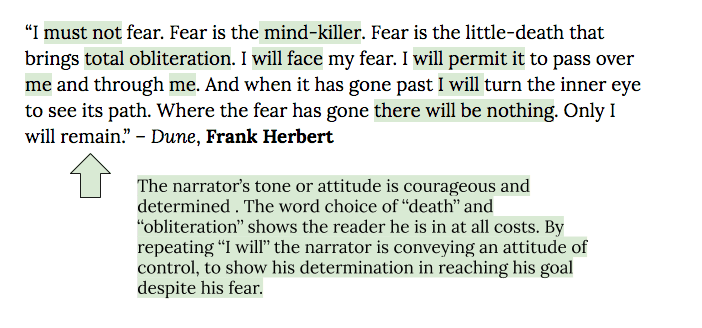
Tone is the author’s or narrator’s attitude toward the subject matter, characters, or audience . It is communicated through word choice and sentence structure. Tone is different from mood (how the reader feels). Tone is how the writer feels about what they’re writing.
A single story told in different tones feels like a completely different book. A war story told in a detached, matter-of-fact tone creates a very different experience than the same events told with anguished intensity.
Common tones in writing: serious, playful, sarcastic, melancholic, hopeful, detached, intimate, humorous, reverent, cynical.
Author tip: Your writing tone should match your genre, your narrator’s personality, and the emotional arc of your story. Sudden, unexplained tonal shifts pull readers out of the experience.
21. Nostalgia
Nostalgia is a literary element that evokes a deep longing for the past. It can be for a specific time, place, or experience that carries emotional weight. When used skillfully, nostalgic writing creates an atmosphere of warmth and emotional resonance that draws readers deeply into a story.
Authors use nostalgic passages to reveal what characters value and what drives their present-day decisions. It adds complexity by showing who a character was, and who they wish they could be again.
Author tip: Nostalgic writing is especially effective in memoir, coming-of-age stories, and any narrative where the past and present are in tension. Ground nostalgic passages in specific sensory details (the smell of a grandmother’s kitchen, the sound of a particular song, the feel of a childhood blanket) to make them feel real and universal.
Literary elements quick-reference chart
| Literary Element | What It Does | Quick Example |
| Allusion | Indirectly references external people, events, or works | “She had a Midas touch with investments.” |
| Alliteration | Repeats consonant sounds at the start of nearby words | Pride and Prejudice |
| Anaphora | Repeats a word/phrase at the start of successive clauses | “It was the best of times, it was the worst of times…” |
| Diction | Uses specific word choices to convey tone and character | Formal: “I shall return” vs. Slang: “I’ll be back” |
| Euphemism | Replaces harsh language with milder expressions | “Passed away” instead of “died” |
| Epistrophe | Repeats a word/phrase at the end of successive clauses | “…of the people, by the people, for the people” |
| Flashback | Transports the reader to a past event | A character remembering childhood during a crisis |
| Foreshadowing | Plants hints about future events | A throwaway comment that gains meaning later |
| Hyperbole | Uses extreme exaggeration for emphasis or humor | “I’ve told you a million times.” |
| Imagery | Engages the 5 senses through descriptive language | “The iron gate screeched as she pushed it open.” |
| Juxtaposition | Places contrasting elements side by side | Baptism vs. violence in The Godfather |
| Motif | Repeats an element throughout a story to reinforce theme | The green light in The Great Gatsby |
| Metaphor | Implicit comparison without “like” or “as” | “That woman is a devil in disguise.” |
| Simile | Explicit comparison using “like” or “as” | “His face was as red as a tomato.” |
| Personification | Gives human traits to non-human things | “The trees whispered in the night.” |
| Onomatopoeia | Uses words that imitate sounds | Buzz, splash, crack, sizzle |
| Oxymoron | Combines contradictory words | “Deafening silence” |
| Paradox | States something seemingly contradictory that holds truth | “The only constant is change.” |
| Symbolism | Uses objects/images to represent abstract ideas | The scarlet letter “A” representing shame |
| Tone | Conveys the author’s attitude toward the subject | Sarcastic, hopeful, detached, intimate |
| Nostalgia | Evokes longing for the past | A character triggered by a childhood song |
6 tips for using literary elements in your writing
Knowing literary elements is one thing, but using them effectively in your book is another. Here are 6 practical tips for using literary devices in your own writing:
Read widely and intentionally. Study the craft of authors you admire. The more you encounter literary devices used well, the more naturally you’ll spot opportunities in your own work. Reading across different book genres expands your toolkit.
Sprinkle, don’t dump. Literary elements are like spice in a recipe. A pinch of foreshadowing here, a dash of imagery there. Overloading your prose with devices makes writing feel forced rather than natural.
Master before you deploy. If you’re not confident with an epistrophe, don’t force one. Study it, read examples, and practice before weaving it into your book. A misused literary device stands out more than a missing one.
Keep your reader in mind. The best literary elements enhance understanding without making the reader stop and puzzle over your meaning. If a metaphor requires a footnote, it’s the wrong metaphor for your audience.
Match devices to your genre. Imagery and symbolism are staples in literary fiction. Foreshadowing drives thrillers and mysteries. Hyperbole and personification work beautifully in humor and children’s books. Choose the tools that serve the story you’re telling.
Practice daily. Set a writing goal to use at least one different literary element in your writing each day. Use our writing prompt generator for practice material. The more you write, the more instinctive these techniques become.
Frequently asked questions about literary elements
Here are answers to some of the most common questions about literary elements:
What are the most common literary elements?
The most commonly used literary elements are metaphors, similes, personification, imagery, symbolism, alliteration, and hyperbole. These devices appear across every genre, and most people encounter them daily in books, songs, advertisements, and everyday conversation without realizing it.
What is the difference between a literary element and a literary device?
In everyday writing discussions, the terms are used interchangeably. Technically, “literary elements” refers to the fundamental building blocks every story needs (plot, character, setting, theme, point of view), while “literary devices” or “literary techniques” are specific tools applied at the sentence level (metaphors, alliteration, foreshadowing). This guide covers both categories.
Can you use literary elements in nonfiction?
Yes. Literary elements are not limited to fiction. Memoir writers use flashbacks, imagery, and symbolism throughout their work. Nonfiction authors use metaphors, anaphora, and diction to make informational content more engaging and memorable.
If you’re learning how to write a nonfiction book, literary devices will help you connect with readers on any topic.
How many literary elements should I use in my book?
There’s no magic number here. The goal isn’t to check every device off a list, it’s to use the right tools at the right moments. Most experienced authors naturally use 5-10 different literary elements throughout a book, often without consciously thinking about it. Start by mastering a handful of devices that complement your voice and genre, then expand from there.
What is the easiest literary element for beginners?
Similes and hyperbole are often the most accessible starting points because they mirror how people naturally speak. Alliteration is also beginner-friendly. Practice it in titles and character names.
From there, imagery and personification are logical next steps that will immediately make your writing more vivid.
Start using literary elements in your book today
Understanding literary elements is one thing. Putting them into practice is where the real breakthrough happens. Start with the devices that feel most natural to your voice, and challenge yourself to try one new technique each week.
Need more guidance? Explore our complete guide on how to become an author for a step-by-step roadmap from blank page to published book. You can also reach out for a call with our team and we can help you write (and publish) that book you’ve always been dreaming about.
The best authors never stop learning. Every book you read, every sentence you craft, is a chance to sharpen your use of literary elements.

![Book Outline: How to Outline a Book in 7 Steps [Template Included]](https://selfpublishing.com/wp-content/uploads/2024/02/book-outline.jpeg)