















TL;DR: A great autobiography title combines a clear theme, a specific audience, and a hook that makes readers stop scrolling. The best titles are short (under 60 characters), emotionally resonant, and searchable. This post breaks down 50 published autobiography titles by category, explains what makes each work, and gives you a step-by-step process to write a title that sells your story.
You’ve written your life story.
You’ve laid your heart bare before the world
So, what’s the best title for your one-of-a-kind masterpiece?
"____________: An Autobiography”?
Nooo!
Seriously, unless you’re a household name, using "autobiography" as part of your title might not work in your favor, but not to worry. You don’t have to be famous to write an autobiography, but you do need a title that will grab a buyer's attention, so they know your book is worth a second look.
On Amazon alone, a search for "autobiography" returns over 700,000 results. Your title is what makes someone stop.
This guide covers everything you need to know: what separates forgettable autobiography titles from ones that sell, 50 real-world examples organized by theme, and a proven process for writing your own.
What makes a great autobiography title?
The best autobiography titles combine emotional resonance, thematic clarity, and audience specificity in 60 characters or fewer.
Think of your title as a promise to the reader. It signals: this book is for you, and here's what you'll get.
The strongest autobiography titles do at least one of the following:
- Reflect the book's central theme or emotional arc
- Speak directly to a specific type of reader
- Create a vivid image or sense of intrigue
- Include a searchable keyword relevant to the subject matter
What they don't do: try to say everything at once. Brevity wins.
Pro tip: Subtitles give you a second chance to clarify. A punchy main title + a direct subtitle is one of the most effective combinations in nonfiction publishing. (More on that below.)
Why you need to think like a marketer
Your title is a marketing tool first, a creative choice second.
This isn't a criticism of autobiography as a form, it's a reality of how books are discovered. Whether a reader finds your book through Amazon search, a social media recommendation, or a bookstore display, your title is doing the heavy lifting before a single page is read.
The American Marketing Association defines marketing as the process of "creating, communicating, delivering, and exchanging offerings that have value for customers." When it comes to your book, the title is the first communication of value your audience receives.
That means asking:
- Who is this book for?
- What problem does it solve or what experience does it offer?
- What emotion do I want a reader to feel when they see the title?
Authors who answer these questions before finalizing their title consistently create stronger, more compelling covers — both visually and conceptually.
If you're in the process of writing your autobiography or memoir and want expert guidance on every stage — from title to launch — selfpublishing.com's Become a Bestseller program pairs you with a 1:1 coach who can help you get it right.
8 rules for writing a standout autobiography title
1. Make it thematically relevant
Your title should reflect your book's central theme, not just your name or a vague description. Draw from a significant moment, statement, or emotional truth in your story. Clever is good. Confusing is not.
2. Speak to your ideal reader
Not every book is for everyone, and that's a strength, not a weakness. Meteorologist Ginger Zee titled her autobiography Natural Disaster: I Cover Them. I Am One, a title that works for her media audience and signals the tone of the book immediately. Target your reader type and trust that specificity attracts.
3. Avoid clickbait
If your title promises something your book doesn't deliver, readers will notice, and leave reviews. Authenticity matters more than provocation.
4. Use a keyword if it fits naturally
Titles like First Gen by Alejandra Campoverdi and Cooked by Jeff Henderson include searchable terms that connect directly to their content. If a keyword fits the voice and theme of your story, use it. If it feels forced, skip it.
5. Invite the reader in
Ask a question. Create a visual. Spark curiosity. What Are You Doing Here? by Baroness Floella Benjamin does this immediately. You want to know the answer. So does The Ugly Cry by Danielle Henderson, which creates a scene in a single phrase.
6. Keep it short
Amazon data indicates that titles over 60 characters are more likely to be skipped. Aim for punchy and precise.
7. Don't skip the subtitle
Subtitles are optional but powerful. They let you clarify, add context, or speak directly to your audience without cluttering the main title. Examples: Boldly Go: Reflections on a Life of Awe and Wonder or Thunder Dog: The True Story of a Blind Man, His Guide Dog, and the Triumph of Trust.
8. Say no to "An Autobiography"
Unless you're a household name, using "autobiography" as part of your title signals very little to a casual browser. Let the category page handle the classification. Your title should intrigue.
50 eye-catching autobiography titles that inspire
After an exhaustive search in the autobiography categories of the top online book retailers, I selected 50 incredible autobiography titles as a starting point for creating an amazing title for your autobiography.
Note: Memoir titles listed under the autobiography category are included in the list.
Autobiography titles about celebrities
- What Are You Doing Here? - Baronness Floella Benjamin
- Tis Herself - Maureen O’Hara
- Finding Me by Viola Davis
- Not That Fancy: Simple Lessons on Living, Loving, Eating, and Dusting Off Your Boots By Reba McEntire
- Live Wire: Long-Winded Short Stories by Kelly Ripa
- Thicker than Water by Kerry Washington
- We Were Dreamers by Simu Liu
- Enough Already: Learning to Love the Way I Am Today by Valerie Bertinelli
- Just as I am by Cicely Tyson
- A Promised Land by Barack Obama
- Making It So by Patrick Stewart
- Inside Out by Demi Moore
- In Pieces by Sally Field
- The Last Black Unicorn by Tiffany Haddish
- Boldly Go: Reflections on a Life of Awe and Wonder by William Shatner
- Troublemaker: Surviving Hollywood and Scientology by Leah Remini
- Look Out for the Little Guy! By Scott Lang
- I Can’t Make This Up: Life Lessons by Kevin Hart, Neil Strauss
- No Time Like the Future: An Optimist Considers Mortality by Michael J. Fox
- Scenes from My Life by Michael K. Williams
- The Way I Heard It by Mike Rowe
- I Came as a Shadow - John Thompson
Autobiography titles about authors
- I Know Why the Caged Bird Sings by Maya Angelou
- Lit by Mary Karr
Autobiography titles about family
- The Glass Castle by Jeannette Walls
- Mott Street by Ava Chin
- The Girl in the Middle by Anais Granofsky
- All You Can Ever Know by Nicole Chung
- The Ugly Cry by Danielle Henderson
Autobiography titles about immigration, culture, and race
- The Girl in the Middle by Anais Granofsky
- Good Morning, Hope: A True Story of Refugee Twin Sisters and Their Triumph over War, Poverty, and Heartbreak by Argita Zalli, and Detina Zalli
- Negroland by Margo Jefferson
- First Gen by Alejandra Campoverdi
- Between the World and Me by Ta-Nehisi Coates
- The Best We Could Do by Thi Bui
- Heart of Fire: An Immigrant Daughter’s Story - Mazie K. Hirono
- The Girl Who Smiled Beads by Clementine Wamariya, Elizabeth Weil
Autobiography titles about beating the odds
- Cooked by Jeff Henderson
- The Pale-Faced Lie by David Crow
- Thunder Dog: The True Story of a Blind Mann, His Guide Dog, and the Triumph of Trust by Michael Hingson and Susy Flory
- When the Tears Dry by Meredith Hawkins
- Reaching for the Moon by Katherine Johnson
- 80 Percent Luck, 20 Percent Skill: My Life as a WWII Navy Ferry Pilot by Ralph T. Alshouse
Autobiography titles about faith
- Like a River: Finding the Faith and Strength to Move Forward After Loss and Heartache by Granger Smith
- The Barn by David Hill
- All My Knotted-Up Life by Beth Moore
Autobiography titles about journalists, reporters, and media
- Natural Disaster: I Cover Them. I am One by Ginger Zee
- Going There by Katie Couric
- Rough Draft by Kati Tur
- The Long Loneliness by Dorothy Day
Use a free tool to generate your own autobiography title
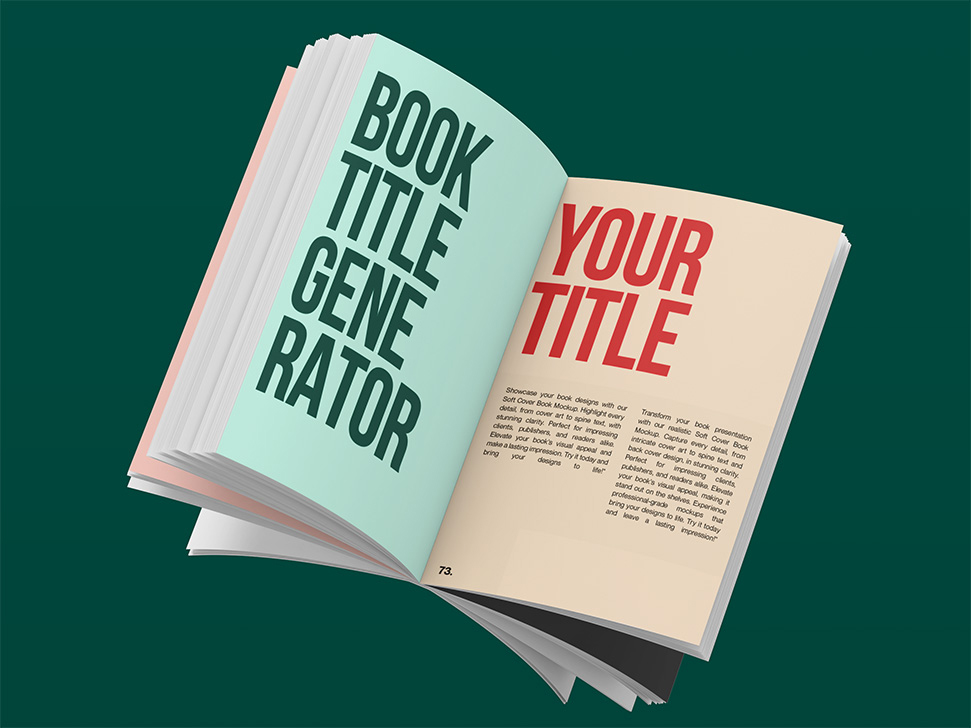
You obviously can't use these published autobiography titles for your own book - but you can use our free book title generator to come up with suggestions that you could use.
It's really easy to use, and instantly gives you an unlimited amount of working titles - or even final titles - to use for your book!
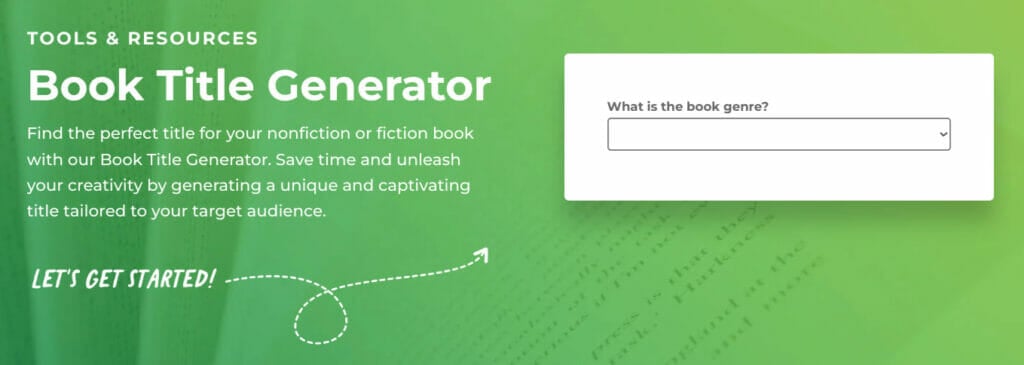
1. Select nonfiction for the book’s genre in the drop-down menu
2. Fill in the details
For the next question, if you have a book description, type “yes” and add your description in the text box.
If you don’t have a description yet, answer “no” and fill out the questions. Eventually, you will need to write a book description, but this is often something our authors do after they complete their manuscript.
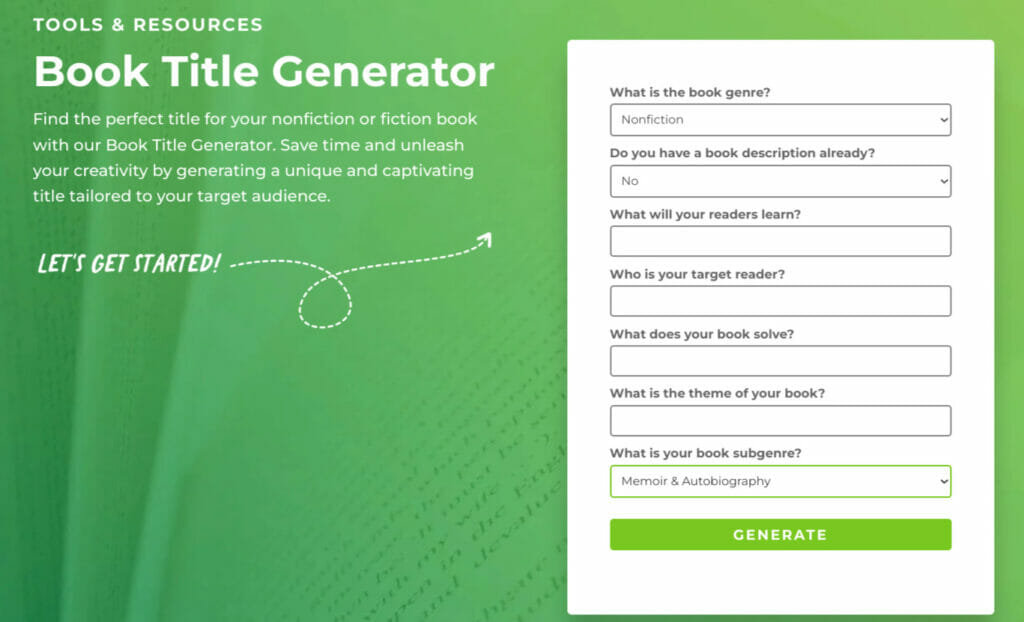
3. Click “generate”
That's it! Get ready for some unique autobiography book title suggestions. Remember, if you don't like the one that you see, you can continue to generate as many as you'd like.
Autobiography vs. memoir: does the title approach change?
Autobiographies and memoirs use the same title principles, but the emotional framing can differ.
An autobiography typically covers an entire life, while a memoir focuses on a specific period, theme, or transformation. Memoir titles often carry a more focused emotional charge because they're zeroing in on one arc. (Think: What My Bones Know by Stephanie Foo, a memoir title that would work equally well as an autobiography title.)
For a deeper look at the differences, read our guide on how to write a memoir and how nonfiction storytelling works across formats.
Common autobiography title mistakes to avoid
Most weak autobiography titles share the same handful of problems. Here's what to watch for:
- Using your full name as the primary title — Unless your name is immediately recognizable, lead with theme, not identity
- Being too vague — Titles like My Story or A Life Lived give readers nothing to hold onto
- Over-explaining in the main title — Save the detail for the subtitle
- Choosing a title that sounds like every other memoir — If you've seen it before, keep brainstorming
- Ignoring searchability — Especially if self-publishing on Amazon, a title with a relevant keyword can improve discoverability
Frequently asked questions about autobiography titles
How long should an autobiography title be? Aim for under 60 characters in the main title. Subtitles can run longer. Amazon data shows that shorter titles get more attention in search results and browsing contexts.
Can I change my autobiography title after publishing? Yes, especially if you're self-publishing. Updating a title on Amazon KDP is possible, though it can temporarily affect your search ranking. Getting the title right before launch is always the better approach.
Should my autobiography title include my name? Only if your name is a recognized brand. For most first-time authors, leading with a strong thematic title and placing your name on the cover design is more effective.
What's the difference between an autobiography title and a memoir title? The titling process is identical. The difference is in scope: an autobiography covers a full life, while a memoir focuses on a specific theme or period. If you're unsure which format fits your story, read our guide on autobiography vs. memoir.
Do I need a subtitle for my autobiography? Subtitles are optional but highly recommended. They add searchable context, clarify the book's audience, and give you space to expand on the main title's hook.
What comes after your title?
Your title is the door. Your book is what's behind it.
Once you've landed on a title that works, the next step is making sure everything else (your cover, your description, your launch strategy) is working just as hard.
That's exactly what selfpublishing.com is built to help with. The Become a Bestseller program gives you a 1:1 coach, a proven publishing roadmap, and expert support on cover design, formatting, and launch. Over 7,000 have used selfpublishing.com to go from blank page to published book.
Your story deserves a title, and an audience, that does it justice.