

















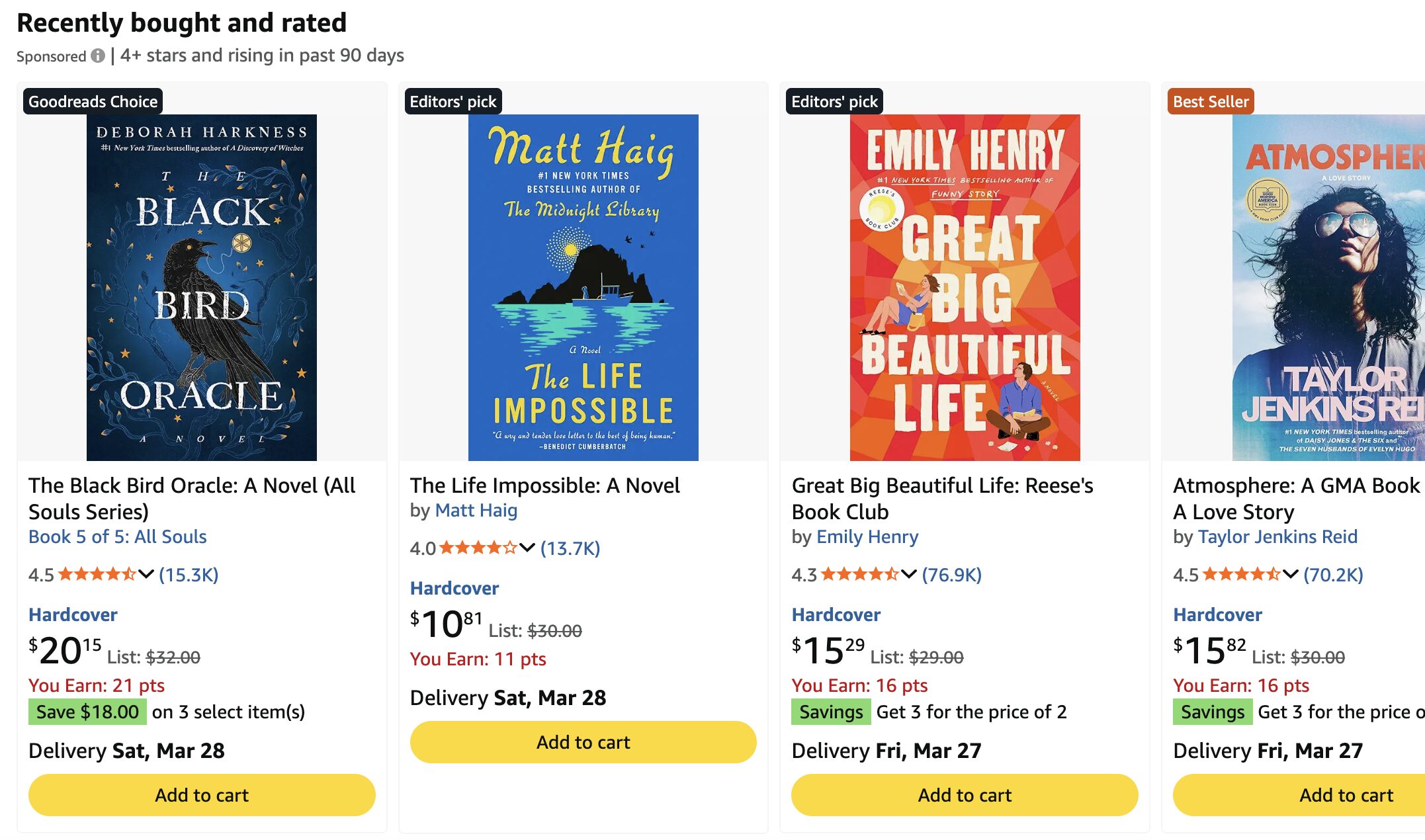

If you’re an author trying to sell your books on Amazon, you’ve probably noticed it’s not enough to simply publish and hope readers find you. Amazon is the world’s largest bookstore, and also a sophisticated search engine that decides which books get seen and which stay hidden.
That’s where Amazon SEO comes in.
By understanding how the platform ranks listings and learning how to optimize your book for both readers and the algorithm, you can increase visibility and boost your sales.
In this guide, we’ll walk you through everything from keyword research and listing optimization to reviews, pricing, and advanced strategies so your book can rise above the competition and reach more readers.
What is Amazon SEO?
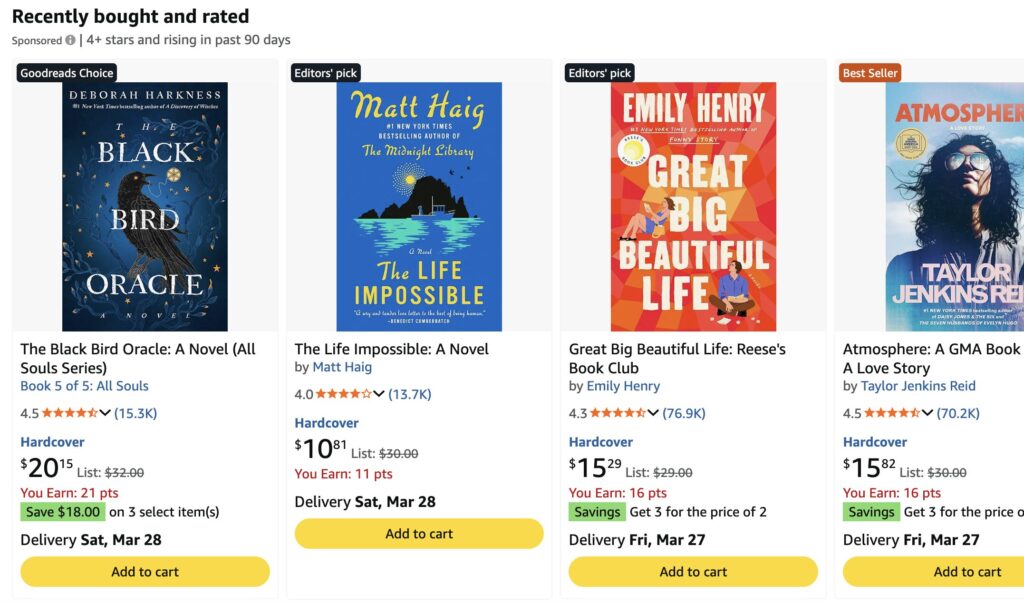
Amazon SEO is the process of optimizing your product listings so they rank higher in search results within Amazon.
Just like traditional search engines, Amazon uses an algorithm to decide which products appear when a shopper types in a query. The difference is that Amazon’s goal isn’t to provide information, it’s to sell products.
That means every element of your listing (your title, bullet points, keywords, images, pricing, and reviews) plays a role in how visible your product is. Done right, Amazon SEO helps your product show up in front of high-intent shoppers who are ready to buy.
Why Amazon SEO matters more than ever in 2026
Competition on Amazon has exploded over the past few years. Millions of sellers are fighting for attention, and simply listing a product is no longer enough. If your product isn’t ranking on the first page, it’s essentially invisible.
At the same time, Amazon’s algorithm has become more sophisticated. It now evaluates not just keywords, but also how shoppers interact with your listing (click-through rates, conversions, and overall performance).
In 2026, strong Amazon SEO is no longer optional. It’s one of the most critical drivers of:
- Organic (free) traffic
- Lower advertising costs
- Higher sales and profitability
Without it, even great products struggle to gain traction.
Amazon SEO vs traditional SEO
While both Amazon SEO and traditional SEO aim to improve visibility, they operate very differently.
Traditional SEO (like ranking on Google) is largely focused on informational intent. Users are often researching, comparing options, or looking for answers. Content like blog posts and guides dominate these results.
Amazon SEO, on the other hand, is all about buyer intent. People searching on Amazon are typically much closer to making a purchase. They’re not asking “what is the best blender?” They’re searching for “stainless steel blender 1200W” and are ready to buy.
This key difference changes everything:
On Google: traffic is the goal
On Amazon: conversions are the goal
If your listing doesn’t convert, it won’t rank no matter how well optimized your keywords are.
At the core of Amazon SEO is its ranking system, commonly known as the Amazon A9 algorithm. This algorithm determines which products appear in search results and in what order.
A9 primarily focuses on two things:
Relevance: How well your listing matches the search query
Performance: How well your product sells when people find it
In recent years, Amazon has evolved beyond A9 into what many sellers refer to as “A10.” While Amazon hasn’t officially named it this way, the shift reflects important changes in how rankings work.
The newer system places greater emphasis on external traffic (visitors coming from outside Amazon), brand authority and trust, and customer behavior signals like clicks, time on page, and conversions.
Amazon is getting better at rewarding listings that not only match keywords, but actually satisfy shoppers.
How Amazon’s algorithm works
To succeed with Amazon SEO, you need to understand one fundamental truth: Amazon is not a search engine in the traditional sense. It’s a revenue engine.
Every ranking decision its algorithm makes is designed to answer one question:
“Which product is most likely to generate a sale?”
The core goal: conversions
Amazon as a revenue-driven search engine
Unlike platforms focused on information, Amazon prioritizes products that make money. When a shopper searches for something like “historical fiction novel” or “self-help book for anxiety,” Amazon wants to show results that are most likely to lead to a purchase.
That’s why two books with similar keywords can perform very differently.
For authors, this means:
- A compelling book cover matters as much as keywords
- A strong title and subtitle can directly impact visibility
- Reviews and ratings heavily influence ranking
Amazon is always testing. If your book gets clicks and sales, it rises. If it doesn’t, it sinks.
Why conversion rate is king
Conversion rate is the percentage of people who buy your book after viewing its listing. It’s one of the most powerful signals in Amazon SEO.
Think of it this way:
If 100 people view your book and 10 buy it, it’s a strong signal.
If 100 people view it and only 1 buys, it’s a weak signal.
Amazon will naturally favor the first book because it generates more revenue per visitor.
For authors, improving conversion rate often comes down to:
- Eye-catching, genre-appropriate covers
- Clear, benefit-driven book descriptions
- Strong social proof (reviews, ratings)
- A price that feels competitive for your category
Even small improvements here can significantly boost your rankings.
Key ranking factors
Amazon’s algorithm (commonly referred to as the Amazon A9 algorithm) evaluates listings based on three main categories:
Relevance
Relevance determines whether your book matches what the shopper is searching for.
This includes keywords in your title and subtitle, backend keywords (especially important for KDP authors), and categories and metadata.
For example, if someone searches “productivity for writers,” Amazon will prioritize books that clearly include those terms or closely related phrases.
This means your SEO starts with understanding how readers search, not just how you describe your book.
Performance
Performance is how well your book sells once it’s visible.
Key signals include sales velocity (how quickly your book is selling), conversion rate, and total sales history.
If your book consistently converts browsers into buyers, Amazon will push it higher in rankings, even against more established competitors.
This is why launches, promotions, and early traction are so important for authors.
Customer experience
Amazon also evaluates how satisfied customers are after purchasing.
This includes:
- Reviews and star ratings
- Return rates (less relevant for ebooks, but still a factor for print)
- Overall listing quality
For authors, this reinforces the importance of delivering on your book’s promise and matching reader expectations (genre, tone, content).
A book that disappoints readers will struggle to maintain rankings over time.
A9 vs A10: what changed?
While the Amazon A9 algorithm laid the foundation, Amazon’s ranking system has evolved.
The core shift? Amazon is getting better at identifying real value and genuine demand.
Amazon now rewards products that bring in traffic from outside its platform.
For authors, this is huge.
If you drive readers from your email list, social media, or your author website and they convert into buyers, Amazon sees this as a strong signal of demand.
This can directly boost your rankings, especially during a book launch.
Amazon also increasingly favors trusted sellers and recognizable brands.
An author with multiple successful titles is more likely to rank quickly with new releases compared to a brand-new publisher.
This is why long-term consistency matters just as much as individual book optimization.
Lastly, Amazon is paying closer attention to how shoppers interact with listings.
They are looking at:
Click-through rate (CTR): Do people click your book when they see it?
Dwell time: Do they spend time reading your description or leave quickly?
Conversion behavior: Do they ultimately buy?
Understanding how Amazon’s algorithm works gives you a major advantage. Instead of guessing, you can focus on what actually matters: getting the right readers to click, and making sure they want to buy once they do.
Keyword research for Amazon
Keyword research is the foundation of Amazon SEO. If you don’t know what readers are searching for, you can’t position your book in front of them (no matter how good it is).
For authors, this step is especially important because readers rarely search by title unless they already know you. Instead, they search by genre, topic, trope, or problem.
Your job is to align your book with those searches.
High-intent vs low-intent keywords
Not all Amazon keywords are created equal. Some signal that a reader is ready to buy, while others indicate they’re just browsing or researching.
High-intent keywords are specific and action-oriented.
Some examples are:
“romance novel enemies to lovers”
“beginner mindfulness book”
“fantasy book with dragons series”
These searches often lead to purchases.
Low-intent keywords are broader or more informational.
Examples:
“best books to read”
“how to be more productive”
“writing tips for beginners”
These may get traffic, but they don’t always convert.
For Amazon SEO, high-intent keywords are where the real value lies.
Product vs informational queries
This is where Amazon differs dramatically from traditional search engines.
Informational queries (common on Google) are:
“what is self-discipline”
“how to write a novel”
Product-focused queries (common on Amazon) are:
“self-discipline books”
“how to write a novel book”
“thriller novels best sellers”
Even when a reader is trying to learn something, they often search in a way that leads directly to a product.
This means you need to focus on phrases that naturally lead to buying a book.
How to find keywords
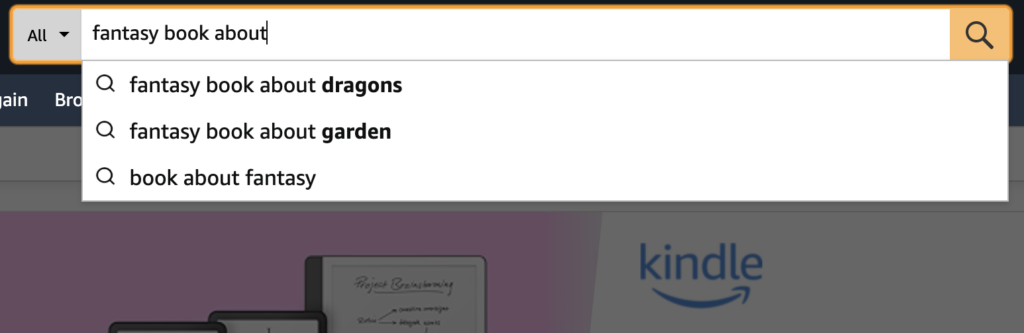
One of the simplest and most powerful tools is Amazon’s own search bar.
Start typing a phrase like:
“romance novel…”
“productivity book…”
Amazon will automatically suggest completions based on real user searches.
These suggestions are valuable because they reflect actual demand and often reveal long-tail keywords.
This is a goldmine for discovering niche angles and subgenres.
But the search bar isn’t the only place to look.
Your competitors are already telling you what works if you know where to look.
Study books in your category and analyze:
- Titles and subtitles
- Bullet points (for print books) or descriptions
- Categories and themes
- Repeated phrases across top-ranking listings
For example, if multiple bestselling books include phrases like “psychological thriller with twists,” that’s a strong keyword signal.
You can also use tools like Helium 10 and Jungle Scout.
Keyword tools can take your research to the next level.
Platforms like Helium 10 and Jungle Scout help you estimate search volume, discover related keywords, analyze competitors, and identify ranking opportunities.
These tools can help you discover underserved niches, high-demand, low-competition keywords, and even trends in reader behavior.
Keyword types to target
A strong Amazon SEO strategy uses a mix of keyword types, each serving a different purpose.
You should aim to use at least one primary keyword.
This is your main target keyword.
For example:
“historical fiction novel”
“self-help book for anxiety”
For authors, this often defines how your book is positioned in the market.
You should also look for some long-tail keywords tare are more specific, lower-competition phrases.
Examples:
“historical fiction novel set in World War II”
“self-help book for anxiety and overthinking”
These keywords are easier to rank for and often convert better because they are more specific to your book.
For new or lesser-known authors, long-tail keywords are one of the fastest ways to gain traction.
Amazon allows you to add hidden keywords that don’t appear on your listing but still influence ranking.
These are perfect for:
- Misspellings
- Alternate phrasing
- Extra relevant terms you couldn’t fit elsewhere
For example:
“ww2 fiction”
“anxiety help guide”
For authors using KDP, this is a critical (and often underused) space.
Keyword research is all about connecting your book with the exact readers who are already looking for it. When you get this right, everything else in Amazon SEO becomes significantly easier.
Listing optimization (on-page SEO)
Once you’ve done your keyword research, the next step is turning that data into a listing that actually ranks.
On Amazon, your listing isn’t just a description of your book. It’s your sales page. Every word has a job: attract attention, match search intent, and convince the reader to click “Buy now.”
For authors, this is where creativity meets strategy.
Product title optimization
Your title is the single most important piece of real estate in your listing.
It’s one of the first things both the algorithm and the reader look at. That means your primary keyword should appear as naturally as possible, ideally in the title or subtitle.
For example, instead of a vague title, many successful authors use subtitles to anchor their SEO:
Main Title: The Silent Mind
Subtitle: A Psychological Thriller with Twists and Suspense
This approach allows you to stay creative while still signaling relevance.
But there’s a balance to strike.
If your title becomes a string of keywords, it may technically be optimized, but it will hurt your conversion rate. Readers don’t want to buy books that feel robotic or spammy.
Clarity always wins over cleverness, but readability always wins over keyword stuffing.
Amazon also enforces character limits (which vary slightly by category), so formatting matters. Keep it clean. Avoid unnecessary repetition. And make sure your title still sounds like something a real person would want to read.
Product description
Your product description is where you close the sale.
This is your chance to pull the reader deeper into your book.
Good descriptions blend storytelling and SEO seamlessly.
For fiction, that might mean a compelling hook, a sense of tension, and just enough intrigue to make the reader curious.
For nonfiction, it often means clearly articulating the transformation:
Where is the reader now?
Where will they be after reading?
While doing this, you should still incorporate keywords subtly. The goal is flow, not repetition.
If you have access to HTML formatting (common in KDP), use it to improve readability. Simple elements like bold text, spacing, and short paragraphs can make a big difference.
And always think mobile-first.
Most Amazon users browse on their phones. If your description looks like a wall of text, it won’t get read, no matter how well written it is.
Backend keywords
Backend keywords are the hidden layer of Amazon SEO. Readers never see them, but the algorithm does.
This is where you include additional keywords that didn’t fit naturally into your listing. Think of it as expanding your reach without cluttering your visible content.
A smart strategy here includes:
- Alternate phrasing (“self improvement” vs “personal development”)
- Niche terms or subgenres
- Common misspellings or variations
But there are also common mistakes to avoid.
Don’t repeat keywords you’ve already used in your title or description. Amazon typically ignores duplicates.
Avoid irrelevant terms just to chase traffic. It can hurt your conversion rate and confuse the algorithm.
And don’t waste space on filler words. Every character counts.
At the end of the day, listing optimization isn’t about cramming in as many keywords as possible. It’s about alignment.
When your keywords, messaging, and presentation all match what the reader is looking for, Amazon does the rest by putting your book in front of more of the right people.
Product images & visual SEO
When it comes to selling books on Amazon, many authors underestimate the power of visuals.
But your images (especially your cover) are often the first and most important conversion factor in your entire listing.
Amazon’s algorithm pays close attention to how shoppers behave. If more people click on your book and then buy it, your rankings improve. If they scroll past it, your visibility drops.
That means images don’t just influence conversions, they influence whether you rank at all.
Why images impact conversions (and rankings indirectly)
Think about how readers browse Amazon.
They type in a search, scroll through results, and make split-second decisions about what to click. At that moment, your cover is competing against dozens of others.
If it doesn’t immediately communicate the genre and quality of your book, it gets ignored.
And if your click-through rate drops, Amazon interprets that as a weak result and pushes your book down.
The same applies after the click. Once someone lands on your listing, your visuals help them decide whether your book feels worth buying.
Strong visuals lead to higher click-through rates and better conversion rates.
Image best practices
Your main image is your book cover, and it needs to do a lot of work in a very small space.
At thumbnail size, clarity matters more than detail.
That means:
- Use bold, readable fonts
- Ensure strong contrast between text and background
- Avoid cluttered designs
- Make sure the title is legible even on mobile
Just as important, your cover must match reader expectations.
A romance novel should look like a romance novel. A thriller should feel tense and dramatic. If your cover confuses the genre, even great SEO won’t save your conversions.
Visual SEO is often overlooked by authors who focus heavily on keywords. But the reality is simple:
You can rank with good keywords.
But you only stay ranked if your visuals convince people to buy.
And on a crowded platform like Amazon, that difference is everything.
Pricing strategy & its SEO impact
Pricing is not only a financial decision on Amazon, it’s a visibility strategy.
The price of your book directly affects how likely someone is to buy it. And since Amazon’s algorithm prioritizes products that generate revenue, your pricing plays a quiet but powerful role in your SEO.
When a reader searches for books in your genre, they’re not evaluating your book in isolation. They’re comparing it to dozens of others on the same page.
If your price is significantly higher than similar books, you create friction. Even if your book looks great, fewer people will take the chance, especially if you’re a newer or lesser-known author.
On the other hand, a competitive price can increase click-through rate and early sales velocity.
This is especially important during a launch. A slightly lower price can help you gain traction faster, which can lead to better rankings and more organic visibility over time.
The psychology of book pricing
Pricing also shapes perception.
Readers often associate price with value, but only within the context of your category.
For example:
A $0.99 ebook may feel like a low-risk impulse buy
A $4.99–$9.99 ebook often feels like a “standard” price range
A higher-priced nonfiction book may signal authority if the positioning supports it
The key is alignment.
If your pricing matches reader expectations and your presentation (cover, description, reviews), it reinforces trust. If it feels off, it creates hesitation, and hesitation hurts conversions.
Temporary price changes can also be a powerful SEO lever.
Promotions, like limited-time discounts or free campaigns, can dramatically increase downloads and sales in a short period of time. This spike in activity tells Amazon that your book is gaining attention.
This can lead to improved category rankings and increased visibility in search results.
And once your book starts converting consistently, Amazon is more likely to keep recommending it, even after the promotion ends.
There’s no single “perfect” price for every book.
Instead, think of pricing as something you test and refine.
Start with a price that fits your genre and audience. Then monitor how readers respond and adjust based on performance.
If your book is getting traffic but not converting, pricing may be part of the issue. If it’s converting well, you may have room to increase it.
In the end, pricing is tightly connected to everything else in Amazon SEO.
A well-optimized listing gets you visibility.
But the right price helps you turn that visibility into sales.
And on Amazon, sales are what drive rankings.
Reviews & ratings optimization
Reviews are one of the most powerful forces behind success on Amazon.
They influence how readers feel about your book within seconds.
They shape trust, reduce hesitation, and often determine whether someone clicks “Buy now” or keeps scrolling.
And because reviews have such a strong impact on conversions, they also play an important role in Amazon SEO.
Amazon’s algorithm is constantly measuring performance.
If your book gets more clicks and more purchases, it rises in the rankings. Reviews directly affect both of those behaviors.
A book with a high rating and strong review count attracts more clicks from search results and builds immediate credibility.
Compare that to a book with few or no reviews. Even if it ranks temporarily, it will struggle to convert, and that weak performance will eventually push it down.
Reviews act as social proof at scale. They tell future readers, “This book is worth your time.”
How to get more reviews (ethically)
Getting reviews is one of the hardest parts of publishing, but also one of the most important.
The key is to approach it consistently and ethically.
One of the simplest methods is to ask.
A short, genuine request at the end of your book can make a difference. Readers who enjoyed your work are often willing to leave a review. They just need a reminder.
You can also follow up with your audience outside of Amazon through email lists, reader communities, and social media.
At selfpublishing.com, we create a launch team of 100 people for our authors, so that they have 100 reviews by the time their book launches. This helps significantly with early traction. You can also build a launch team on your own by sending out ARCs.
What to avoid
Amazon has strict rules around reviews, and violating them can damage your account.
Avoid:
- Paying for reviews
- Offering incentives in exchange for positive feedback
- Asking only for “5-star reviews”
- Having friends or family leave biased reviews
These tactics might seem tempting in the short term, but they carry real risk, and often backfire.
Quality matters more than quantity
While having more reviews helps, the quality of those reviews matters just as much.
Detailed, thoughtful reviews build stronger trust with potential readers and improve conversion rates.
Even a few well-written reviews can outperform dozens of vague ones.
The long-term impact
Reviews compound over time.
As your book gains more visibility and sales, it naturally attracts more reviews, which then improves conversion rates further. This creates a positive feedback loop that strengthens your rankings.
For authors, this is why early momentum is so important. The sooner you start generating reviews, the sooner this cycle begins.
Sales velocity & conversion rate
If there’s one concept that can dramatically change how you approach Amazon SEO, it’s this:
Speed matters.
On Amazon, it’s not just about how many books you sell, it’s about how quickly you sell them.
This is what’s known as sales velocity, and it’s one of the strongest ranking signals in the algorithm.
Amazon is constantly looking for products that are gaining momentum.
If your book suddenly starts selling consistently over a short period of time, that sends a clear signal: this is something people want right now.
In response, Amazon pushes your book higher in search results to maximize potential revenue.
This creates a powerful cycle:
- More visibility leads to more sales
- More sales increase your rankings
- Higher rankings bring even more visibility
But the opposite is also true. If your book isn’t selling, it’s unlikely to rank, no matter how well optimized your keywords are.
That’s why conversion rate is so closely tied to sales velocity.
You can drive all the traffic you want to your listing, but if people aren’t buying, your rankings won’t improve. On the other hand, even a smaller amount of highly targeted traffic can perform extremely well if it converts.
This means your goal isn’t just traffic, it’s qualified traffic that turns into buyers quickly.
Launch strategies
Your book launch is the best opportunity to build strong sales velocity early.
Instead of waiting for organic traffic, successful authors actively create momentum from day one.
This is why we create such a big launch team for our authors. It helps them create sales velocity from day one.
PPC campaigns
Amazon’s internal advertising platform allows you to promote your book directly in search results.
These pay-per-click (PPC) ads can put your book in front of the right keywords immediately, generate early clicks and sales, and help you discover which keywords convert best.
In the beginning, this data is incredibly valuable. It tells you how readers are actually responding to your listing and gives you a chance to refine it quickly.
More importantly, those early sales contribute to your overall velocity, which can lift your organic rankings over time.
Promotions
Discounts and limited-time offers are one of the fastest ways to increase sales volume.
For authors, this often looks like:
- Launch pricing (e.g., starting at a lower price)
- Temporary discounts
- Free promotions (especially for ebooks)
These strategies reduce friction and encourage more readers to take a chance on your book.
When done correctly, a promotion can create a surge in downloads or purchases, which boosts your visibility and helps you climb category rankings.
External traffic (social media, influencers)
One of the biggest shifts in Amazon’s algorithm is how it values traffic from outside the platform.
If you can bring readers to your book (and they convert) Amazon sees that as a strong signal of demand.
For authors, this opens up a range of opportunities:
- Sharing your launch with your email list
- Promoting your book on platforms like Instagram, TikTok, or YouTube
- Collaborating with influencers, reviewers, or book communities
Even a small, targeted audience can make a big difference if they’re engaged and ready to buy.
Bringing it all together
Sales velocity and conversion rate are deeply connected.
You build momentum by driving traffic.
You sustain it by converting that traffic into buyers.
For authors, this is where everything comes together:
Your keywords bring the right people.
Your listing convinces them to buy.
Your launch strategy accelerates the process.
When those pieces align, Amazon starts working in your favor.
Amazon PPC & SEO synergy
Many authors think of ads and SEO as separate strategies. On Amazon, they’re closely connected.
Amazon PPC (pay-per-click advertising) can directly support your organic rankings by generating the one thing the algorithm cares about most: sales.
When you run ads, your book appears for targeted keywords right away. If those clicks turn into purchases, you’re sending strong performance signals to Amazon. Over time, this can help your book rank organically for those same keywords.
PPC is also a powerful research tool.
It shows you which keywords actually convert and which audiences respond to your book.
The strategy is simple: use ads to gain visibility and data, then use that data to strengthen your listing and SEO.
In the best-case scenario, your ads don’t just generate sales, they help your book reach a point where it can sustain those sales organically.
Advanced Amazon SEO strategies
Once you’ve mastered the basics (keywords, listing optimization, reviews, and traffic) it’s time to level up with advanced tactics that give your book a competitive edge. These strategies help you refine your presence, maximize conversions, and build long-term visibility on Amazon.
Competitor reverse ASIN lookup
One of the most powerful tools in Amazon SEO is analyzing top-performing books in your category. By looking at their ASINs (Amazon Standard Identification Numbers), you can uncover:
- Which keywords they rank for
- How their listings are structured
- What content resonates with readers
This can reveal niches and keyword opportunities you might have missed, as well as insights into pricing, cover design, and description strategies that work.
Listing split testing
Amazon allows you to test variations of your title, subtitle, description, and even images. This process, often called A/B testing or split testing, helps you identify which elements convert best.
For example, you could test two different subtitle versions: one emphasizing suspense, the other emphasizing character-driven storytelling. Small changes can have a significant impact on both conversion and organic ranking.
A+ content (enhanced brand content)

Enhanced Brand Content, or Amazon A+ content, allows you to add richer descriptions, images, and storytelling to your listing. For authors, this might include:
- A series overview
- Author biography and credentials
- Excerpts or teasers from the book
This content doesn’t just make your listing more appealing, it can also improve conversion rates, which in turn signals to Amazon that your book is performing well.
Advanced strategies like these aren’t mandatory, but they can make a major difference, especially in competitive genres. By combining tactical insights with creative presentation, you can elevate your book from simply “discoverable” to truly standout.
Common Amazon SEO mistakes
Even experienced authors can fall into traps that hurt their rankings and conversions. Understanding these pitfalls can save you time, frustration, and lost sales.
Keyword stuffing
It’s tempting to cram as many keywords as possible into your title, description, or backend search terms. But Amazon prioritizes readability and relevance over raw keyword density.
Overstuffing can make your listing feel spammy and turn readers away, ultimately hurting your conversion rate and your rankings.
Ignoring backend keywords
Many authors focus solely on the visible parts of their listing and neglect the backend keywords. These hidden terms are a chance to capture alternate search phrases, misspellings, or subgenres that don’t fit naturally in your title or description.
Skipping this step is leaving potential traffic (and sales) on the table.
Poor images
A weak cover or low-quality images can sabotage an otherwise strong listing. Remember, your cover is the first thing shoppers see. If it doesn’t clearly communicate genre and quality, readers will scroll past, lowering click-through rates and sending negative signals to the algorithm.
Not optimizing for mobile
Most Amazon shoppers browse on mobile devices. Walls of text, tiny fonts, or cluttered formatting can make your description unreadable. If your listing isn’t mobile-friendly, your conversions will drop, and your rankings can suffer as a result.
Focusing on traffic instead of conversions
Traffic alone won’t rank your book. Amazon rewards listings that convert. You can have hundreds of visitors per day, but if few of them buy, your listing won’t climb. Every optimization (from cover to description to reviews) should focus on turning browsers into buyers.
Avoiding these common mistakes ensures your listing is set up for both visibility and performance. Even small adjustments can have a significant impact on your book’s discoverability and sales.
Become a pro at Amazon SEO
Mastering Amazon SEO as an author isn’t just about keywords or getting a few sales, it’s about creating a listing that connects with the right readers, convinces them to buy, and builds momentum over time.
From understanding how Amazon’s algorithm works to optimizing your title, cover, description, and backend keywords, every element of your listing contributes to visibility and conversions.
Reviews, pricing, sales velocity, and even external traffic all play a role in signaling to Amazon that your book deserves to be seen.
The most successful authors treat SEO as an ongoing process, not a one-time task. They research, test, and refine continuously, always looking for ways to better reach their audience.
In the end, strong Amazon SEO gives your book a fighting chance in a crowded marketplace. When your listing is optimized, your traffic is targeted, and your readers are engaged, the algorithm starts working for you.
Success on Amazon is a combination of strategy, creativity, and persistence. Focus on all three, and your book has the best chance to shine.