


















TL;DR
Hermione Granger is the Muggle-born witch at the centre of the Harry Potter series, defined by 3 traits working against each other: relentless intellect, moral conviction, and a private fear of failing. She matters to writers because her competence is always paid for. Every strength she has costs her something, and that exchange rate is what makes her feel real.
Most writers who try to build "a smart character" end up with a walking search engine. The character knows the answer, delivers the answer, and the plot moves on. Readers forget them inside a chapter.
Hermione Granger is the counterexample that has held up for nearly 30 years, and she's the reason a generation of readers can describe a fictional 11-year-old's flaws faster than they can describe their own coworkers'.
Hermione Granger is a timeless character. I identified deeply with her as a child, and saw myself in her behaviors both in and out of the classroom. But what makes us identify so strongly with her? What makes this a character people have talked about for decades?
This guide does two things. First, it gives you the complete, canon-accurate profile: her background, her traits, her arc in all 7 books, her relationships, and her cultural footprint. Second, at every stage, it pulls out the specific technique underneath, because the whole point of studying a character this good is to steal from her.

Unlock the Magic of Imagination
With the Ultimate Fantasy Author's Resource Bundle!
Who is Hermione Granger?
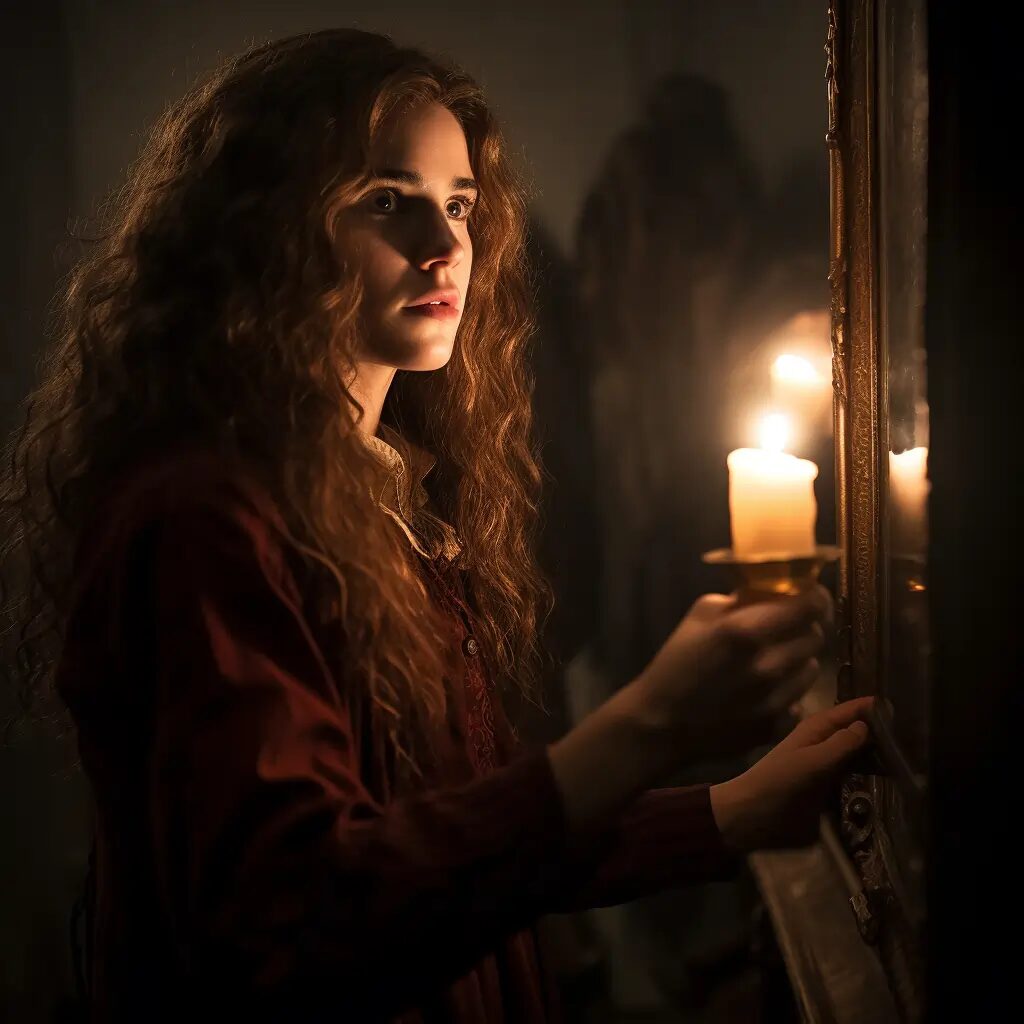
Hermione Jean Granger is a Muggle-born witch in Gryffindor House and one of the 3 protagonists of J.K. Rowling's Harry Potter series, known for her academic brilliance, moral conviction, and loyalty to Harry Potter and Ron Weasley.
She's introduced in Harry Potter and the Philosopher's Stone (also called Harry Potter and the Sorcerer's Stone in the USA) as an unwelcome interruption: a girl who has already read the textbooks, already knows the spells, and has no instinct for when to stop talking. Rowling gives her the least sympathetic possible entrance, then spends 7 books earning her back.
Her defining structural feature is that she's an outsider twice over. She has no magical family, which makes her a target in a society organised around blood purity. And she has no social fluency, which makes her a target among 11-year-olds. Both exclusions push her toward the same coping mechanism, which is knowing more than everybody else.
Hermione Granger fast facts:
| Full name | Hermione Jean Granger |
| Born | September 19, 1979 |
| Blood status | Muggle-born |
| Parents | Mr and Mrs Granger, both dentists |
| House | Gryffindor (the Sorting Hat considered Ravenclaw) |
| Wand | 10¾ inches, vine wood, dragon heartstring core |
| Patronus | Otter |
| Boggart | Failure, specifically Professor McGonagall telling her she failed everything |
| Pet | Crookshanks, a part-Kneazle cat |
| Groups | Dumbledore's Army, Order of the Phoenix, founder of S.P.E.W. |
| First appearance | Harry Potter and the Philosopher's Stone (1997), aboard the Hogwarts Express |
| Spouse | Ron Weasley |
| Children | Rose and Hugo Granger-Weasley |
| Later career | Department for the Regulation and Control of Magical Creatures, then Magical Law Enforcement, then Minister for Magic |
| Portrayed by | Emma Watson (films, 2001 to 2011); Arabella Stanton (HBO series, premiering Christmas 2026) |
What is the background of Hermione Granger?
Hermione was born to 2 Muggle dentists and had no idea magic existed until her Hogwarts letter arrived at age 11, making her the first witch in her family.
That detail does an enormous amount of quiet work. In a society where family name is currency, Hermione has none. She arrives at Hogwarts with nothing but preparation, which is exactly why she over-prepares. She memorized her textbooks before term started, not because she's naturally insufferable, but because she'd correctly assessed that she was walking into a room where everybody else had an 11-year head start.
Her surname is also a small piece of authorial precision. "Granger" is an occupational English surname for a farm steward. It's about as far from Malfoy or Black as a name can get, and it signals ordinariness in a cast full of ancient houses. If you're naming characters, that kind of signal is doing free characterization before the reader has met anybody. We break the method down in our guide to choosing character names.
What is the background and origin of Hermione Granger’s character traits?
Her traits come from the collision of 2 things: supportive Muggle parents who rewarded curiosity, and a wizarding society that treated her origin as a defect.
Her parents are barely on the page, and that's deliberate. What we see of them is stable, undramatic, and encouraging. They're proud of her, mildly baffled by her, and completely absent from her adventures. Rowling gives Hermione the one thing Harry lacks, which is a loving home, then removes it from the story so it can't rescue her.
The wizarding world supplies the other half. Draco Malfoy uses a slur against her in her second year, and the word lands hard enough that adults in the room react to it. From that point on, prejudice isn't an abstraction to Hermione, it's a thing that has been aimed at her. This is the root of her activism. She founds S.P.E.W. to campaign for house-elf rights not because she's a natural crusader, but because she recognises the machinery.
The craft note
Hermione's convictions are traceable to an experience, not assigned as a personality feature. If your character believes something fiercely, the reader should be able to point at the scene that installed it. Belief without an origin reads as an author's opinion wearing a costume.
Her Muggle upbringing also gives her a tactical advantage nobody else has. She thinks in systems rather than traditions. At the end of Philosopher's Stone, the obstacle that stops Harry is a logic puzzle, and Hermione solves it in a room where most wizards would have reached for a wand. She is repeatedly the character who notices that magic has rules and that rules can be read.
What are the main character traits embodied by Hermione Granger?
Hermione's core character traits are intelligence, loyalty, courage, resourcefulness, empathy, determination, pragmatism, moral conviction, stubbornness, and anxiety about failure.
Here's the full set, with the cost attached to each one. The cost column is the part most writers skip, and it's the part that makes a trait list into a character.
| Trait | How it shows up | What it costs her |
|---|---|---|
| Intellectual | Top of nearly every class, first to master the Levitation Charm, produces a corporeal Patronus at 16 | Isolation. Being right constantly is not a way to make friends at 11. |
| Loyal | Stays with Harry through the Horcrux hunt when Ron walks out | She gives up a normal seventh year and her own safety. |
| Brave | Faces a mountain troll, Death Eaters, and torture at Malfoy Manor | Her courage is chosen, not felt, so it exhausts her. |
| Resourceful | Brews Polyjuice Potion in her second year, packs a bottomless beaded bag before the war | Everyone comes to rely on her, which is its own weight. |
| Empathetic | Founds S.P.E.W., defends Hagrid, sees Dobby as a person before anyone else does | She's mocked for it, including by her closest friends. |
| Determined | Uses a Time-Turner to double her course load rather than drop a subject | Burnout. She physically breaks down by mid-year. |
| Pragmatic | Modifies her parents' memories to protect them, plans the escape before the fight | She carries decisions nobody thanks her for. |
| Moral | Acts as the group's conscience, objects to the Marauder's Map, to Rita Skeeter, to cheating | She's the killjoy, and she knows it. |
| Stubborn | Argues with Professor Trelawney, with Umbridge, with Ron for 7 straight books | She's slow to admit error, which nearly costs Harry his broom in book 3. |
| Anxious | Her boggart is failure. Her worst moment in book 3 is a bad exam, not a Dementor. | The engine of her excellence is also the thing hurting her. |
Hermione Granger personality traits, and why they contradict each other
The searchable list above is useful, but it undersells what's actually happening. The interesting thing about Hermione Granger personality traits is that they don't harmonise. They fight.
- Rule-follower versus rule-breaker. She reports a broom to a teacher in book 3 and brews an illegal potion in book 2. Both are in character, because her real loyalty is to what's right, and rules are only a proxy for that.
- Confident versus insecure. She'll correct a professor without hesitating and then fall apart over a grade. Her certainty is about facts. Her insecurity is about herself.
- Logical versus fierce. She's the group's rational voice and she also punches Draco Malfoy in the face and sets Snape's robes on fire.
That's the mechanism. A trait list is inert. Traits in opposition generate scenes on their own, because the reader can feel the character choosing.
The craft note
Give your protagonist 2 values that cannot both be honoured at once. Then build your plot so they have to pick. You will never run out of conflict, and you'll never have to manufacture it. Our guide to the types of characters in fiction covers how this differs by story role.
What personality type is Hermione Granger?
No personality framework is canon, so treat this as fan consensus rather than fact. Readers most commonly type her as an ISTJ or ESTJ in Myers-Briggs terms, driven by duty, structure, and concrete detail rather than abstraction.
In Enneagram terms she's usually read as a Type 1, the Reformer, which fits her perfectionism and her moral urgency better than any of the alternatives.
Born on September 19, she's a Virgo, which is either meaningful or extremely on the nose depending on your view of astrology.
How is Hermione Granger described in the books?
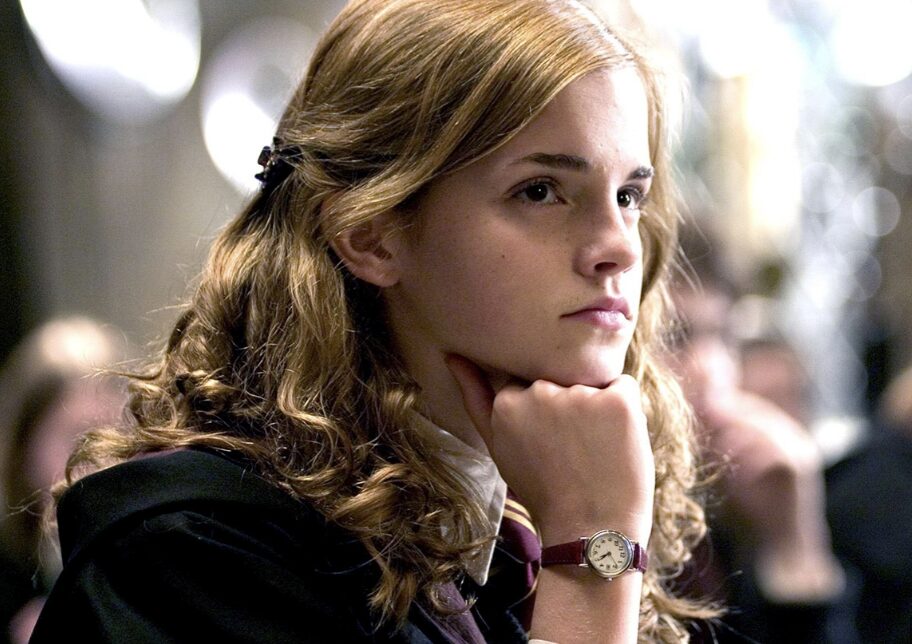
The Hermione Granger book description is short and specific: bushy brown hair, brown eyes, and large front teeth, delivered in a bossy voice. Rowling never gives her a height.
This is the section where the films and the books diverge most, and it's worth getting right if you're writing about her or writing like her.
Book Hermione vs Film Hermione
| Detail | In the books | In the films |
|---|---|---|
| Hair | Bushy, brown, frequently unmanageable and commented on | Styled, softened progressively after the first 2 films |
| Teeth | Large front teeth, a running detail until they're magically resized in book 4 | Dropped entirely |
| Appearance | Explicitly not described as pretty until the Yule Ball, which is the point of that scene | Conventionally attractive throughout, which weakens the Yule Ball reveal |
| Skin tone | Never specified. The text gives brown eyes and brown hair and nothing more. | Cast as white in the films; Noma Dumezweni later played the role on stage in The Cursed Child, consistent with the text |
| Manner | Bossy, corrective, described as a know-it-all by other characters | Softer, warmer, more openly emotional |
Notice how little Rowling actually spends. There's no head-to-toe inventory, no eye-color poetry. She gives 3 details and 1 of them, the teeth, is chosen because it's the kind of thing a self-conscious 12-year-old fixates on. The description does characterization work rather than portrait work.
The best physical descriptions tell you what the character notices about themselves, not what a camera would see.
If you tend to over-describe, our lists of descriptive adjectives and strong verbs will help you cut the padding and keep the details that carry weight.
How does Hermione Granger undergo character development during Harry Potter?
Hermione develops from a rule-bound student who trusts institutions into a strategist who trusts her own judgement, and the shift is driven by institutions failing her.
Her arc is not "shy girl becomes brave." She's brave from chapter 1. Her arc is about where she locates authority.
- Books 1 to 2, authority is external. Teachers know best, books know best, and rules exist for good reasons. When she breaks a rule, she agonises over it.
- Books 3 to 4, authority starts cracking. A teacher she respects is a fraud, a Ministry she trusts convicts an innocent man, and she discovers that the wizarding legal system is fine with enslaving house-elves.
- Books 5 to 7, authority is internal. The Ministry is captured, the school is hostile, and Dumbledore leaves them a puzzle instead of a plan. Hermione stops asking permission. By book 7 she's the one packing the bag, forging the plan, and modifying her parents' memories without consulting anyone.
That's a real arc, and it's invisible if you only track her competence, because her competence barely changes. What changes is what she does with it.
The craft note
Character growth doesn't have to mean acquiring a skill. It can mean changing what you're loyal to. That version is harder to write and far more satisfying, because it can't be demonstrated in a training montage. See our breakdown of story arcs for how to structure it across a full book.
What is Hermione Granger’s character arc in each of the Harry Potter books?
Each book gives Hermione 1 specific pressure and 1 specific lesson, escalating from social belonging in book 1 to wartime moral responsibility in book 7.
| Book | Her arc | The technique underneath |
|---|---|---|
| Philosopher's Stone (1997) | Starts as an unbearable know-it-all, is saved from a troll, then lies to a teacher to protect the boys. Learns that friendship outranks approval. | Redemption through a single costly choice, not a personality transplant |
| Chamber of Secrets (1998) | Targeted with a blood-purity slur, brews Polyjuice Potion to investigate, and is petrified for most of the climax. Learns her origin will be used against her. | Removing your most capable character to force the others to grow |
| Prisoner of Azkaban (1999) | Overloads herself with a Time-Turner, physically collapses, reports Harry's broom, and slaps Malfoy. Learns her limits are real. | Letting a strength become the source of the crisis |
| Goblet of Fire (2000) | Founds S.P.E.W., is dismissed for it, and attends the Yule Ball with Viktor Krum. Learns that being right and being heard are different things. | Giving a character a cause the narrative itself treats as unfashionable |
| Order of the Phoenix (2003) | Organises Dumbledore's Army, outmanoeuvres Umbridge, and traps Rita Skeeter. Learns she can lead, not just assist. | Promoting the sidekick to strategist |
| Half-Blood Prince (2005) | Watches Ron date Lavender Brown and handles it badly. Learns that competence doesn't transfer to feelings. | Exposing a competent character in the 1 domain where they're a beginner |
| Deathly Hallows (2007) | Erases her parents' memories of her, holds the hunt together alone after Ron leaves, and survives torture without breaking. Becomes fully herself. | The sacrifice nobody witnesses, which is the most convincing kind |
If you're building a series: notice that Rowling gives Hermione a distinct pressure in every single book rather than 1 arc stretched over 7. That's the difference between a series and a long book. Our Fundamentals of Fiction program walks authors through mapping arcs across multiple volumes so book 4 isn't a repeat of book 2.
What role does Hermione Granger play in the Harry Potter series?
Hermione is the trio's strategist and moral centre. Structurally, she's the character who converts mystery into information so the plot can move without the narrator explaining it.
She has 4 distinct jobs in the machinery of the books:
- Exposition delivery. When the reader needs to know what a Horcrux is, Hermione has read about it. This is the hardest role to write without it feeling like a lecture, and Rowling solves it by making the research itself effortful and often wrong at first.
- Moral brake. Harry acts on instinct and Ron acts on feeling. Hermione is the one who asks whether they should.
- Competence floor. Because she's reliably capable, her failures are load-bearing. When Hermione doesn't have the answer, the reader knows the situation is genuinely bad.
- Reader proxy. She arrives at Hogwarts as an outsider who has done the reading, which is exactly the reader's position.
The trap most writers fall into
If your smart character always has the answer immediately, they stop being a character and become a plot device. Hermione is wrong about Trelawney's prophecies, wrong to trust the Ministry, and wrong about Rita Skeeter's methods for most of a book. Her research fails in Deathly Hallows for hundreds of pages. Give your expert an error rate.
What are the relationships between Hermione Granger and other Harry Potter characters?
Hermione's relationships work because each one reveals a different part of her. Her bond with Harry shows loyalty, Ron shows vulnerability, and Dobby shows conviction.
Rowling uses relationships as a diagnostic tool. Among the wider cast of Harry Potter characters, Hermione is defined less by what she says about herself and more by who she becomes in each pairing.
| Character | The relationship | What it reveals about her |
|---|---|---|
| Harry Potter | Sibling-adjacent loyalty with no romantic charge. She's his voice of reason and the only one who stays for the entire Horcrux hunt. | Her loyalty is a decision, repeated daily, not an emotion |
| Ron Weasley | 7 books of friction that resolves into romance. They argue about Crookshanks, Scabbers, Lavender, and house-elves. | Her one genuine incompetence, which humanises everything else |
| Neville Longbottom | She corrects him constantly and defends him absolutely. | Her bossiness is a clumsy form of care |
| Professor McGonagall | Her model for what a serious woman with authority looks like. McGonagall is also the face of her boggart. | Whose approval she's actually chasing |
| Draco Malfoy | Pure antagonism. He slurs her; she slaps him. | Her limit, and the fact that she has one |
| Luna Lovegood | Initial contempt for Luna's unevidenced beliefs, gradually replaced by respect. | The one prejudice she has to unlearn |
| Dobby | She recognises his enslavement before anyone else and campaigns about it. | Her conviction operating without an audience or reward |
| Ginny Weasley | An easy, uncomplicated friendship with another capable girl. | What she's like when she isn't under pressure |
| Viktor Krum | He notices her before her own friends do. | How little she expects to be seen |
The craft note
Build a relationship grid for your protagonist. For each significant character, write 1 line: what does this pairing reveal that no other pairing can? If 2 relationships reveal the same thing, one of them is redundant. Our free character bio template includes a version of this grid.
What are the most pivotal moments for Hermione Granger?
Her 8 defining moments each function as a hinge, changing either what she believes or what the other characters believe about her.
- Lying to McGonagall about the troll (book 1). She takes the blame to protect Harry and Ron. This is the moment the trio exists.
- Solving the potions riddle (book 1). Logic beats magic, and the series' smartest character is established as its most useful.
- Being petrified (book 2). She works out the basilisk and is silenced by it, leaving a clue clutched in her hand.
- Slapping Draco Malfoy (book 3). The rule-follower snaps, and readers cheer, which tells you how carefully the restraint was built.
- The Time-Turner rescue (book 3). Her hoarded secret becomes the mechanism that saves 2 lives.
- The Yule Ball (book 4). Not a makeover scene. A scene about being seen by the wrong person and not the right one.
- Founding Dumbledore's Army (book 5). She proposes it, organises it, and jinxes the sign-up parchment. Leadership, not assistance.
- Erasing her parents' memories (book 7). She makes her own family forget she exists. No one witnesses it, no one thanks her, and she never brings it up again. It's the single best-constructed sacrifice in the series.
What impact has Hermione Granger had on pop culture and books?
Hermione redefined the female sidekick as the group's competence engine rather than its emotional support, and that template now runs through most modern young adult fiction.
Before her, the smart girl in an adventure trio was usually there to be rescued, to have feelings about the hero, or to explain things and then step aside. Hermione is the one who plans the mission. "I'm a Hermione" became a self-description worn as a compliment, which is a strange and telling thing for a character introduced as annoying.
The cultural footprint is measurable in other ways too. She has generated more fan fiction, academic papers, cosplay, and argument than most literary protagonists of the last century. Search volume for her name still runs at roughly 120,000 US queries per month and around 406,000 globally, nearly 3 decades after her first appearance and 19 years after her last canonical book.
Her influence also shifted publishing's assumptions about who reads fantasy. A generation of authors writing capable, prickly, morally serious young women in speculative settings are writing in the space she opened.
How has the character of Hermione impacted the wider fantasy genre?
She proved a fantasy story can carry real-world political argument without slowing down, which reshaped what mainstream fantasy is allowed to be about.
Hermione's S.P.E.W. subplot is the clearest example. House-elf enslavement is a fantasy invention, but the reader recognises the argument immediately, including the discomfort of the enslaved characters who don't want liberating and the friends who find her campaign tedious. Rowling gets to run a real debate about complicity inside a children's adventure.
That's the genre lesson. Fantasy's advantage is that it can strip a real argument of its baggage and let readers meet it fresh. Hermione is the vehicle for most of that in the Harry Potter series, and later fantasy has leaned hard on the technique. If you're building your own world, our guides to high fantasy versus low fantasy and the elements of fiction cover where to put that kind of weight.
Hermione Granger in the HBO series
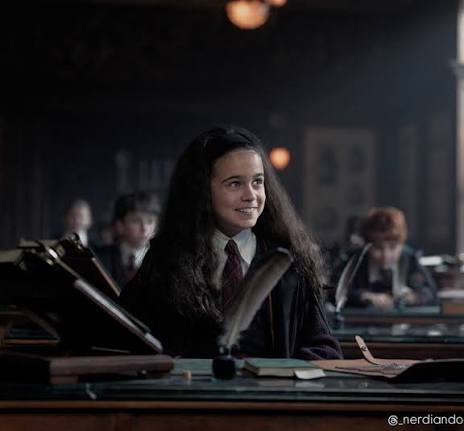
Arabella Stanton was cast as Hermione in May 2025 for HBO's Harry Potter series, which premieres Christmas 2026 and adapts 1 book per season.
Stanton, a British actress previously known for playing Matilda in the West End, was announced on May 27, 2025, alongside Dominic McLaughlin as Harry and Alastair Stout as Ron, after an open call that drew roughly 32,000 auditions. Season 1 covers Philosopher's Stone. She also voices Hermione in the full-cast Audible editions.
For writers, the interesting part is what the show has to do differently. The films compressed 7 books into 8 movies and lost most of Hermione's activism, her teeth, and the texture of her rule-following. A season per book means the S.P.E.W. subplot, the Rita Skeeter arc, and her exam breakdown all have room. It's a live demonstration of how much characterisation lives in the material adaptations usually cut first.
What can authors steal from Hermione Granger?
6 techniques make Hermione work, and every one of them is reusable in any genre with any character.
This is the section to actually apply. Take your protagonist and run them through all 6.
1. Make competence expensive
Every one of Hermione's strengths has a bill attached. Her intelligence isolates her, her preparation exhausts her, her conviction makes her unpopular. Free competence is boring. Ask what each of your character's strengths costs them, and put the receipt on the page.
2. Give the flaw and the virtue the same root
Hermione's perfectionism produces both her excellence and her breakdown. They aren't 2 separate traits, they're 1 trait pointed in 2 directions. This is why she reads as a person instead of a list.
3. Introduce them at their worst
Rowling's boldest choice is making Hermione irritating in chapter 6. Readers who dislike her and then watch her lie to a teacher to save 2 boys who were mean to her have earned a relationship with her. A likeable first impression buys you nothing.
4. Let them be wrong on the record
She's wrong about Trelawney, wrong to trust the Ministry, wrong for most of book 7's research. An expert who's never wrong isn't an expert, they're an oracle, and oracles have no arc.
5. Build sacrifices nobody sees
The memory charm on her parents is unwitnessed and unmentioned afterwards. Sacrifices performed for an audience read as heroism. Sacrifices performed alone read as character.
6. Use dialogue rhythm as fingerprint
Hermione speaks in complete sentences with subordinate clauses, cites sources, and corrects mid-sentence. You can identify her line in an unattributed exchange, which is the actual test. Our guide to writing dialogue covers how to build that fingerprint, and show don't tell covers how to stop explaining what the dialogue already proved.
Common mistakes writers make when copying Hermione
The 4 most common failures all come from copying her surface traits, the intelligence and the bossiness, without copying the structure underneath.
Mistake 1: the walking encyclopaedia
Your character knows everything, so the plot has no friction. Fix it by making the research cost time, by making the first answer wrong, or by giving the information a price.
Mistake 2: bossy without vulnerable
Hermione's bossiness is tolerable only because we've seen her cry in a bathroom. If your prickly character never breaks, readers won't stay.
Mistake 3: convictions with no origin
Hermione's activism traces to a specific slur in a specific scene. If your character's politics arrive fully formed, they read as your politics, and the reader will feel handled.
Mistake 4: competence with no domain of failure
Hermione is useless at romance and bad at accepting she's wrong. Pick 1 area where your capable character is a genuine beginner and refuse to let them improve at it quickly.
How can Hermione Granger inspire writers?
She's the clearest available proof that readers bond with characters through cost and contradiction, not likeability.
Most first drafts we see at selfpublishing.com have the opposite instinct. Authors protect their protagonist. They make them competent without cost, principled without inconvenience, and likeable on page 1. The result is a character readers respect and forget.
Hermione is the argument for the other approach. She's introduced badly, she's frequently wrong, she's exhausting to her friends, and she pays for every single thing she's good at. That's why an entire generation can list her flaws from memory. Being memorable and being pleasant are not the same project.
If you're at the stage where this is theoretical, the practical next step is small: pick your protagonist's greatest strength and write 1 scene where it directly causes a problem. That single exercise fixes more flat characters than any amount of backstory.
Turn your character into one readers argue about
Hermione works because of structure, not inspiration. That structure is teachable, and it's what we teach.
Our fiction coaches have helped authors publish over 7,000 books. In a free consult, we'll look at your actual protagonist, find where the cost is missing, and map a plan to finish and publish the book. Book a free strategy call to get started.
Frequently asked questions about Hermione Granger
How old is Hermione Granger?
She was born on September 19, 1979, which makes her 11 when she starts Hogwarts in September 1991 and 18 at the Battle of Hogwarts in May 1998. She's about 10 months older than Harry, who was born on July 31, 1980.
What house is Hermione Granger in?
Gryffindor. The Sorting Hat reportedly considered Ravenclaw given her intellect, which makes the choice meaningful rather than automatic: she's sorted for courage, not cleverness.
How tall is Hermione Granger?
The books never give her a height, and no official source has. Any number circulating online is either fan estimate or Emma Watson's height rather than the character's.
Who does Hermione Granger marry?
She marries Ron Weasley. They have 2 children, Rose and Hugo Granger-Weasley, and Hermione goes on to work in magical law enforcement and eventually becomes Minister for Magic.
Does Hermione Granger die?
No. She survives all 7 books, including being tortured at Malfoy Manor and fighting in the Battle of Hogwarts, and appears alive 19 years later in the epilogue of Deathly Hallows.
What is Hermione Granger’s wand and Patronus?
Her wand is 10¾ inches, vine wood, with a dragon heartstring core. Her Patronus is an otter. She produced a corporeal Patronus at 16, which is advanced magic for her age.
Why is Hermione called the brightest witch of her age?
The phrase is used by Remus Lupin and it refers to her generation, not her years. It's earned in the text: she's top of her class in every subject except Defence Against the Dark Arts, where Harry beats her.
Who plays Hermione Granger in the new Harry Potter series?
Arabella Stanton, cast in May 2025. The HBO series premieres Christmas 2026 and adapts 1 book per season. Emma Watson played the role in the 8 films released between 2001 and 2011.
Is Hermione Granger a good character to model my protagonist on?
Yes, provided you copy the structure rather than the surface. Copying "clever and bossy" produces an irritating character. Copying "every strength has a cost, and the flaw and the virtue share a root" produces a memorable one in any genre.
What personality type is Hermione Granger?
Nothing is canon. Fan consensus most often lands on ISTJ or ESTJ in Myers-Briggs and Enneagram Type 1, the Reformer. Her September 19 birthday makes her a Virgo.