





















TL;DR
Show don't tell writing is a writing technique that lets readers experience a story through action, sensory detail, and dialogue instead of being told what to think or feel. Instead of writing "she was nervous," you show her tugging her sleeve and losing her words. Showing pulls readers into the scene, but skilled authors still tell when it keeps the story moving.
You've heard "show, don't tell" a hundred times. It's the first note in nearly every critique and the last line of half the writing advice online. The problem is that almost nobody explains what it actually looks like on the page. So you nod along, go back to your manuscript, and still can't tell whether you're showing or telling.
Here's the fix: every idea below comes with a side-by-side example, the same moment written as telling, then as showing, so you can see the difference instead of just reading about it.
Steal the patterns, apply them to your own book, and the rule stops being abstract.
Want to learn how to show and not tell in writing? Read on!
What does “show don’t tell writing” mean?
Show, don't tell means conveying a story through actions, senses, and dialogue so readers experience it for themselves, rather than stating facts and emotions outright. You literally want to show, not tell.
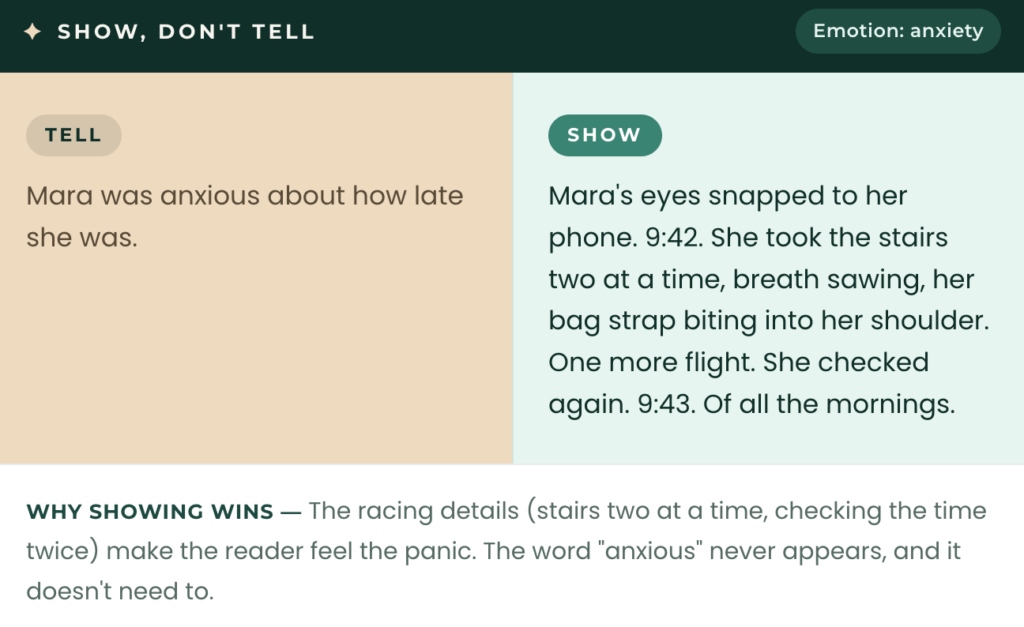
Telling hands the reader a conclusion: "He was nervous." Showing hands them the evidence and lets them reach the conclusion on their own: the bouncing knee, the third trip to the coffee machine, the sentence he starts twice and abandons.
When readers draw the conclusion themselves, they feel it. That's the whole point. You're trading information for experience.
Show don’t tell examples
Showing replaces a flat statement like "he was angry" with the evidence (a clenched jaw, a fist on the table, a voice dropping low and tight).
The technique works the same way across narrative, dialogue, character, and setting. Here are a few examples for each:
Showing in narrative
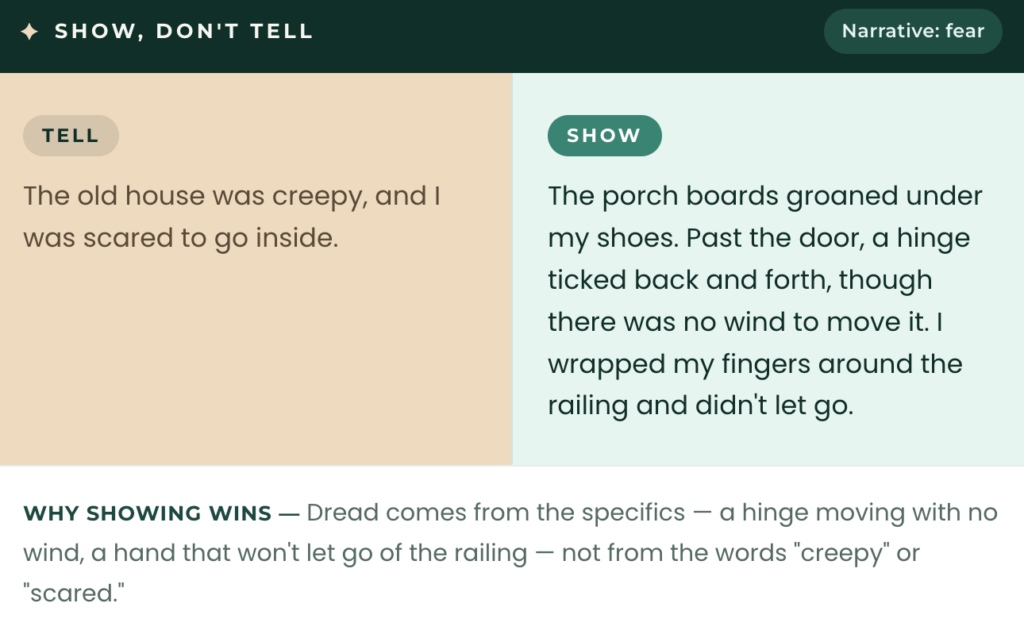
This is the version most writers picture first. Describing a moment so the reader lives inside it.
Showing in dialogue
People rarely say exactly what they mean. The way a character speaks (what they dodge, repeat, or trail off from) shows what's happening inside them.
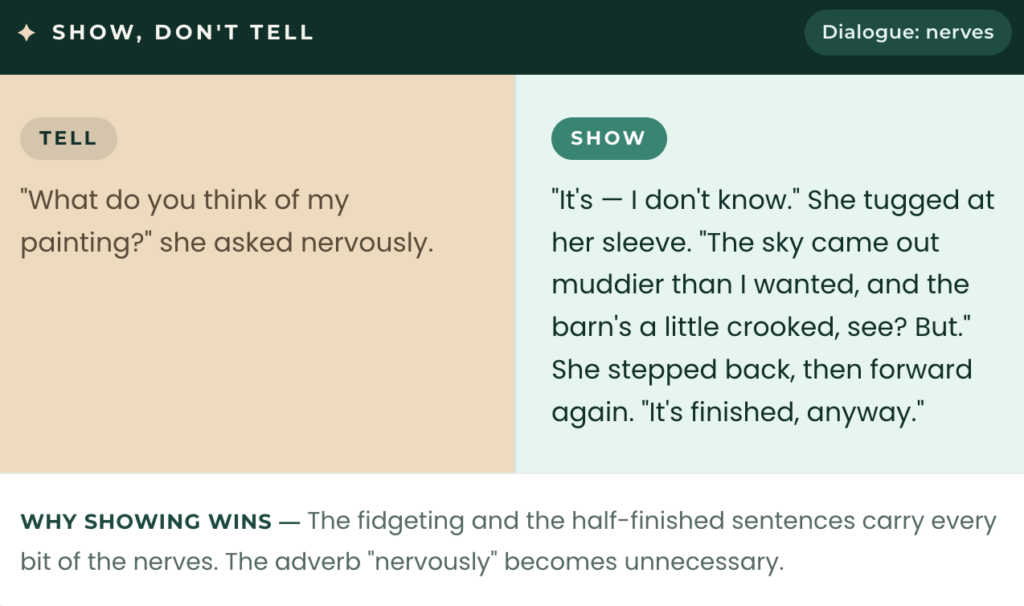
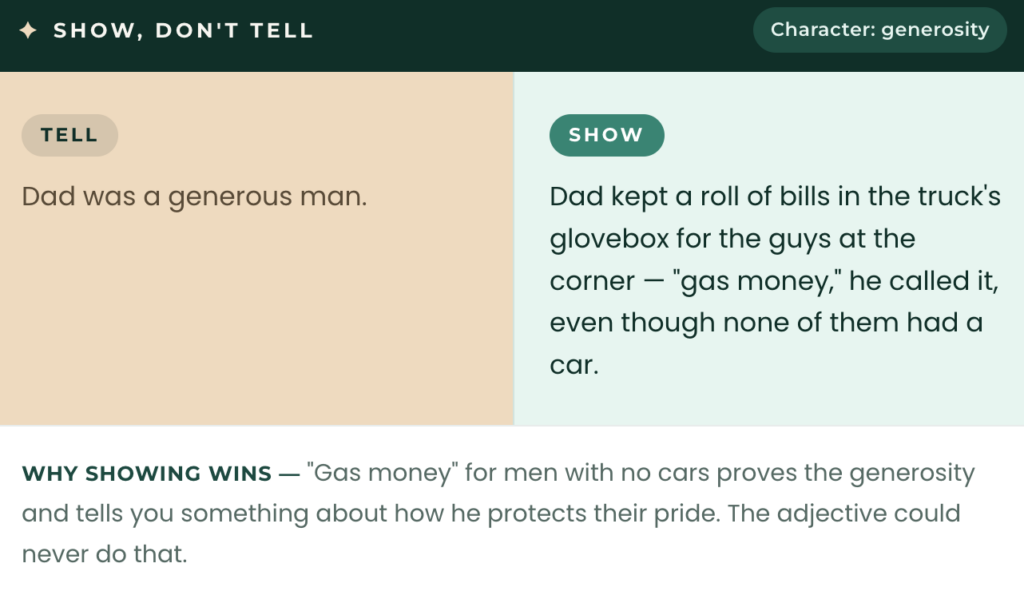
Showing character
Instead of labeling a trait, put the character in a moment that proves it. One concrete action outweighs a paragraph of description.
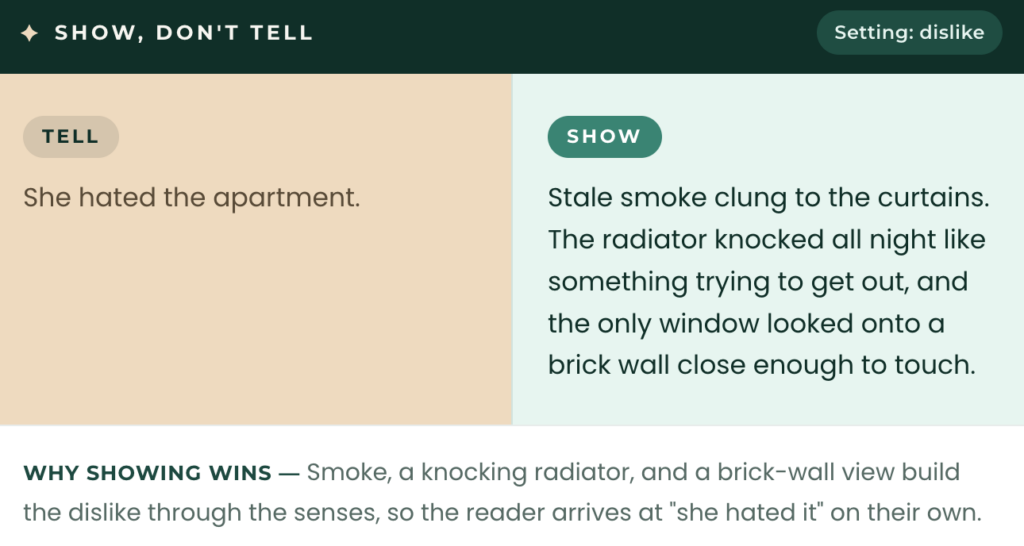
Showing setting and atmosphere
A place can carry emotion. Let the details of a room tell the reader how a character feels about being in it.
What is the golden rule of show don’t tell writing?
The golden rule of show don't tell writing is to dramatize the moments that carry emotion or meaning, and summarize the rest.
Show what matters to character and plot; tell to bridge the gaps.
Showing exists to build an emotional connection and keep readers turning pages. So ask one question of any scene: does showing this make the reader care more about the character or the outcome? If yes, slow down and show it. If it's just moving people from one place to the next, a sentence of telling will do.
Does show don’t tell writing work in nonfiction and memoir?
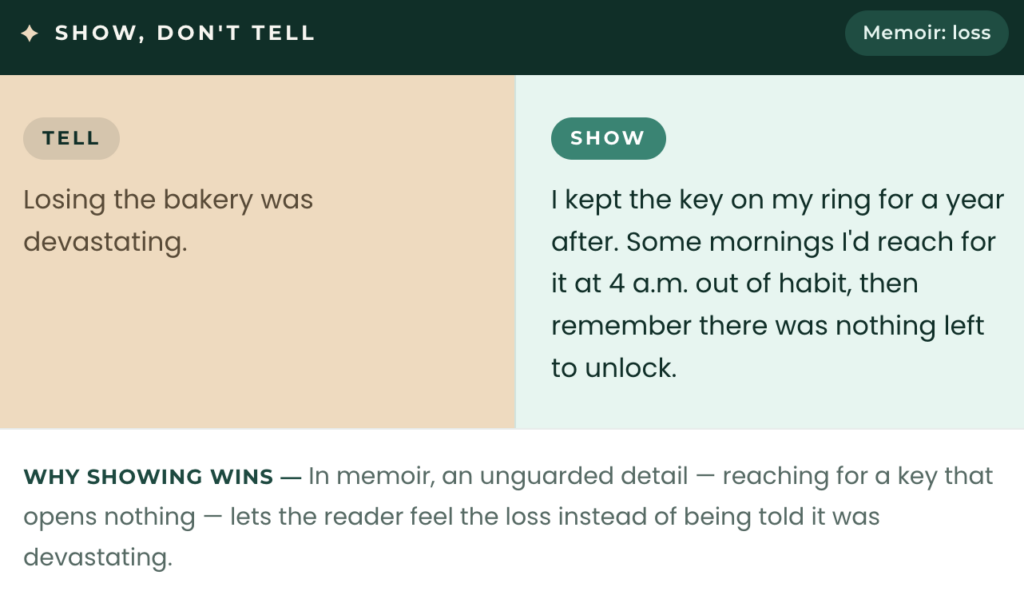
Yes. Show don't tell writing works in nonfiction and memoir too. Concrete scenes and sensory detail turn real events into experiences readers feel, not just facts they read.
Fiction writers hear this advice constantly, but it matters just as much when you're writing the story of your life or building a case in a nonfiction book. The reader is distracted by kids yelling, a phone buzzing, or dinner on the stove. Showing is how you pull them out of their kitchen and into your scene.
When should you tell instead of show?
Tell instead of show for transitions, time skips, low-stakes information, and the moments right after a big reveal.
Telling keeps pace; showing creates impact.
Here's what the rule's loudest fans leave out: a book made entirely of showing would be exhausting and twice as long as it needs to be. Telling is a legitimate tool, not a failure. Use it to:
- Cover time quickly - "Three years passed" beats three years of dramatized scenes.
- Move between scenes - get a character across town without narrating the drive.
- Deliver low-stakes facts - background a reader needs but won't feel anything about.
- Breathe after a big moment - a line of telling lets a reveal land before the next scene.
The skill isn't "always show." It's knowing which moments deserve the spotlight and which just need to move the story forward.
How to show, don’t tell in your writing
Here are some tips for using show don't tell writing in your book:
1. Cut filter words
Filter words like "I saw," "I heard," "I felt," "she noticed," "he realized" put a narrator between the reader and the moment. Delete them and drop the reader straight into the experience. Instead of "I heard footsteps crunching behind me," write "Footsteps crunched behind me."
Try this
Search your draft for "saw," "heard," "felt," "noticed," and "realized." For each one, cut the filter and let the detail stand on its own. Read the before and after out loud. The second version almost always hits harder.
2. Replace emotion labels with physical reactions
Words like happy, sad, angry, and excited name the feeling but don't make the reader feel it. Show the body instead: the uncontrollable grin, the jaw that won't unclench, the hands that won't stop moving. Let the reader name the emotion themselves.
3. Describe body language
Actions are a window into the mind. You can tell someone has a crush just by how they shift when their person walks in. Trust your reader to read those signals. Over-explaining the emotion afterward is what makes a scene feel flat and "telly."
4. Use strong, specific verbs
"She walked across the room" tells. "She stormed," "shuffled," or "drifted" across the room shows. Each verb carries a different mood. A precise verb does the work of an adjective and an adverb combined.
5. Engage the senses
Showing isn't only visual. Sound, smell, touch, and taste are often more immersive because we expect them less. "The faint scent of stale cigarette smoke pulled her face into a grimace" shows distaste through the nose, not a label.
6. Practice every day and read like a writer
This becomes second nature with reps. Write daily, and when you read, watch for how your favorite authors handle a tense or tender moment. Notice when they show, when they tell, and why the balance works. Then bring it back to your own pages.
Common show don’t tell mistakes
The most common mistakes are showing everything (which kills pace), overwriting with adjectives, naming the emotion after you've already shown it, and leaning on filter words.
- Showing everything - even routine transitions, which bloats the book and buries the moments that matter.
- Naming the emotion anyway - showing the clenched fist, then adding "he was angry" and undoing the work.
- Piling on adjectives - three describing words where one strong verb or noun would land cleaner.
- Filter words creeping back - "she felt," "he saw," "I noticed" sliding into the draft during revision.
- Showing low-stakes info - dramatizing a grocery run nobody needs to experience in real time.
Showing is a skill. So is finishing your book.
Mastering show don't tell writing is one piece of writing a book you're proud of.
We've helped authors publish over 7,000 books, coaching them through writing, editing, formatting, and launch.
If you're ready to stop circling the same draft and finally finish, let's map your path on a free strategy call.
Frequently asked questions
What does "show, don't tell" mean in simple terms?
It means letting readers experience a story through action, dialogue, and sensory detail instead of stating facts and feelings directly. Rather than writing "he was scared," you show his shaking hands and shallow breath, and the reader concludes he's scared on their own.
What's a quick example of show versus tell?
Tell: "She was exhausted." Show: "She set the mug down, missed the coaster, and didn't notice. Halfway through the sentence, she forgot what she was saying." The showing version makes you feel the exhaustion instead of just reading the word.
Who actually said "show, don't tell"?
It's often credited to Anton Chekhov, but that's not quite accurate. In a letter to his brother, Chekhov wrote about evoking a moonlit night through a single detail - light glinting off a piece of broken glass. The compact motto itself traces to early-20th-century playwriting advice, and Ernest Hemingway popularized the underlying idea through his "Iceberg Theory," the belief that what a writer leaves unsaid still makes the reader feel it.
Should you always show and never tell?
No. A story built entirely on showing would be exhausting and far too long. Telling is the right choice for transitions, time skips, low-stakes information, and the beat right after a big reveal. The skill is choosing which moments deserve to be dramatized and which just need to move the story along.
Does show, don't tell apply to nonfiction and memoir?
Yes. Concrete scenes and sensory detail turn real events into experiences readers feel. A memoir that shows a specific 4 a.m. moment will move readers far more than one that simply says an event was difficult.
What are filter words?
Filter words are phrases like "I saw," "I heard," "I felt," "she noticed," and "he realized" that place a narrator between the reader and the action. Cutting them drops the reader directly into the scene and is one of the fastest ways to shift from telling to showing.