



















TL;DR
Descriptive adjectives are words that modify nouns by adding concrete detail, telling readers how something looks, sounds, feels, tastes, or smells. Use this list to swap vague words for vivid ones, organized by sense: voice, appearance, movement, sight, color, emotion, setting, texture, sound, and taste. The goal is a sharper picture in the reader's mind, not more words on the page.
It's not enough to give a vague description and call it good enough. Readers always take imaginative liberties with what you write. We all picture a different thing when we read the word "dog," or hear that something "crunched." A descriptive adjectives list is one of the most practical tools for closing that gap, so the picture in the reader's mind matches the one in yours.
That translation, from your imagination to your reader's, is what makes a book engaging and memorable. Below you'll find what descriptive adjectives are, how to use them without overwriting, and a list of 200+ good descriptive words for creative writing you can pull from whenever your writing feels flat.
Guide to Self-Editing Mastery
Learn how to avoid the most time-consuming editing mistakes most authors make and self-edit your book like a seasoned professional with our free guide.
What are descriptive adjectives?
Descriptive adjectives are words that modify a noun by describing one of its qualities, such as size, color, sound, texture, or emotion. They tell the reader what something is like.
Instead of writing "the dog barked," you could write "the fierce dog barked," or "the small, timid dog barked." Each adjective sends the reader's imagination somewhere specific. Without them, every reader builds a slightly different scene, and you lose control of the one you worked to create.
Vivid adjectives add specificity and depth, the same way strong verbs do for action. They're the difference between a scene the reader skims and one they can actually see.
Types of descriptive adjectives
These descriptive keywords come in three forms: simple (one word), compound (two words joined by a hyphen), and proper (formed from a proper noun). All three add detail to a noun.
Grammatically, descriptive adjectives sit in one of three buckets. Knowing them helps you vary your descriptions instead of leaning on the same single-word adjectives every time.
Simple adjectives
A single word that describes the noun. These are the most common: a quiet room, a jagged cliff, a weary traveler.
Compound adjectives
Two or more words joined by a hyphen to act as one descriptor. They let you be more precise: a broad-shouldered stranger, a sun-bleached sign, a razor-sharp reply.
Proper adjectives
An adjective formed from a proper noun, often a place, era, or name: a Victorian staircase, Shakespearean dialogue, a Parisian cafe. They carry instant context with a single word.
Beyond form, descriptive adjectives are usually grouped by the quality they describe, such as appearance, color, sound, texture, and emotion. That's exactly how the list below is organized, so you can find the right word for the sense you're trying to reach.
The order of descriptive adjectives
When you have a list of adjectives before a noun, English follows a natural order: opinion, size, age, shape, color, origin, material, then purpose. Break it and the phrase sounds wrong, even to readers who can't name the rule.
You already know "a lovely little old round red Italian wooden table" sounds right, while "a wooden red Italian round old little lovely table" sounds broken. That instinct is the order of adjectives at work. Here's the sequence most writers follow:
| Order | Category | Examples |
|---|---|---|
| 1 | Opinion | lovely, hideous, charming |
| 2 | Size | tiny, towering, slight |
| 3 | Age | ancient, new, youthful |
| 4 | Shape | round, jagged, square |
| 5 | Color | crimson, ashen, golden |
| 6 | Origin | Parisian, coastal, northern |
| 7 | Material | velvet, iron, oaken |
| 8 | Purpose | writing (desk), hunting (knife) |
One more rule worth knowing: descriptive adjectives come after articles, numbers, and limiting words. You'd write "she bought some ripe peaches," never "ripe some peaches." You rarely need more than two or three adjectives at once, so use this order to sequence the few that earn their place.
How to use descriptive adjectives well
Use descriptive adjectives sparingly and specifically. One precise adjective beats three vague ones. Overloading a sentence creates purple prose, where the description gets so heavy the reader loses the image entirely.
Descriptive adjectives strengthen writing, but only in moderation. When prose reads as overly flowery, or so packed with description that the reader actually loses the visual, it's usually because the author piled on too many modifiers. Here's how to keep your descriptions sharp:
1. Be specific
Choose precise adjectives over generic ones. Instead of "plain," reach for "unadorned," "ordinary," or "unassuming," depending on the context. The right specific word does more work than a stack of vague ones.
2. Avoid overuse
It's tempting to keep adding adjectives, but moderation is what separates vivid from melodramatic. Use just enough to give the reader a clear picture without overwhelming them.
3. Match the tone
Your adjectives should fit the mood of the scene. A horror story leans on words like "eerie," "dark," and "chilling." A romance reaches for "tender," "passionate," and "gentle." Mismatched adjectives quietly undercut the feeling you're building.
4. Show, don't tell
Descriptive adjectives work best when they sharpen an image rather than replace it. Instead of telling the reader "the room was depressing," show it: "the room was dim, cold, and sparsely furnished." Let the details do the work.
Rule of thumb: Limit yourself to one or two adjectives per noun unless the description truly calls for more. "The bright, sunny day" lands just as well as "the bright, sunny, cheerful day," and it reads cleaner.
Descriptive adjectives in action
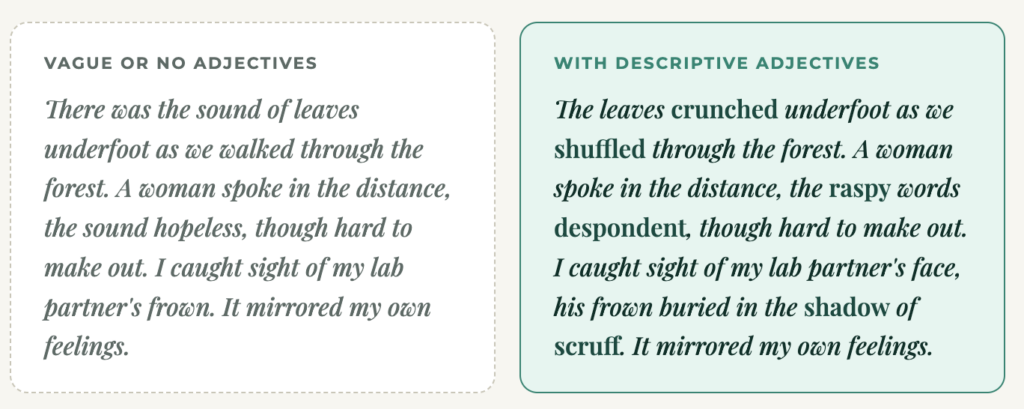
The same passage, with and without descriptive adjectives, shows the difference instantly. Vague words inform the reader; vivid words let them experience the scene.
Here's one passage written two ways. The first does the job. The second, using words from the list below, builds a far stronger picture and captures the tone of the scene.
You can see this technique in published fiction everywhere. In The Hunger Games, Suzanne Collins describes Buttercup the cat across two stages of his life rather than settling for "ugly," so the reader ends up with two clear visuals on the very first page. A strong description that early pulls readers in and keeps them reading. The same move works whether you're describing a voice, a movement, or a meal, and the list below gives you a word for each.
The descriptive adjectives list: examples of vivid adjectives
This list of descriptive words is grouped by sense and quality, so you can jump straight to voice, appearance, movement, sight, color, emotion, setting, texture, sound, or taste and smell.
If your writing feels like it's missing something, or a beta reader says they can't quite picture the scene, try swapping or adding a few words from vivid adjectives list below:
Sound of a voice
- Melodious
- Raspy
- Booming
- Whispery
- Gravelly
- Shrill
- Soft
- Piercing
- Husky
- Silky
- Deep
- Flat
- Brittle
- Throaty
- Lilting
- Breathy
- Monotonous
- Velvety
- Nasal
- Muffled
- Crisp
- Echoing
- Harsh
- Wobbly
- Soothing
In a sentence: "What is it you wish to do?" The man's breathy monotone pulled my brows together. When I didn't reply, he continued in a velvety voice that raised goosebumps on my skin.
Physical appearance
- Slender
- Athletic
- Curvy
- Petite
- Tall
- Stocky
- Lanky
- Muscular
- Plump
- Lean
- Brawny
- Chiseled
- Graceful
- Stout
- Svelte
- Broad-shouldered
- Scruffy
- Dapper
- Elegant
- Shabby
- Handsome
- Radiant
- Youthful
- Wrinkled
- Rugged
- Pale
- Tanned
- Freckled
- Rosy
- Flawless
In a sentence: The freckled youth stood taller, hoping it would stretch out his otherwise stocky frame. Broad-shouldered and fit as he was, the shabby set of his hair and the scruff on his chin only read as rugged, no matter how elegant he tried to appear.
Personality and character
- Aloof
- Brooding
- Cunning
- Earnest
- Gregarious
- Impulsive
- Meticulous
- Stoic
- Timid
- Vivacious
- Cantankerous
- Affable
- Devious
- Headstrong
- Wistful
- Brazen
- Reserved
- Magnetic
- Surly
- Tenacious
In a sentence: She was affable with strangers and surly with friends, a headstrong, magnetic woman who drew people in and then dared them to stay.
Movement
- Brisk
- Leisurely
- Shuffling
- Graceful
- Limping
- Hesitant
- Confident
- Staggering
- Steady
- Purposeful
- Swaying
- Bouncy
- Plodding
- Lightfooted
- Lumbering
- Cautious
- Energetic
- Sluggish
- Swaggering
- Jerky
- Tiptoeing
- Marching
- Trudging
- Elegant
- Hunched
In a sentence: She saw the man hunched over the fallen tree, swaying ever so slightly. Approaching with caution, she tiptoed until only a few paces separated them. For someone who looked so sluggish, he closed the gap fast, yet gently.
Sight and light
- Bright
- Glittering
- Opaque
- Murky
- Vibrant
- Shimmering
- Dusky
- Golden
- Ragged
- Cloudy
- Gleaming
- Luminous
- Dim
- Shadowy
- Hazy
- Dazzling
- Iridescent
- Mottled
- Translucent
- Stark
In a sentence: While the meadow usually looked bright and vibrant on a sunny day, it was now muted with lingering frost, glittering in the early morning sun.
Color
- Crimson
- Scarlet
- Amber
- Emerald
- Slate
- Ivory
- Charcoal
- Ashen
- Sapphire
- Russet
- Ochre
- Bronzed
- Inky
- Pearly
- Sallow
In a sentence: The ashen sky pressed low over slate rooftops, and a single amber window glowed against the inky street below.
Emotion
- Ecstatic
- Heartbroken
- Anxious
- Hopeful
- Melancholy
- Despondent
- Nostalgic
- Triumphant
- Sorrowful
- Pathetic
- Elated
- Forlorn
- Apprehensive
- Serene
- Wistful
- Bitter
- Jubilant
- Crestfallen
- Restless
- Content
In a sentence: As I peered through the shop's foggy window, the melancholy in the owner's face was unmistakable. Where another might have found the old man pathetic, even forlorn, all I felt was heartbroken.
Setting and atmosphere
- Desolate
- Bustling
- Eerie
- Cozy
- Cavernous
- Pristine
- Dilapidated
- Sprawling
- Claustrophobic
- Tranquil
- Foreboding
- Quaint
- Barren
- Lush
- Cramped
In a sentence: The cavernous hall felt desolate now, its dilapidated balconies looming over a floor that had once been bustling.
Texture
- Smooth
- Jagged
- Velvety
- Coarse
- Grainy
- Slippery
- Rough
- Sticky
- Slick
- Pocked
- Silky
- Gritty
In a sentence: Though the creature's pocked skin looked grainy, the woman struggled to keep hold of its slippery dampness.
Sound
- Crisp
- Booming
- Faint
- Raspy
- Piercing
- Muffled
- Melodic
- Shrill
- Thudding
- Scraping
In a sentence: The faint screeching rose to a shrill panic as the woman wandered deeper down the alley, drowning out the thudding of her own heart.
Taste and smell
- Savory
- Bitter
- Pungent
- Tangy
- Fragrant
- Zesty
- Aromatic
- Putrid
- Sugary
- Chalky
- Acrid
- Briny
- Mellow
- Rancid
In a sentence: I choked down the pungent dessert and chased it with a swig of bitter wine, fragrant with roses. Even the tangy drink couldn't clear the chalky taste from my mouth.
Vivid adjectives to replace boring words
The fastest way to sharpen a draft is to hunt down tired, overused adjectives and swap in vivid ones. Words like "good," "big," and "nice" inform the reader without making them feel anything.
Certain adjectives are so overused they've lost their impact. "Beautiful," "amazing," and "dark" barely register anymore. Keep this swap table nearby during revision and trade up whenever you catch a flat word doing important work.
| Boring word | Vivid adjectives to try instead |
|---|---|
| big | colossal, hulking, immense, towering |
| small | diminutive, dainty, slight, cramped |
| good | exceptional, sterling, first-rate, commendable |
| bad | dismal, woeful, dreadful, abysmal |
| happy | elated, jubilant, buoyant, radiant |
| sad | forlorn, crestfallen, mournful, downcast |
| beautiful | radiant, striking, enchanting, exquisite |
| scary | harrowing, sinister, menacing, ghastly |
| old | ancient, weathered, antiquated, decrepit |
| nice | gracious, charming, agreeable, warm |
| tired | weary, drained, listless, haggard |
| cold | frigid, biting, glacial, raw |
One caution: a vivid word still has to fit the context. "Radiant" and "exquisite" both beat "beautiful," but they don't mean the same thing. Pick the synonym that matches your tone, not just the first upgrade on the list.
Common mistakes to avoid
The three most common adjective mistakes are stacking too many at once, choosing words that don't match the tone, and using adjectives to tell what your scene should show instead.
Piling on adjectives
"The dark, gloomy, cold, foreboding forest" asks the reader to hold four moods at once. Choose the single adjective that best sets the tone, "the gloomy forest," and let the reader fill in the rest. Less is almost always more.
Adjectives that fight the tone
A "delightful" graveyard or a "menacing" wedding will quietly confuse the reader unless you're doing it on purpose. Make sure each word pulls in the same emotional direction as the scene.
Telling instead of showing
Using "the room was depressing" hands the reader a conclusion. Using "the room was dim, cold, and bare" gives them the evidence and lets them feel it. When in doubt, get feedback from a beta reader and watch where the picture blurs.
Your book deserves more than good words
Vivid description is one piece of writing a book readers can't put down. At selfpublishing.com, we've helped authors publish over 7,000 books, with 1:1 coaching that turns a strong idea into a finished, polished book. Get started with your free strategy call today.
Frequently asked questions
What is a descriptive adjective?
A descriptive adjective is a word that modifies a noun by describing one of its qualities, such as size, color, sound, texture, or emotion. Examples include "fierce," "velvety," "towering," and "ancient." They tell the reader what something is like. You can see many examples in the list of descriptive adjectives above.
What are examples of descriptive adjectives?
Common examples include raspy, slender, brisk, luminous, crimson, melancholy, eerie, jagged, and pungent. Each one adds a specific detail to a noun, whether that's the sound of a voice, the way someone moves, or the smell of a room.
What is the difference between descriptive adjectives and vivid adjectives?
All vivid adjectives are descriptive, but not all descriptive adjectives are vivid. "Big" is descriptive but dull; "towering" is descriptive and vivid. Vivid adjectives are simply the more specific, sensory, less overused options that make a reader feel the scene rather than just understand it.
How many descriptive adjectives should I use in one sentence?
As a rule of thumb, use one or two adjectives per noun. Stacking three or more usually creates purple prose, where the description gets so heavy the reader loses the image. One precise adjective almost always beats several vague ones.
What is the correct order of descriptive adjectives?
When you use more than one, English follows this order: opinion, size, age, shape, color, origin, material, then purpose. That's why "a lovely little old round red Italian table" sounds natural and any other sequence sounds off.
Are descriptive adjectives the same as sensory words?
They overlap heavily. Sensory words appeal to the five senses, and most descriptive adjectives do exactly that, describing how something looks, sounds, feels, tastes, or smells. The list above is organized by sense for that reason.