

















TL;DR
Strong verbs are specific, vivid action words that show how an action happens, like "bolted" instead of "ran" or "muttered" instead of "said." They replace weak verbs and adverb crutches, sharpen the image in a reader's mind, and cut word count. Use the 340+ strong verbs list below, organized by category, then apply them in moderation when the manner of an action matters.
Most first drafts don't fall flat because the ideas are weak. They fall flat because the language is. And one of the fastest ways to make your writing clearer, more vivid, and more immersive is to swap weak verbs for strong verbs.
You've probably seen the advice that strong verbs improve your writing. It's true. But like every craft rule, strong verbs only work when you understand how they work, so you can decide when to reach for one and when to leave a plain verb alone.
So what are strong verbs?
This guide gives you the full picture: a clear definition, the difference between strong and weak verbs, a categorized list of more than 340 strong verbs (with the weak verbs they replace), before-and-after examples, and how the best authors use them. Bookmark it, then put it to work on your current chapter.
Guide to Self-Editing Mastery
Learn how to avoid the most time-consuming editing mistakes most authors make and self-edit your book like a seasoned professional with our free guide.
What is a strong verb?: Strong verb definition
A strong verb is a precise, descriptive action word that conveys how an action is performed, making it specific enough to stand on its own without an adverb. "Stomped" and "bolted" are strong verbs; "walked" and "ran" are weak ones.
From every English class growing up, you know a verb describes an action, state, or occurrence. A strong verb is simply a sharper, more specific version of that action. It tells the reader not just what happened, but how.
Take "walk." There are hundreds of ways to do it. Someone can saunter, trudge, strut, shuffle, or slink, and each one paints a completely different picture. That's why "walk" is considered a weak verb, and why strong verbs do so much heavy lifting in vivid writing.
The grammar definition vs. the craft definition
Here's a distinction most lists skip, and it's worth knowing so you sound like you know your craft.
- The grammar meaning: In linguistics, a "strong verb" is one that forms its past tense by changing its internal vowel (sing becomes sang, swim becomes swam) rather than adding "-ed." This comes from the Germanic roots of English.
- The craft meaning: When an editor or writing coach tells you to "use strong verbs," they mean vivid, specific verbs like "dashed" instead of "ran." That's the meaning this guide uses, and the one that actually improves your book.
So when this post says strong verbs, it means the stylistic kind: words chosen for impact, not for their conjugation pattern.
Strong verbs vs. weak verbs: what’s the difference?
Weak verbs name an action in its plainest form (walk, run, said, look). Strong verbs describe the same action with built-in detail (slink, sprint, muttered, glared), so they carry more meaning in fewer words.
The plain verb still tells the story. The strong verb makes the reader feel it. Here are common weak verbs and the strong verb forms that can replace them:
| Weak verb | Strong verb options | What changes for the reader |
|---|---|---|
| Walk | slink, saunter, trudge, strut, mope | Reveals mood and intent |
| Run | bolt, sprint, dart, careen, hurtle | Shows speed and urgency |
| Say | mutter, snap, whisper, blurt, declare | Conveys tone and emotion |
| Look | glare, peer, scan, gaze, gawk | Signals attention and feeling |
| Make | forge, craft, brew, mold, conjure | Adds texture and effort |
| Hold | clutch, grip, clasp, cradle, clench | Communicates pressure and care |
| Hit | smash, batter, slam, pummel, strike | Raises force and stakes |
You can use the basic verb and tell the same events. But swap in a strong verb and you create a deeper impact in the reader, because you've handed them a precise image instead of a vague one.
Why strong verbs matter
Strong verbs matter because they create sharper visuals, deepen emotion, support "show, don't tell," cut adverbs, and tighten prose. They do five jobs at once with a single well-chosen word.
1. They build sharper visuals
The most important job of any scene is giving readers a precise picture. Compare these:
- She walked into the room, her cape trailing behind her.
- She charged into the room, her cape billowing behind her.
- She strutted into the room, her cape flowing behind her.
Same girl, same cape, same room. But "charged" and "strutted" tell you the how, and the how sets mood, builds suspense, and creates anticipation for what's coming.
2. They deepen emotion
Readers come to your book to feel something. Strong verbs are how you stir that feeling:
- My heart was beating so fast I could hear it.
- My heart crashed against my ribs, echoing in my skull.
The second line doesn't describe anxiety. It makes you feel it.
3. They help you show, not tell
Strong verbs force you to picture the action before you write it, which naturally pulls you toward showing instead of telling. If you want to go deeper on that skill, our guide to different writing styles pairs well with this one.
4. They reduce weak adverbs
"I gripped the steering wheel firmly" leans on an adverb to do the verb's job. Replace "gripped firmly" with clenched or squeezed and the sentence gets stronger and shorter at the same time.
5. They make writing more concise
One precise strong verb can replace a weak verb plus two or three propping words. That trims the bloat that makes prose feel wordy, and it saves you hours when you reach the editing stage.
The strong verbs list: 340+ examples by category
List of strong verbs is organized by action category so you can find the right word fast. Each of the examples of strong verbs shows the weak verbs it replaces, plus definitions for the standout picks.
Most strong verbs lists dump 300 words in one alphabetical pile. This one sorts them by the action you're trying to sharpen, so you can scan to the category you need and swap in seconds.
Walking and moving on foot
Replaces: walk, go, move
Amble, saunter, stroll, mope, slink, trudge, stomp, march, stagger, lurch, shuffle, pad, prowl, skulk, creep, totter, hobble, toddle, traipse, plod, stride, strut, sidle, meander, slouch.
Saunter: walk in a slow, relaxed, unbothered way. Skulk: move stealthily to avoid being seen. Trudge: walk heavily, as if exhausted.
Running and fast movement
Replaces: run, rush, hurry
Bolt, dart, dash, sprint, careen, hurtle, scamper, scurry, scuttle, race, tear, barrel, charge, surge, zoom, streak, lunge, leap, vault, bound, hurry, rush.
Careen: move fast while swaying or veering out of control. Hurtle: move with great, often reckless, speed.
Said and dialogue tags
Replaces: said, asked, told
Whisper, mutter, murmur, hiss, snap, snarl, growl, bark, blurt, stammer, stutter, croak, rasp, purr, drawl, gush, blab, babble, wail, shriek, bellow, boom, roar, demand, insist, plead, scoff, sneer, taunt, quip, retort, declare, confess, vow.
Use these sparingly. "Said" is nearly invisible to readers, which is usually a feature. Reach for a strong dialogue verb only when the manner of speaking carries real meaning.
Looking and seeing
Replaces: look, see, watch
Gaze, stare, glare, peer, peek, glance, scan, survey, scrutinize, inspect, study, eyeball, ogle, gawk, squint, glimpse, observe, behold, leer, probe, discern, perceive.
Scrutinize: examine closely and critically. Leer: look in an unpleasant, often suggestive way.
Hands, holding, and touching
Replaces: hold, take, grab, throw
Clutch, grasp, grip, clasp, clench, squeeze, seize, snatch, grab, grope, pluck, pinch, yank, wrench, wrest, fling, hurl, heave, shove, thrust, jab, prod, stroke, caress, fumble, clamp, cradle.
Wrest: pull something away with a violent twist. Cradle: hold gently and protectively.
Fighting, force, and impact
Replaces: hit, push, fight
Strike, smash, batter, bash, pummel, slam, crash, collide, clobber, thrash, hammer, pound, smite, lash, whack, ram, jolt, jostle, assail, attack, storm, strain, wrestle, tussle.
Pummel: strike repeatedly with the fists. Smite: strike with a heavy, often decisive, blow.
Destruction and damage
Replaces: break, ruin, destroy
Shatter, demolish, obliterate, crush, wreck, ruin, raze, dismantle, splinter, crumble, collapse, topple, gut, flatten, pulverize, scorch, scrape, slash, rip, strip, erase.
Raze: tear down to the ground completely. Obliterate: destroy so thoroughly that no trace remains.
Creating and building
Replaces: make, create, build
Forge, craft, mold, shape, sculpt, weave, fashion, assemble, mint, brew, conjure, spawn, generate, foster, refashion, refine, revitalize, transform, transfigure.
Forge: create something strong and enduring through effort. Conjure: bring into being as if by magic.
Light and shine
Replaces: shine, light
Gleam, glint, glisten, glitter, shimmer, sparkle, glow, blaze, flare, flicker, dazzle, radiate, beam, illuminate, twinkle, ignite, scintillate.
Glint: shine with a quick, sharp flash. Shimmer: shine with a soft, wavering light.
Sound and noise
Replaces: make noise, sound
Crackle, sizzle, rumble, thunder, clang, clatter, screech, squeal, hum, buzz, thud, rattle, reverberate, echo, hiss, peal, groan, moan, slosh, slurp, pop, snap, zing.
Reverberate: echo repeatedly, lingering in the air. Peal: ring out loudly, like bells.
Emotion and reaction
Replaces: feel, react
Recoil, flinch, cringe, wince, shudder, tremble, quiver, bristle, fume, seethe, simmer, brood, sulk, melt, swoon, ache, yearn, long, crave, dread, cower, revel, muse.
Seethe: feel intense anger that you hold inside. Cower: shrink back in fear.
Nature, objects, and motion
Replaces: fall, rise, float, grow
Plunge, plummet, soar, surge, swell, billow, ripple, churn, swirl, cascade, tumble, drift, hover, dangle, sway, teeter, sprout, wilt, wither, bloom, balloon, mushroom, snowball, engulf, envelop.
Plummet: fall straight down at high speed. Billow: swell and roll outward, like smoke or fabric.
Eating and consuming
Replaces: eat, drink
Devour, gobble, gulp, gnaw, nibble, slurp, guzzle, wolf, inhale, scarf, savor, munch, chomp, peck.
Devour: eat hungrily and greedily. Savor: enjoy slowly, drawing out the pleasure.
Thinking, discovering, and leading
Replaces: think, find, lead
Ponder, mull, reckon, fathom, deduce, envision, picture, realize, uncover, unearth, unveil, detect, pinpoint, locate, guide, steer, shepherd, usher, command, direct, launch, pilot.
Fathom: understand something deep or difficult. Unearth: discover by digging or searching.
Want this list on hand while you edit? Keep a categorized strong verbs list open in a second window as you revise, then run a find-and-replace for your most-repeated weak verbs. If you're picking writing tools to draft and revise in, see our roundup of the best book writing software for authors.
“To be” verbs and weak verbs to watch for
"To be" verbs (is, am, are, was, were) describe a state rather than an action. They aren't wrong, but overusing them flattens your prose and leans toward telling instead of showing.
Part of using strong verbs well is recognizing the weak verbs that drag your writing down. The most common culprits are "to be" verbs, also called state-of-being verbs. Watch for these in your manuscript:
| State-of-being verbs to flag |
|---|
| am, are, be, been, being, can, could, did, do, does, had, has, have, is, may, might, must, shall, should, was, were, will, would |
Here's how replacing "to be" verbs strengthens a sentence in stages:
| "To be" version | Tighter verb | Strong verb |
|---|---|---|
| She was walking through the corridor. | She walked through the corridor. | She slinked through the corridor. |
| Conrad is afraid of the dark. | Conrad fears the dark. | Conrad cowers from the dark. |
| I was being chased by someone. | I was chased by someone. | Someone hunted me through the dark. |
| I was wanting to see the forest. | I wanted to see the forest. | I longed to see the forest. |
Keep in mind that "to be" verbs are fine in moderation. Even authors known for tight prose, like Hemingway, use them constantly. The goal isn't to erase them. It's to notice when a stronger verb would do more work.
How to use strong verbs the right way
Use strong verbs in moderation, only when the manner of an action matters. Overloading every sentence with vivid verbs is as distracting as using none, and it can make your prose read as amateurish.
Like every craft rule, strong verbs work best with restraint. Littering a page with them won't make it better. Done to excess, they call attention to the writing instead of the story. Here's a reliable approach.
The one-question test
Before swapping a verb, ask: Is this action being performed in a particular way that matters to the scene?
- Yes: a character storms out in anger, so "stomped" or "stormed" earns its place.
- No: a character simply crosses a room with no emotional weight, so plain "walked" is the right call.
A 4-step strong verbs editing pass
- Search for "-ly" adverbs. Each one is a flag for a weak verb that could be replaced (gripped firmly becomes clenched).
- Search for "to be" verbs. Use your word processor's find tool to spot was, were, is, and are, then revise the clunkiest.
- Read the verb out loud. If it feels flat, scan the category above for a sharper option.
- Stop before it's too much. If a paragraph has three vivid verbs fighting for attention, soften two of them.
This pass fits naturally into self-editing, before you ever hand your book to a professional. If you want a fuller process, our guide to copy editing walks through the editing layers in order.
Before and after: strong verbs in action
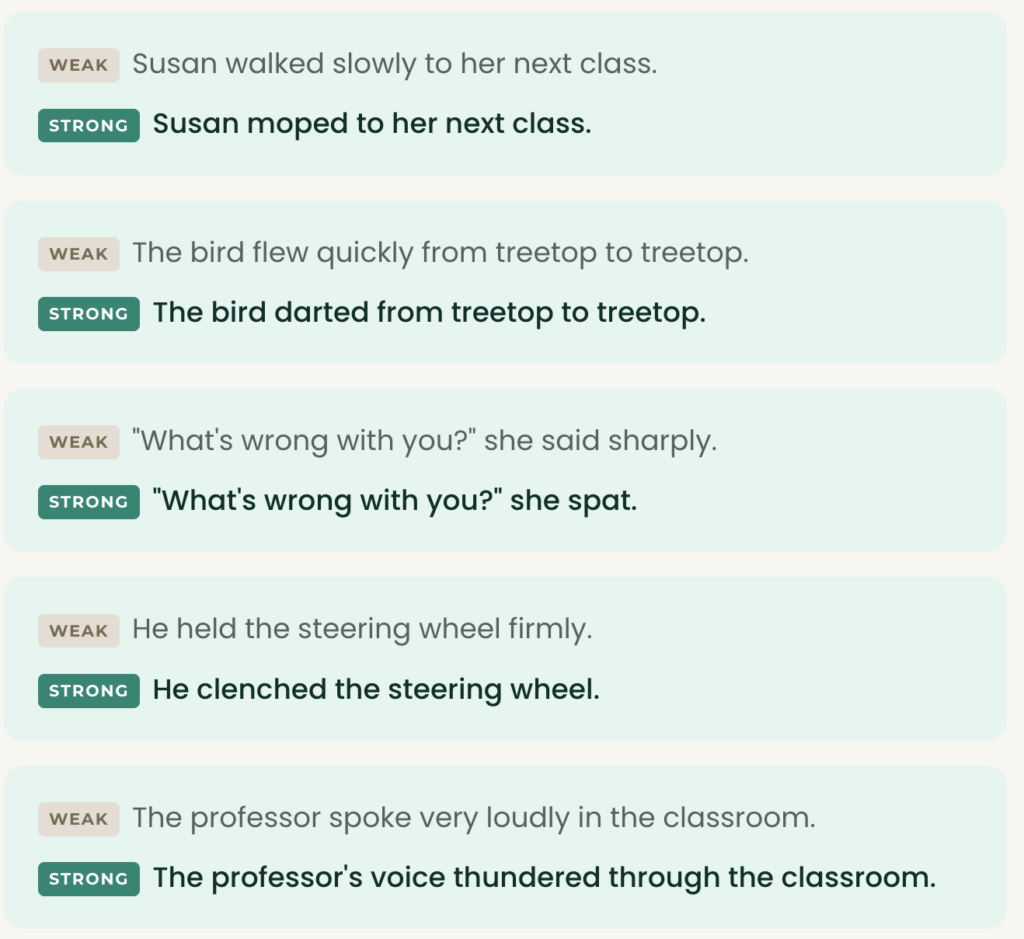
The fastest way to learn strong verbs is to see weak sentences rewritten. In each pair below, one precise verb replaces a weak verb plus its adverb crutch.
Common strong verb mistakes to avoid
The biggest strong verb mistakes are overusing them, swapping out every "said," and choosing exotic verbs that pull readers out of the story. Precision beats decoration every time.
- Overloading every sentence. When every verb is vivid, none of them stand out. Reserve your strongest verbs for moments that matter.
- Replacing every "said." Readers skim "said" without friction. Trading it for "ejaculated" or "expostulated" on every line is distracting.
- Reaching for the thesaurus first. Choose the precise verb you mean, not the most unusual one you can find. Obscure verbs trip readers up.
- Forcing strong verbs onto calm moments. A quiet scene often needs quiet verbs. Match the verb to the energy of the moment.
- Ignoring rhythm. Strong verbs back to back can make prose feel breathless. Vary your intensity.
Turn sharper sentences into a finished book
Strong verbs fix a sentence.
A proven system finishes the book.
selfpublishing.com offers a coaching program that takes you from blank page to published author with 1:1 support every step of the way. Book a free strategy call today to get started.
Strong verbs FAQ
What is a strong verb?
A strong verb is a specific, vivid action word that conveys how an action is performed, such as "bolted," "muttered," or "shattered." It carries enough detail to stand on its own without an adverb, unlike a weak verb such as "ran," "said," or "broke."
What is the difference between strong verbs and weak verbs?
Weak verbs name an action in its plainest form and often need an adverb to add meaning (walked slowly). Strong verbs build that meaning into a single word (trudged). Strong verbs are more specific, more concise, and more emotionally precise.
Is "walk" a strong verb?
No. "Walk" is a weak verb because it describes a plain action with no detail about how it happens. Strong verbs like "saunter," "march," "stagger," or "slink" show the manner of walking and create a clearer picture.
Is "grabbed" a strong verb?
Yes. "Grabbed" suggests sudden, forceful movement and replaces weaker phrases like "took hold of quickly." Depending on intensity, you might also choose "snatched," "seized," or "clutched."
What are strong verbs for "said"?
Strong alternatives to "said" include whispered, muttered, snapped, hissed, blurted, demanded, and pleaded. Use them only when the way a character speaks adds real meaning, since "said" is usefully invisible to readers most of the time.
How many strong verbs should I use in my writing?
Use strong verbs whenever the manner of an action matters to the scene, and plain verbs everywhere else. There's no fixed number. The goal is precision, not density. Overloading a page with vivid verbs is as distracting as using none.
Do strong verbs really improve your writing?
Yes. Strong verbs sharpen imagery, deepen emotion, support "show, don't tell," cut unnecessary adverbs, and tighten prose. Used in moderation, they're one of the fastest ways to make a draft read like polished, professional writing.