


















TL;DR: A prologue is a short scene that comes before chapter 1 of a fiction book, written in the story's voice but set apart by time, place, or perspective. It exists to deliver information the main story can't carry on its own. Most run 500 to 2,500 words, shorter than an average chapter. Not every book needs one, and a weak prologue does more harm than skipping it entirely.
Should your book open with a prologue, or should you drop readers straight into chapter 1?
Get this call wrong and you either bury your hook under pages a reader will skip, or you cut a scene your story genuinely needs to make sense. Get it right and you hand your reader a reason to keep turning pages before chapter 1 even starts.
This is one of the most important structural decisions you'll make while writing a novel.
Below, we'll cover what a prologue is, how to tell if your book needs one, and 6 tips for writing a prologue readers won't skip.

What is a prologue?
A prologue is a short scene set apart from chapter 1 that gives readers information the main story can't deliver on its own, told in the same voice and style as the rest of the book.
So what does prologue mean in practice? Think of it as a small, self-contained story: set in your book's world, written in your book's voice, but clearly separated from where chapter 1 begins.
The word itself comes from the Greek "prologos," meaning "before the word." That's a useful way to think about the prologue meaning today too: it's everything that has to happen before your story's real beginning can land.
A prologue of a book can take a few different forms, depending on what your story needs:
- A flash-forward. A glimpse of your protagonist's future that plants a question the rest of the book answers.
- A historical trigger. An event from years or centuries earlier that sets your story's inciting incident in motion.
- World context. Background a reader needs to settle into a fantasy or sci-fi setting, without becoming an info dump.
- A different point of view. A scene from a character's perspective the reader won't get anywhere else in the book, often someone who can't narrate the main story themselves.
Here's the test we use with authors in our fiction program: if you're struggling to give readers the context they need to understand what's happening, a prologue is probably what your story needs. If you can work that same context into chapter 1 or 2 without slowing the pace, skip it.
A well-written prologue reads like a short story with no true ending. It should leave your reader curious, not satisfied. Whatever question you raise in the prologue has to get answered by the end of the book.
Now that you have a working prologue definition, let's look at what separates a prologue that earns its place from one that gets skipped.
How to make a prologue stand out
A strong prologue is written in your book's voice but reads as clearly separate from chapter 1, usually through a shift in time or point of view.
If a reader can't tell your prologue apart from the rest of the story without the label "prologue" at the top, it isn't doing its job. It should feel connected to your book, but distinct enough that removing the label would still leave the shift obvious.
Two techniques create that separation:
Time difference. Set your prologue in the past to reveal an event the reader needs, or jump into the future so the rest of the book plays out as the path toward that moment. Many future-set prologues never appear again in the book itself. The story ends before it catches up, but everything in between should build logically toward it.
Different perspective. If your story is in first person, show the prologue from a third-person omniscient view. Or let a parent, friend, or minor character narrate a moment the protagonist can't. Some authors even use a character who never appears again in the main story.
One rule either way: don't return to that same perspective or timeline anywhere else in the book. If you could, that's a sign the material belongs in the story itself, not in a separate prologue.
Prologue vs. preface vs. foreword vs. introduction
A prologue is part of the story and written in narrative voice, while a preface, foreword, or introduction sits outside the story and speaks directly to the reader in the author's own voice.
These four terms get confused constantly, so here's how to know if you're actually writing a prologue.
Preface
A preface is the author explaining how the book came to be: what inspired it, who helped, what the reader should know going in. It isn't part of the story, and a reader can skip it without losing anything.
Foreword
A foreword works the same way as a preface, but it's written by someone other than the author, often to reflect on how the book connects to a bigger conversation or audience.
Introduction
A book introduction shows up almost exclusively in nonfiction. It gives supplemental context and generally isn't essential to understanding the rest of the book.
Prologue
A prologue is what fiction uses instead. It's written in the same writing style and voice as the rest of the book, even if it shifts timeline or perspective, and it delivers story information a reader actually needs. Skip it, and the rest of the book gets harder to follow.
Does your book need a prologue?
Your book needs a prologue only if it contains information critical to the story that can't be worked into the main narrative without slowing it down or creating confusion.
Not every book needs one. Add a prologue your story doesn't need and you risk giving away too much too soon or padding your opening with content that has nothing to do with hooking your reader.
Write a prologue if:
- Something happens outside your story's timeline that's crucial to understanding it, and there's no clean way to work it into the main narrative.
- The story genuinely doesn't make sense without it. Try the test: if a reader could skip it and still follow the book, you don't need it.
- Folding that information into the story itself would muddle your plot or slow your pacing.
Skip the prologue if:
- Your story makes sense without it.
- The content could live inside the main story instead.
- You're using it to avoid writing a genuinely interesting opening chapter.
- It's an info dump, a mood-setter, or world-building with nothing else doing real work.
- You're including one just because you think fiction is supposed to have one.
Prologues can absolutely add mood, atmosphere, or clever exposition. The problem is when that's the only thing they're doing. If you're on the fence, be harder on your prologue than you'd be on any other chapter. There are more reasons to cut one than to keep one.
If your story does need a prologue, here's how to write one that earns its place.
How to write a good prologue for your book
A prologue that works is short, purposeful, and written with the same care as your best chapter, ending on a question your reader needs answered.
Not every prologue is created equal. A great one can hook a reader before chapter 1 even starts. A bad one teaches readers to skip your openings for the rest of the book. Here's how to land on the right side of that line.
1. Keep it brief (and know how long a prologue should be)
How long should a prologue be? As a general benchmark, keep it shorter than your average chapter length, typically somewhere between 500 and 2,500 words depending on your genre and pacing. Epic fantasy can stretch toward the higher end; most other genres should stay closer to the lower end.
Cover one event, maybe two at most. Skip character development entirely, and include only the information your reader can't get anywhere else.
2. Keep it interesting
If your prologue is boring, readers skip it, and some will put the book down entirely before reaching chapter 1. Your prologue needs to be just as gripping as your opening chapter, not a warm-up act for it.
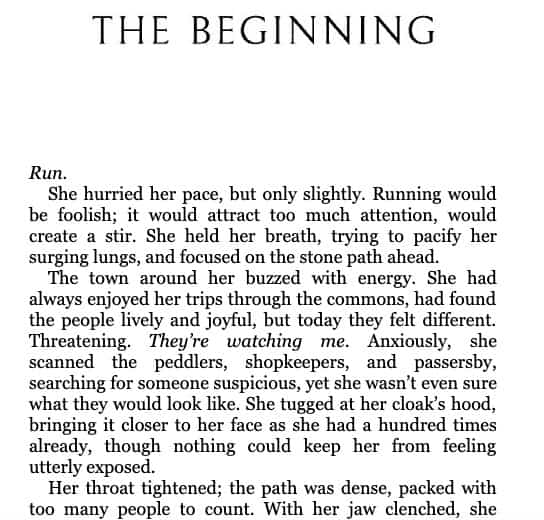
Jenna Moreci's The Savior's Champion is a strong example: the prologue runs in a different perspective from the rest of the book and is arguably more gripping than chapter 1 itself. That's the bar.
3. Focus on crisp, original prose
Even if your prologue covers a historical event or a genre that feels less "exciting" on paper, hold your prose to the same standard as the rest of the book. This is your reader's first taste of your writing. Make it count.
4. End with a burning question
Your prologue should leave readers needing to know what happens next, immediately, before they can put the book down. George R.R. Martin opens A Song of Ice and Fire with a prologue following men beyond the Wall investigating a disturbance. It ends with readers unsettled and desperate for answers, which is exactly the job a prologue's ending should do.

5. Make it an event, not an exposition dump
This is where most prologues fail. Writers use them to hand readers a pile of world or backstory information before the reader has any reason to care yet. Readers skim it, skip it, or close the book. Give your prologue a single, active moment instead of a lecture.
6. Give your prologue a purpose beyond the page
A great prologue does nothing for you if it stays in a file on your computer. If you're ready to finish your manuscript and move toward publishing your book, that's the next real step.
Most authors try to figure out structure, pacing, and publishing alone, and get stuck rewriting the same opening chapters for months. If that sounds familiar, our Fundamentals of Fiction program walks you through the entire process, from your opening pages to a finished, published book.
Prologue FAQ
What is the purpose of a prologue?
A prologue delivers information the main story needs but can't carry on its own: background, a crucial event, or a shift in mood or perspective that sets up what's coming. It's a tool for context, not a substitute for a strong chapter 1.
Do you really need a prologue?
Not every story needs one. If your book makes sense without it, or the same information fits naturally into your opening chapters, skip it. A prologue should earn its place, not just follow convention.
What makes a bad prologue?
A bad prologue is an info dump, runs longer than it needs to, or fails to hook the reader the way your first chapter should. It should never function as a substitute for writing a genuinely strong opening.
What is the difference between a prologue and a preface?
A prologue is part of the story itself, written in narrative voice and set in the book's world. A preface sits outside the story, written by the author to explain the book's origin, purpose, or significance, and is far more common in nonfiction.
How long should a prologue be?
Most prologues run 500 to 2,500 words, shorter than the book's average chapter length. Genre affects this: epic fantasy and sci-fi tend to run longer because of world-building needs, while thrillers and contemporary fiction usually stay tighter. If your prologue is approaching chapter length, ask whether it should just be chapter 1 instead.
Ready to turn your manuscript into a published book?
Schedule a free consult and we'll help you build a plan to get your fiction book written, edited, and published with one-on-one coaching and professional assistance every step of the way.