





















TL;DR
A book is built from three layers: front matter (cover, title page, copyright, table of contents, dedication, foreword), the body (your introduction, chapters, and story structure), and back matter (acknowledgements, author bio, and the back-cover synopsis). Some parts of the book are required, many are optional, and getting the mix right is what makes a self-published book look professional.
You know what you want to write about. What you might not know is which different parts of a book actually belong in yours, and which ones to skip.
What are the components of a book?
Get this wrong and your book looks low-quality, which costs you sales, reviews, and the credibility you wrote it to build. Get it right and you look like the professional you are. It starts with knowing what each part is and what it's for.
The 3 main parts of a book
Most books are built in three layers: front matter (everything before the main text), the body (your actual content of a book and story), and back matter (everything after the main text).
Design and content together make up the whole book. Before we through the parts of a book in order, here's the wide-angle view of the structure of a book, where each piece lives, and whether your book needs it.
| Layer | What it includes | Purpose |
|---|---|---|
| Front matter | Cover, title page, copyright, table of contents, dedication, foreword | Sets up the book and makes it look professional |
| Body | Introduction, prologue, chapters, sections or acts, story beats, epilogue | Delivers your story or your message |
| Back matter | Acknowledgements, author bio, "read more" page, back-cover synopsis | Wraps up, builds credibility, and sells the next read |
No book uses every part. The right combination of these sections of a book depends on whether you're writing fiction or nonfiction, and what your book is trying to do.
Front matter
Front matter is everything before your main text. It establishes the book's identity and handles the publishing details that signal a professional product.
1. Book cover (Required)
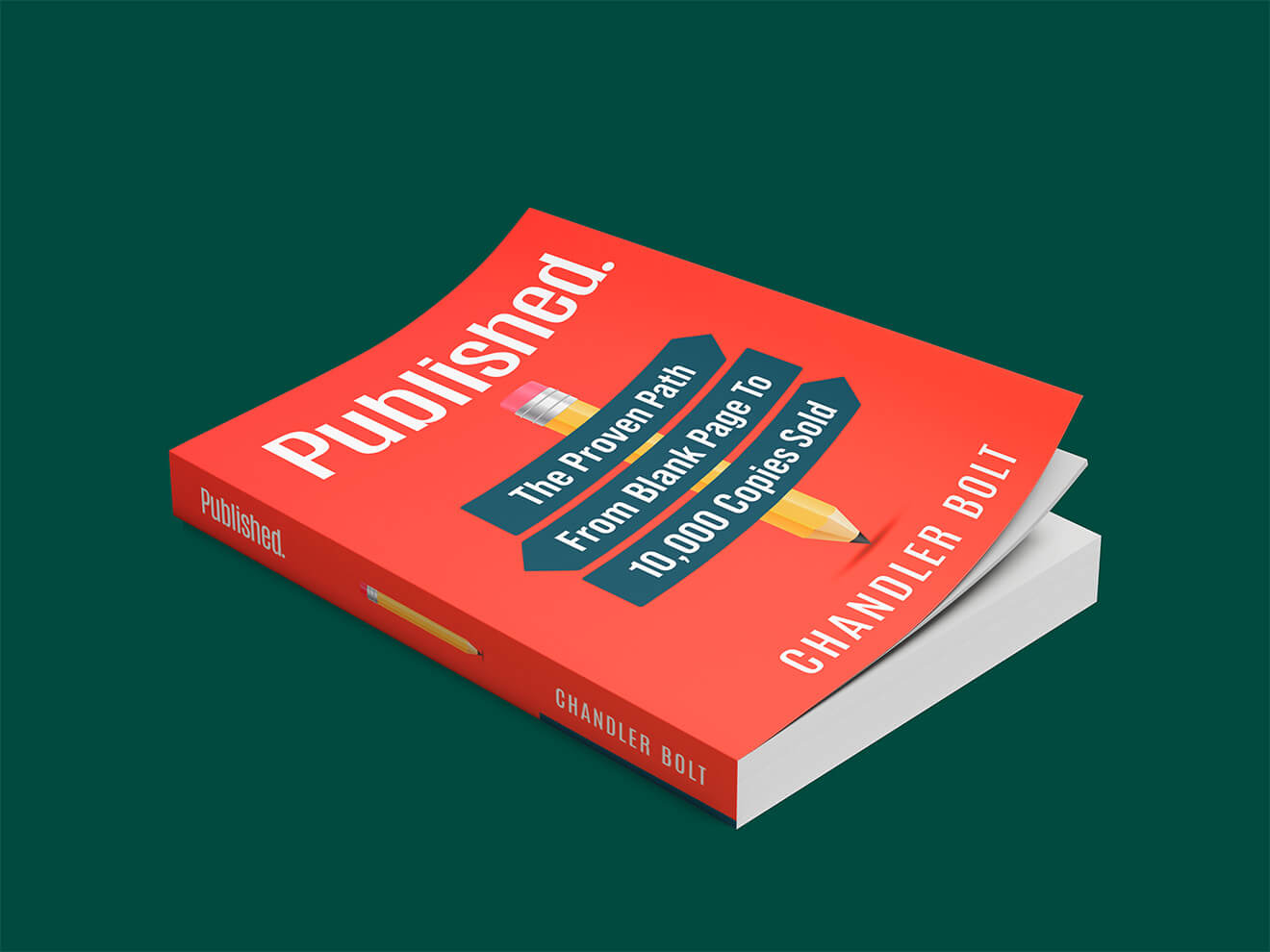
A book cover is the front, spine, and back design that wraps your book and creates the reader's first impression.
As much as we'd like to believe people don't judge a book by its cover, they do. A quality cover is one of the best things you can do to sell more copies as a self-published author. It's the first thing a potential buyer sees, and they form an opinion in seconds.
Here’s an example of a full, front-to-back strong book cover that fits the tone, style, and contents of a book titled The Politically Homeless Christian by Aaron Schafer.

2. Title page (Required)
A title page is the page that clearly presents your title, subtitle, and author name near the front of the book.
Your title is often a reader's first impression, and paired with the cover it signals the genre and tone. The title page itself is an industry standard. It's simply your main title, any subtitle, and your name at the bottom, but it should be formatted cleanly with consistent fonts and no distracting images.
Here’s an example of a great title page and what you can use to replicate your own from I Wish Everyone Was an Immigrant by Pedro Mattos:

3. Copyright page (Required)
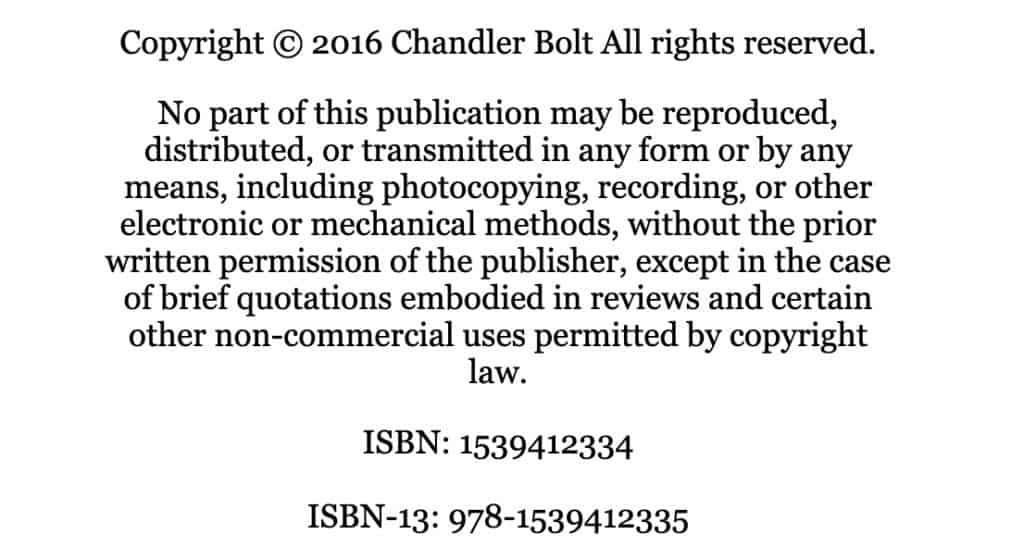
A copyright page is the page that states your legal ownership of the work, along with publication details and your ISBN.
Your work is technically protected the moment you write it, but registering your copyright makes it fully enforceable. What appears on the page shifts depending on the type of book, and certain material (especially in memoir) can't be exclusively claimed. We have a full guide on how to copyright a book if you want the details.
4. Table of contents (Recommended)
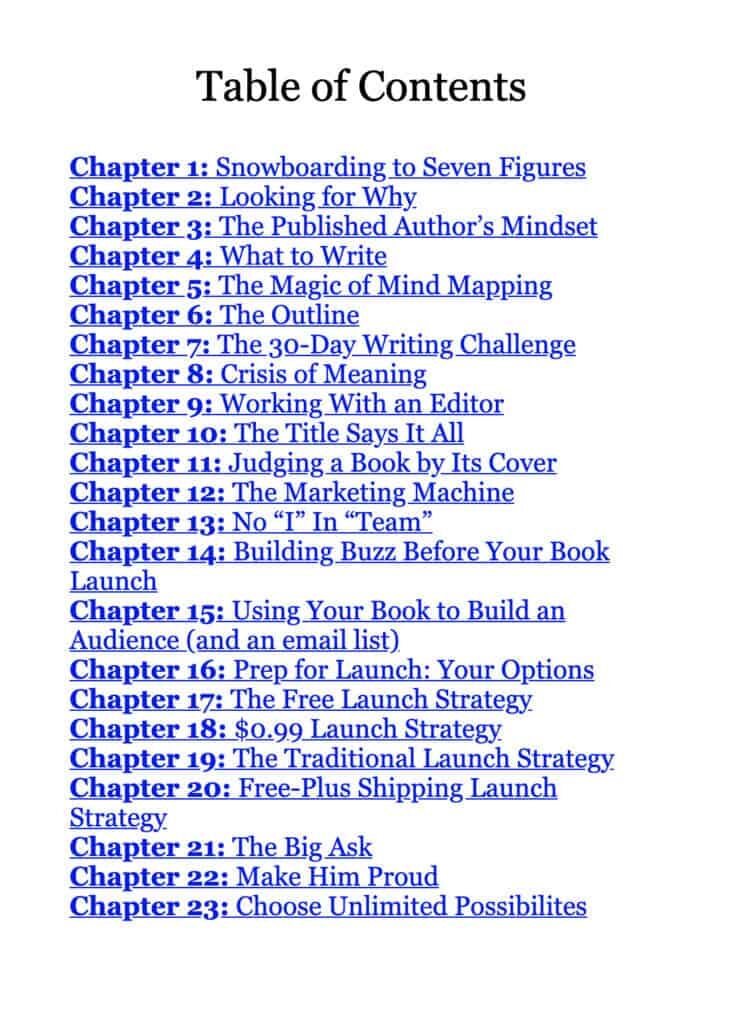
A table of contents lists your book's chapters or sections, with page numbers or, in ebooks, clickable links.
A table of contents helps readers find what they're looking for, and it's essential in Kindle and ebook versions so readers can tap straight to a chapter instead of paging through. The easier your book is to navigate, the happier the reader, and the better your reviews.
5. Dedication (Optional)
A dedication is a short, personal note near the front of the book thanking or honoring someone meaningful to you.
Most of us write the dedication in our heads long before the book is done. Think of it as your acceptance speech, except the book is the award and you get to place the speech where everyone sees it before they start reading. It usually sits after the title page and before the table of contents.
This is an example of what a dedication of your book may look like from our own Biz Dev Legend Pedro Mattos’ debut book I Wish Everyone Was an Immigrant:

6. Foreword (Optional)
A foreword is a short introduction written by someone other than the author that lends credibility to the book.
If you want to boost your credibility, a foreword from a respected name in your field works like an endorsement. It's usually written by another author or an authority on the subject, and it typically sits after the table of contents and before the introduction or first chapter.
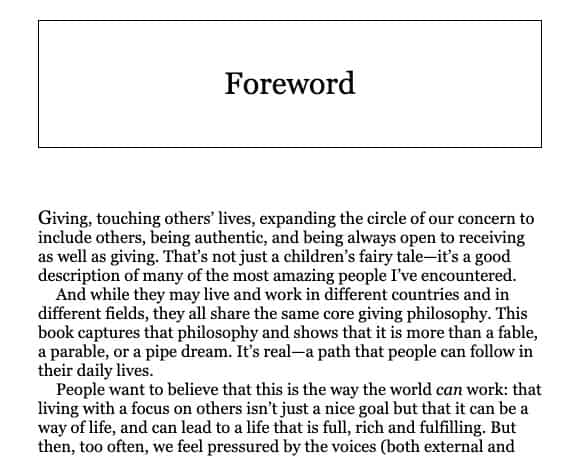
Above is an example of a foreword from The Go-Giver by Bob Burg.
The body: your content and story
The body is the main event: your introduction, chapters, and the structure that carries your story or message. It's what the reader came for.
7. Prologue (Optional)
A prologue is a short opening chapter that gives readers context before the main story begins.
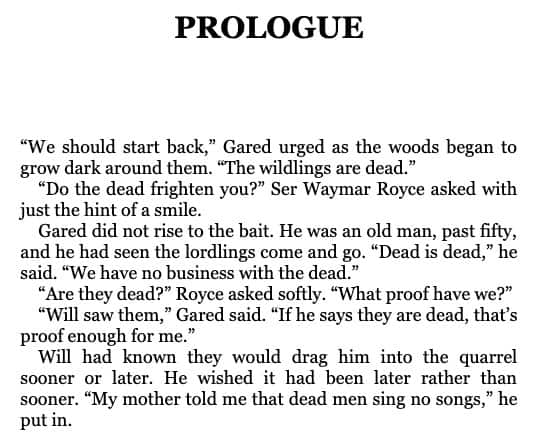
Prologues live in fiction. Sometimes a story needs a little setup before chapter one so the reader can make sense of what follows, and a good prologue can also build intrigue. That said, if you can tell your story without one, that's usually better. Plenty of readers skip prologues entirely.
Below is an example of a prologue from the very popular Game of Thrones by George R.R. Martin.
8. Epilogue (Optional)
An epilogue is a short closing chapter after the final chapter that ties the story together and hints at what comes next.
Not every story ends with everything wrapped up. When you want to show readers where the characters are headed after the main events, an epilogue answers the question "what happens to them next?" It's a satisfying way to give readers that final glimpse beyond the last chapter.
9. Epigraph (Optional)
An epigraph is a short quote, poem, or line placed at the start of a book or chapter to hint at its theme.
Epigraphs aren't required, but they're a nice touch. These short snippets signal the theme or focus of what's ahead, and they often connect your work to earlier writing that shares similar ideas.
For example, below is an epigraph from The 7 Habits of Highly Effective People by Stephen R. Covey.

10. Book introduction (Recommended for nonfiction)
A book introduction is an opening chapter in nonfiction where you introduce yourself, your credibility, and what the book will help the reader do.
Most nonfiction books open with an introduction before chapter one. It's where you show readers why they should keep reading and why you're the person to help them. The strongest approach is to name the problem your book solves, then make it clear how you can help. A little of your backstory works here, as long as it stays tied to the problem at hand. Readers don't need your whole life story.
11. Inciting incident (Fiction)
An inciting incident is the early event that launches your plot and sets your character on a path they can't return from.
This is the point of no return that kicks the story into gear.
A few familiar examples: Katniss volunteers in her sister's place in The Hunger Games; Bella moves to Forks and meets Edward in Twilight; Bran is pushed from the tower after catching Jaime and Cersei in Game of Thrones. Each one changes the character's life for good and drives everything that follows.
12. Sections of a book (Optional for nonfiction)
Sections are larger groupings of chapters in nonfiction, each with its own focus, that build toward one larger purpose.
Some nonfiction books split their chapters into a few larger parts. For example, a book might use three sections: the first on how your childhood shapes your adult behavior, the second on how to move past it and take control of your present, and the third on building the future you want.
Each section has its own theme, but together they solve one bigger problem.
13. Act structure (Optional for fiction)
Act structure organizes a novel into acts (most often three) that create a proven, satisfying order of events.
Where nonfiction uses sections, fiction often uses acts. The three-act structure is the most common. It isn't required, but it's popular because it gives readers a cohesive flow that reliably keeps them engaged.
A popular example of this 3 act structure is in Sabaa Tahir’s An Ember in the Ashes, featured below.

14. First slap (Fiction)
The first slap is the major setback that hits your character soon after the inciting incident, raising the stakes.
If you've spent time around our approach to writing a novel, you've heard us talk about the first and second slap. These are pivotal turns that push the plot forward and make your character's road harder. The first slap is the big setback that follows the inciting incident, like Katniss actually entering the games, or Bella realizing Edward is a vampire. They all make life harder for the character.
15. Second slap (Fiction)
The second slap is a later, often worse setback that lands right after your character has gained some hope.
Like the first slap, the second is a turning point where your protagonist takes a hit, usually after a win or two has the reader feeling hopeful. Place it just as readers start believing your character can pull it off. The second slap is often the worse of the two, knocking out most of that hope, which makes readers root even harder for your character.
16. Climax (Fiction)
The climax is the point of highest tension, where your character faces the biggest obstacle between them and their goal.
The climax is the last and hardest challenge before the resolution, the moment the odds are worse than at either slap. Think Harry Potter facing Voldemort. It's the peak the whole story has been building toward.
Not sure how to structure all this? Inside Fundamentals of Fiction and Become a Bestseller, our coaches walk you through every part of your book, from inciting incident to back-cover synopsis. Book a free call to see which program fits.
Back matter
Back matter is everything after your main text. It thanks the people who helped, builds your credibility, and sells the reader on what to read next.
17. Acknowledgements (Optional)
Acknowledgements are a thank-you section, usually at the back of the book, recognizing the people who helped you write it.
Like the dedication, acknowledgements recognize the people who supported you. Unlike the dedication, they come at the end and can run longer, in full paragraphs rather than a single line.
18. Author bio (Recommended)
An author bio is a short paragraph about you and your credibility, often placed on the back cover or final page.
Not every book includes one, especially fiction (outside of hardback editions). In nonfiction, the author bio often sits at the bottom of the back cover, beneath the synopsis. Keep it short and simple while still showing readers why you're credible on the subject.
19. Coming soon / read more (Optional))
A "coming soon" or "read more" page promotes your other books so readers can buy the next one easily.
This part only matters if you have a series or more than one book. Usually a single page after the epilogue and acknowledgements, it shows the covers, titles, and links to your other books. It makes buying the next one effortless, which sells more books overall.
20. Back cover / synopsis (Required)
The back cover, or synopsis, is the short summary on the back of your book that hooks readers and convinces them to buy.
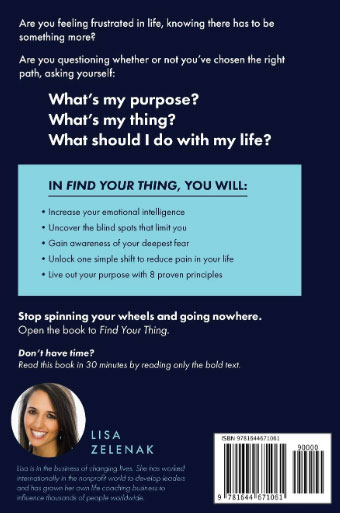
We saved the most important for last. The back-cover synopsis does more to sell your book than almost anything else, and it matters for both fiction and nonfiction.
For fiction, create intrigue and promise a great story in a few short paragraphs.
For nonfiction, make the value obvious.
Either way, keep it concise and convincing, and show the reader exactly what they'll get, whether that's an entertaining read or a solution to their problem.
Here’s an example of a fiction synopsis that works, from Fundamentals of Fiction author Leigh Robert’s Endings and Beginnings: Wrak-Ayya: The Age of Shadows Book 10.

Here’s a nonfiction example of the back cover from Lisa Zelenak’s Find Your Thing:
Ready to become a published author?
Knowing the parts of a book is step one. Putting them together into something readers love is where selfpublishing.com comes in, with coaching and a proven process that takes you from blank page to published author.
Book your free strategy call today to get started.
Parts of a Book FAQ
What are the major parts of a book?
The main book parts include the book cover, title page, copyright page, table of contents, dedication, foreword, prologue, epilogue, epigraph, book introduction, inciting incident, sections of the book, act structure, first slap, second slap, climax, acknowledgements, author bio, coming soon/read more, and the back cover or synopsis.
What is the general structure of a book?
A book generally starts with the front cover, followed by the title page, copyright page, and table of contents. Then it moves into the main content, which includes the introduction, chapters, and sometimes sections or acts. It wraps up with the acknowledgements, author bio, and the back cover or synopsis.
What is the layout of a book?
The layout of a book includes the cover, front matter (title page, copyright, table of contents), main content (introduction, chapters, sections), and back matter (acknowledgements, author bio, synopsis).
What is the table of contents of a book?
The table of contents lists the chapters or sections of a book along with their page numbers. It’s usually found at the beginning of the book and helps readers navigate to specific parts quickly.
What is the back of a book called?
The back of a book is typically referred to as the back cover or synopsis. It usually includes a summary of the book, an author bio, and sometimes reviews or endorsements.
What are the features of a book?
Features of a book include the cover, title page, copyright page, table of contents, dedication, foreword, prologue, introduction, chapters or sections, epilogue, acknowledgements, author bio, and back cover synopsis. These elements help structure the book and provide important information to the reader.