



















TL;DR: Squibler is an AI writing platform that generates outlines, chapters, and full manuscripts from a short prompt. It's free to try and paid plans run $16–$49/month billed annually. It drafts fast, but it holds a 2.3/5 Trustpilot rating, offers only a 7-day refund window, and stops at the draft, not a published book.
You've got the book in your head. You've had it there for a while. Then you find a tool that says it will write the whole thing in minutes, and the question stops being "can I do this?" and becomes "should I let software do this?"
That's a fair question, and most Squibler reviews dodge it. They list features, paste the pricing page, and collect an affiliate commission. This one won't.
We've spent 10 years helping authors publish their books. That gives us a specific vantage point on tools like Squibler: we see what happens after the draft exists. Here's an honest look at what Squibler does well, where it breaks, and what it can't do for you at any price.
What is Squibler?
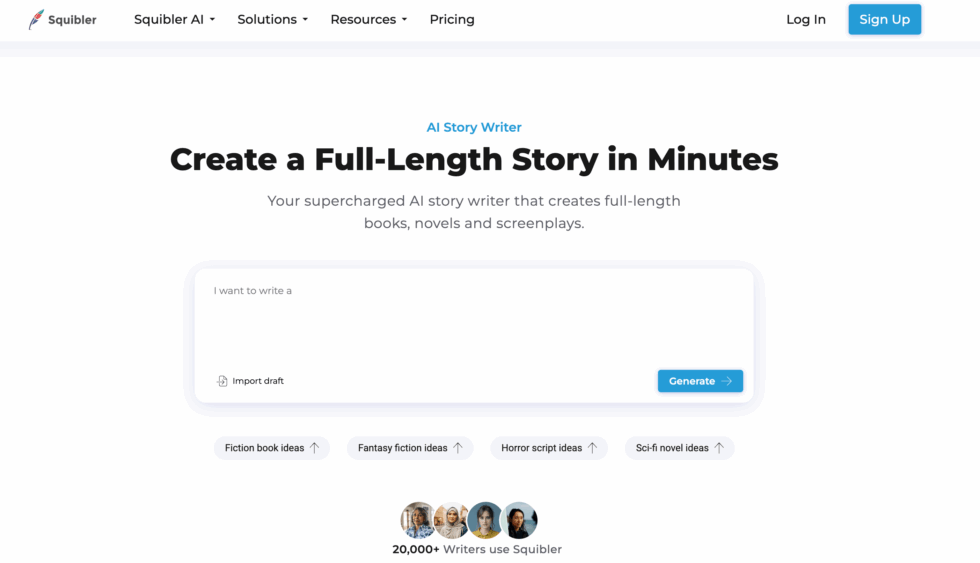
Squibler is a web-based AI writing platform that turns a short prompt into an outline, chapters, or a complete manuscript for books and screenplays.
You pick a project type (novel, nonfiction, short story, script, screenplay) answer a few setup questions, add a title and synopsis, and Squibler generates. For a full-length book, you can also specify roughly how many pages you want.
The company's AI app launched in November 2023, and it now sits alongside a corkboard planner, chapter organizer, template library, and text-to-image generation. Squibler's own site claims over 20,000 writers use the platform.
Worth correcting a claim you'll see repeated online: Squibler is often compared to Scrivener as though they're rivals. They aren't. Scrivener is an organizational writing environment with no AI features at all. Squibler generates prose. If you're comparing them, you're comparing a filing cabinet to a ghostwriter.
Squibler AI features: what it actually does
Squibler generates full manuscripts, expands scenes, rewrites passages, creates story images, tracks versions, and exports to PDF and DOCX.
The feature set is broader than most single-purpose AI writing tools. Here's what you get across the plans:
- Full manuscript generation — a chapter-organized draft from one brief, including 200–300 page books on paid tiers
- Smart Writer — scene expansion, rewrites, and tone or pacing adjustments inside the editor
- Conversational editing — ask the AI questions about your project and have it add chapters or sections
- Corkboard and chapter organization — drag-and-drop scene planning
- Text-to-image generation — story visuals and basic cover images
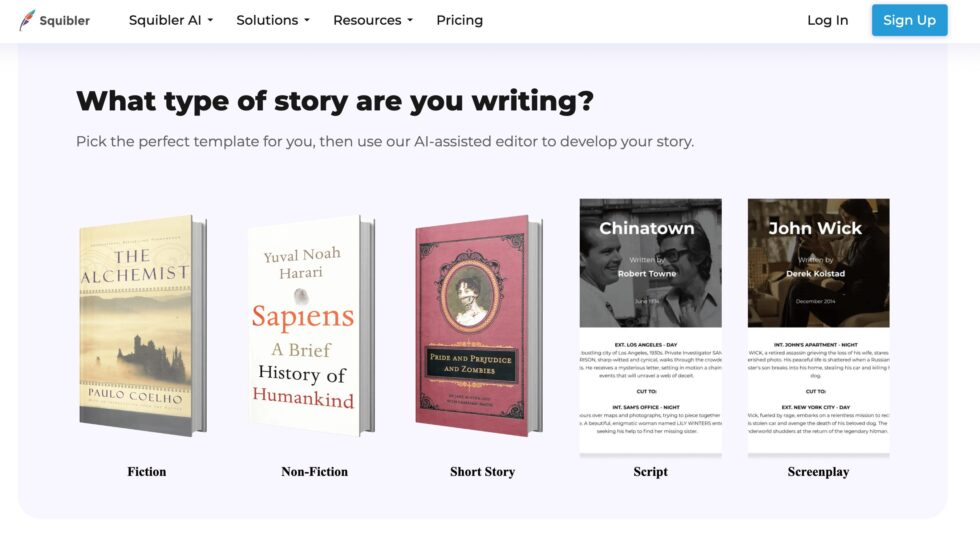
- Templates — fiction, nonfiction, short story, script, and screenplay starting points
- Export — PDF and DOCX, plus a free physical copy of your first book on paid plans
- Version history — automatic revision saving
On rights, Squibler is clear and reasonable: everything you create with Squibler is yours, and you're the author and owner of your work. That's a genuine point in its favor, and not every AI tool says it this plainly.
Is Squibler free?
Yes. Squibler has a permanent free tier with 1,000 AI credits per month, no time limit, and no expiry, but it won't produce a full book.
There's no time limit on the free tier. You can use it as long as you want without getting locked out of your work, you just don't get paid-plan capabilities. The free tier is enough to see how the generator handles your idea. It is not enough to draft a manuscript.
One caution worth knowing before you sign up: several users report the free allowance functioning as a near one-shot trial in practice. A September 2026 reviewer wrote that Squibler worked free once and then not again, with no new credits after creating a single free document. Treat the free tier as a test drive, not a workspace.
Squibler pricing in 2026
Squibler runs three tiers: Free, Plus at $16/month billed annually, and Pro at $49/month billed annually. Monthly billing costs roughly twice as much.
| Plan | Annual price | Monthly price | What you get |
|---|---|---|---|
| Free | $0 | $0 | 1,000 AI credits/month. Test full book and screenplay creation. |
| Plus | $16/mo ($192/yr) | $29.99/mo | 10,000 AI credits/month, full-length 200–300 page manuscripts, AI manuscript editing, PDF and DOCX export. |
| Pro | $49/mo ($588/yr) | $89.99/mo | Everything in Plus, unlimited AI credits, unlimited books. |
The credit math is the part people miss
Plus gives you 10,000 credits a month, which sounds generous until you see how fast generation consumes them. One paying customer reported their 10,000 credits running out after roughly four prompts. Your mileage will vary with project size — but budget for it, and don't assume Plus covers a whole book in one month.
Is Squibler legit?
Squibler is a real, operating company that delivers a working product. Its customer satisfaction record, however, is poor, at 2.3 out of 5 on Trustpilot.
Legitimacy and satisfaction are different questions. Squibler is legitimate: it's a registered US company, the software works, people finish books with it, and you keep the rights to what you make.
The satisfaction picture is harder. Squibler holds a 2.3 out of 5 "Poor" rating across 56 Trustpilot reviews, with 64% at one star and 20% at five stars, showing a sharply split distribution rather than a mediocre middle. To their credit, the company has replied to 60% of negative reviews, and the positive reviews are specific and credible: one customer praised the printed memoir Squibler produced for her mother, calling the hardcover vibrant and well made rather than cheap.
The pattern in the negative reviews is consistent enough to be worth naming.
5 pitfalls to check before you pay for Squibler
The recurring complaints cluster around billing, data loss, credit burn, performance, and the fact that Squibler stops at the draft.
1. The free trial converts automatically, and the refund window is 7 days
This is the single most common complaint. Users describe signing up for a trial, forgetting about it, and finding an annual charge of roughly $190 on the card. Squibler's public position is that subscriptions renew automatically unless canceled, monthly invoices go out by email, and refunds are available within 7 days of a renewal but not outside that window.
That policy is legal and disclosed. It is also unforgiving. Calendar your renewal date the day you subscribe.
2. A platform update cost some authors their manuscripts
This one is serious. After an April 13, 2026 platform update, one author reported losing roughly two-thirds of the chapters of their current manuscript across multiple projects, and was told after nearly two weeks that the content could not be recovered. A second author reported returning to a manuscript to find half of it missing, with chapters out of order, and being told the update had affected many writers.
In its current state, I do not feel confident trusting the platform with important writing projects, particularly where data integrity and version reliability are critical.— Trustpilot reviewer, April 2026
If you use Squibler for anything you care about, export to DOCX after every session.
3. Performance degrades on longer projects
A Pro subscriber reported that the platform works well for a few days and then becomes unusable, with prompts sitting on "loading" for hours. Squibler's engineering team responded publicly that they identified and fixed the issue. Writers complain about lag once documents get long. Your book is a long document.
4. The prose needs real work
As of 2026, Squibler speeds up drafting but often produces generic or drafty prose that needs author reworking. That's the honest tradeoff of every AI drafting tool, not a Squibler-specific flaw, but it matters for your timeline. A generated draft isn't 80% of a book. It's a starting point that still needs structure, voice, editing, and judgment applied to every page.
5. Squibler stops at the draft
This is the structural gap, and it's the one that costs authors the most. Squibler generates text and exports a file. It does not handle professional editing, cover design, print formatting, ISBN and metadata, category and keyword strategy, launch planning, or marketing.
Those aren't optional extras. They're the difference between a document on your hard drive and a book that sells.
The publishing rules nobody tells you about AI-generated books
Two rules apply the moment your AI draft becomes a real book: Amazon requires disclosure, and US copyright protects only your human contribution.
Amazon KDP requires you to disclose AI-generated content
Since September 2023, KDP requires you to inform Amazon of AI-generated content (text, images, or translations) when you publish a new book or edit and republish an existing one. The distinction that matters: content the AI produced is "AI-generated" even if you edited it afterward. Content you wrote and then polished with AI is "AI-assisted" and needs no disclosure.
The disclosure is internal to Amazon and isn't shown to readers. Failing to disclose is what creates risk, it's grounds for removal, and repeat cases escalate to the account level. Amazon has also capped how many new titles an account can create per day, explicitly to protect against abuse.
US copyright only covers what you actually wrote
This is the one that surprises people. The US Copyright Office requires human authorship for registration, and where a work contains more than a minimal amount of AI-generated material, you must disclose it and describe your own contribution. Only the human-authored elements are eligible for protection, and failing to disclaim AI-generated content can leave a registration vulnerable to cancellation.
This is settled, not speculative. In March 2026, the Supreme Court declined to review the human authorship requirement, leaving in place the rule that works created solely by AI aren't eligible for registration.
Practical translation: the more of your book Squibler writes, the less of your book you can protect.
Squibler vs the alternatives
Squibler competes on speed and a free tier. Sudowrite wins on prose quality, Novelcrafter on control, Scrivener on organization, and none of them publish your book.
| Tool | What it's actually for | 2026 price | Gets you to a published book? |
|---|---|---|---|
| Squibler | Generating a full draft fast from a short prompt | Free–$49.17/mo annual | No - draft only |
| Sudowrite | Sentence-level prose craft and creative collaboration | From ~$10/mo annual | No - draft only |
| Novelcrafter | Worldbuilding control, bring-your-own AI model keys | From ~$4/mo + API costs | No - draft only |
| Scrivener | Organizing complex manuscripts. No AI at all. | One-time license | No - organization only |
| selfpublishing.com | Writing, editing, design, publishing, and launch - with 1:1 coaching | Program-based | Yes - that's the deliverable |
This isn't a knock on the AI tools. They do a real job well. It's a category distinction: they're drafting software, and a published book is a production process. Confusing the two is why so many authors have a finished draft and no book.
Is Squibler good? Who it fits and who it doesn’t
Squibler is good for testing an idea quickly on the free tier. It's a poor fit for a book you're serious about selling.
Squibler is a reasonable choice if you…
- Want to see your idea take shape in a few minutes, purely to break the blank-page freeze
- Are writing for fun, for family, or for yourself, with no commercial stakes
- Will stay on the free tier, or will set a renewal reminder the day you subscribe
- Treat the output as raw material to rewrite in your own voice, not a finished draft
- Export to DOCX after every single session
Look elsewhere if you…
- Are writing a book to build authority, land speaking gigs, or grow a business
- Need the finished book to sound like you
- Want copyright protection over the substance of your book
- Need editing, cover design, formatting, and a launch, not just text
- Can't afford to lose the file
What a tool can’t give you
AI can produce words in minutes. It can't tell you whether the book is worth writing, who it's for, or how to sell it.
The authors we work with rarely get stuck because they can't produce words. They get stuck on the decisions: what this book is actually about, which reader it's for, what the core promise is, why anyone would finish it, and what happens on launch day.
That's where a coach beats a generator. Our authors get 1:1 coaching, a proven path from mindmap to launch, and a team that handles the production work like editing, cover design, formatting, Amazon upload, categories and keywords, and the launch campaign.
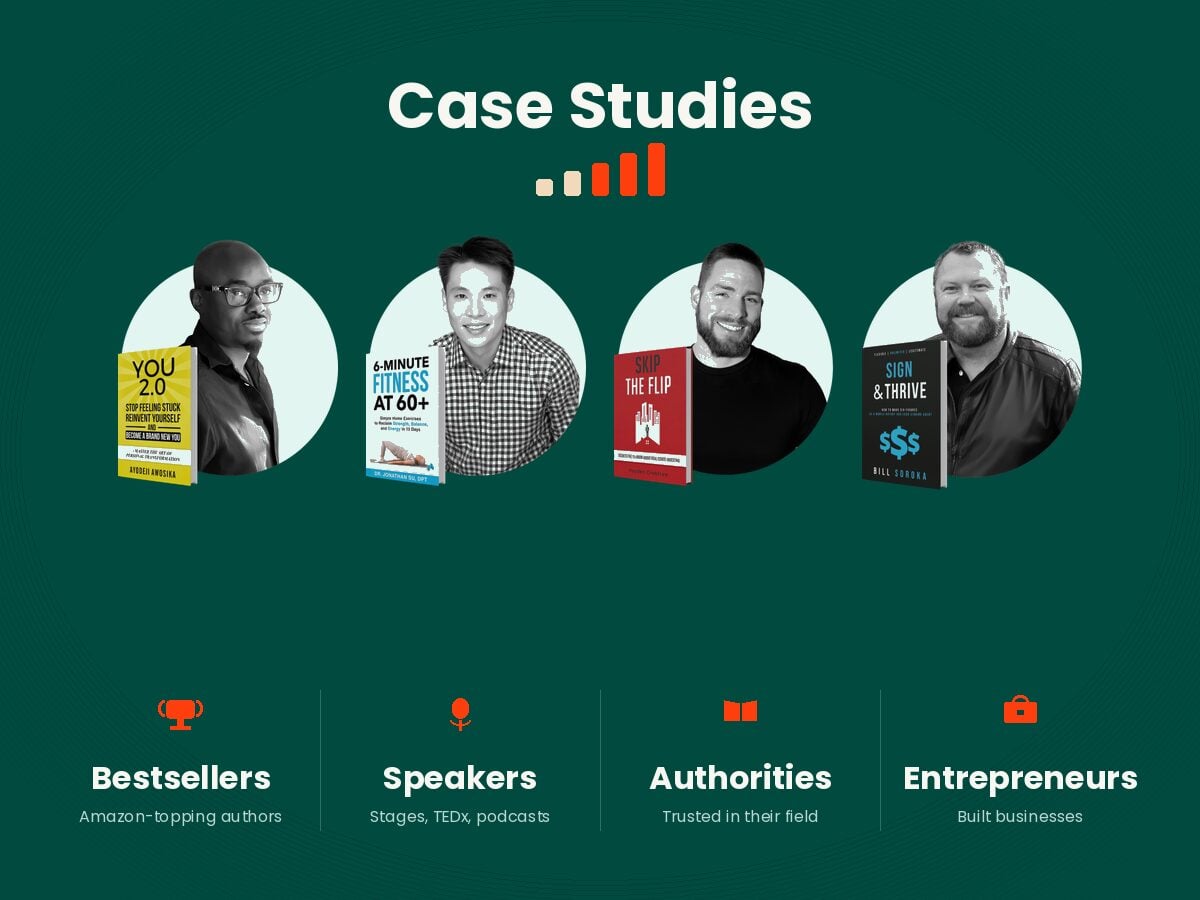
The results look different too. Mike Acker's Speak with No Fear sold more than 40,000 copies and led to a traditional deal with Wiley. Karen Campbell Wilkinson's book turned into 100+ speaking engagements and a coaching business. Those outcomes came from a process, not a prompt.
If you like the idea of outsourcing the writing
If what appeals to you about Squibler is not writing it yourself, professional ghostwriting gets you the same relief with none of the tradeoffs.
Be honest about what drew you to an AI book generator. For most people it isn't the technology, it's the relief of not facing 60,000 words alone.
That's a completely valid reason to look for help. It just doesn't have to mean a generated draft you'll spend months rewriting.
Our professional ghostwriting service works the way it sounds: 1:1 interviews to pull the book out of your head, book positioning, transcription, a ghostwritten manuscript in your voice, then editing, publishing, and done-for-you marketing. Your ideas, your story, your expertise, all captured by a professional writer instead of a prediction engine. AI-assisted and fully human options are both available.
The difference matters where it counts: the book still sounds like you, it's still fully yours to copyright, and you're not the one rewriting 300 pages of generated prose at midnight.
If you want to learn more, schedule a free strategy call today.
Frequently asked questions about Squibler
Is Squibler free?
Yes. Squibler's free tier gives you 1,000 AI credits per month with no time limit. It's enough to test the generator, not enough to draft a full book. Paid plans start at $16/month billed annually.
Is Squibler legit?
Yes, it's a real company with working software, and you retain full rights to what you create. Its customer satisfaction record is weak, though: 2.3 out of 5 on Trustpilot across 56 reviews, with billing and data-loss complaints the most common themes.
Can Squibler write an entire book?
Yes, on a paid plan Squibler can generate a full 200–300 page manuscript from a prompt in minutes. Whether that draft is publishable is a different question. Expect substantial rewriting to make it sound like you.
How much does Squibler cost?
Free tier at $0. Plus at $16/month billed annually or $29.99 monthly. Pro at $49/month billed annually or $89.99 monthly. Annual billing is roughly half the monthly rate, which is also why the auto-renewal complaints involve ~$190 charges.
How do I cancel Squibler?
Cancel in-app under Manage Plan, available from both the dashboard and the editor. Refunds are only available within 7 days of a renewal, so cancel well before your renewal date rather than on it.
Is Squibler better than Scrivener?
They do different jobs. Scrivener organizes manuscripts and has no AI features. Squibler generates prose. If you want AI drafting, Scrivener won't do it. If you want deep organization for a complex manuscript, Squibler isn't built for that.
Do I own what Squibler writes?
Squibler says everything you create is 100% yours. But US copyright registration only protects your human contribution. Purely AI-generated material isn't eligible, and the Supreme Court declined to revisit that rule in March 2026.
Do I have to tell Amazon I used AI?
Yes. KDP requires disclosure of AI-generated text, images, or translations when you publish or republish. The disclosure is internal and isn't shown to readers. Not disclosing is grounds for removal.


