
















Few business authors have had as much impact on modern leadership thinking as Jim Collins. For decades, his research-driven insights have shaped how entrepreneurs and nonprofit leaders think about building organizations that last. Jim Collins books are known for their timeless frameworks that offer practical guidance grounded in real-world evidence rather than trends or hype.
From understanding why some companies endure while others fail, to navigating uncertainty with discipline and focus, Jim Collins books provide a roadmap for sustainable business excellence.

Need A Nonfiction Book Outline?
Get customizable templates for easy book writing and structuring.
In this article, we’ll explore who Jim Collins is, review his major works in publication order, and summarize the core ideas behind each title. Whether you’re new to his work or revisiting the Jim Collins books that shaped your leadership journey, this guide will help you get the most from his ideas.
Who is Jim Collins?
Jim Collins is an American researcher and author best known for his work on leadership and long-term business performance. He began his career as a faculty member at the Stanford Graduate School of Business, where he received the Distinguished Teaching Award.
In 1995, Collins founded a management research laboratory in Boulder, Colorado, dedicated to studying what makes companies and institutions endure.
Collins is the author or co-author of several influential business books, including Built to Last, Good to Great, and Great by Choice, which collectively have sold millions of copies worldwide. His work is grounded in rigorous empirical research, often spanning multiple years and large data sets.
Beyond the corporate world, Collins has applied his ideas to nonprofits, education, healthcare, and the social sector. He also works as a consultant and advisor to leaders across business, government, and philanthropy.
Jim Collins books in order
Here are all the Jim Collins books in order of publication:
Beyond Entrepreneurship (1992)
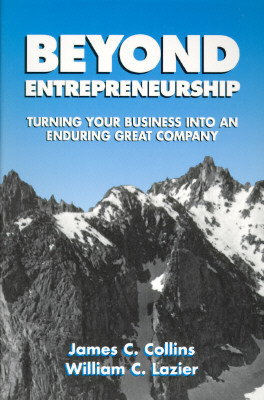
Beyond Entrepreneurship is the first of the Jim Collins books. It focuses on helping entrepreneurs move beyond startup survival toward building enduring, scalable companies.
Collins emphasizes disciplined leadership, clear vision, and strong organizational systems as the foundation for long-term success. Rather than celebrating charisma or rapid growth alone, the book stresses the importance of values and strategic thinking.
Key topics include aligning strategy with purpose, building effective management teams, setting measurable goals, and creating a culture of accountability.
Beyond Entrepreneurship is practical and instructional, aimed at founders and small-business leaders who want to transition from hands-on entrepreneurship to professional management without losing their company’s original spirit.
Built to Last (1994)
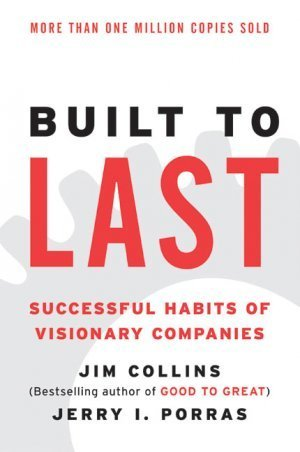
Based on a six-year research project, Built to Last examines why some companies endure for decades while others fade.
Collins studied “visionary companies” such as Disney, 3M, and Johnson & Johnson, comparing them to similar competitors. He concluded that enduring success comes from preserving core values while relentlessly stimulating progress.
Visionary companies prioritize purpose over profits, build strong cultures, promote leaders from within, and rely on systematic processes rather than individual genius.
The book introduces influential ideas like “core ideology,” “BHAGs” (Big Hairy Audacious Goals), and clock-building versus time-telling.
Its central message: greatness is designed intentionally, not created by chance or heroic leadership alone.
Good to Great (2001)

Good to Great is the most famous of the Jim Collins books. In this book, Collins explores why some companies make the leap from good performance to sustained greatness while others stagnate.
Based on five years of research, the book identifies a set of common principles among companies that outperformed the market for at least 15 years.
Key concepts include Level 5 Leadership (humble yet driven leaders), the Hedgehog Concept (focus on what you can be best at), the Flywheel effect (momentum through consistent effort), and a culture of discipline.
Collins argues that greatness is achieved through steady, cumulative actions rather than dramatic transformations. The book has become a foundational text in management thinking and remains one of the most influential business books ever written.
Good to Great and the Social Sectors (2005)
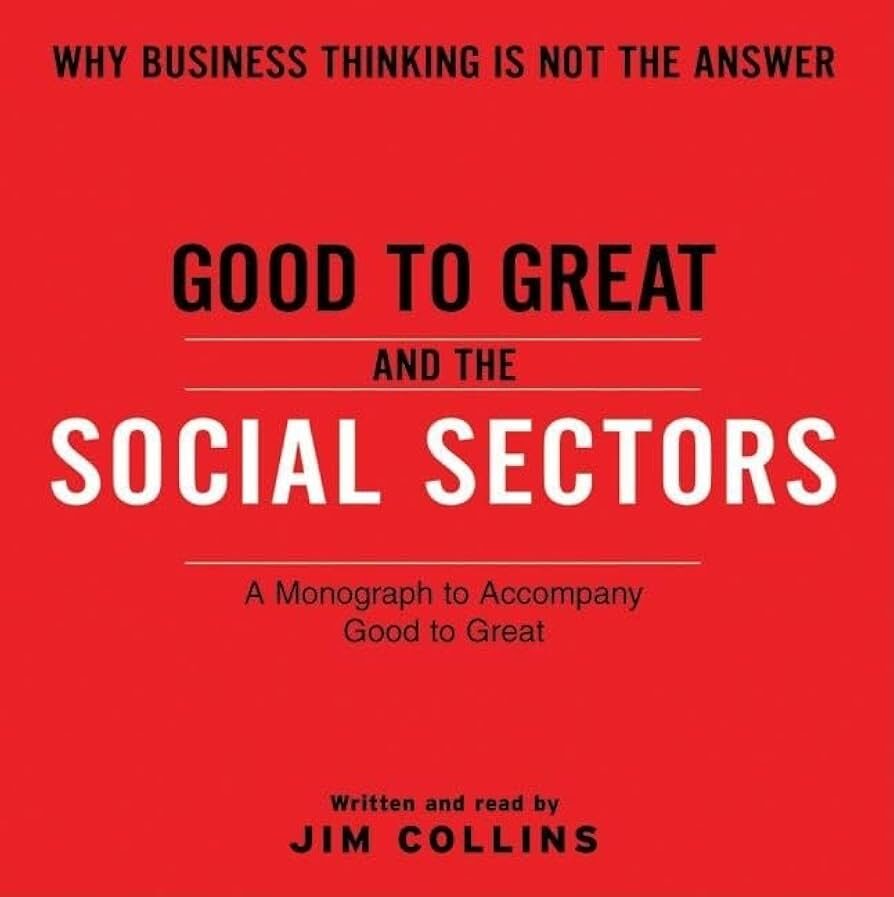
This short monograph adapts Good to Great principles for nonprofits, government agencies, and social enterprises. Collins argues that “greatness” in the social sector is not measured by financial returns but by mission effectiveness and impact. He reinterprets concepts such as the Hedgehog Concept, leadership, and discipline in contexts where profit is not the primary goal.
For example, leadership is often distributed, and success depends on aligning values, mission, and resources rather than market dominance. Collins emphasizes the importance of disciplined thought and accountability even without traditional market pressures.
The monograph clarifies common misunderstandings and shows how social-sector leaders can pursue excellence without mimicking for-profit business models.
How the Mighty Fall (2009)

This book examines how once-great companies decline and sometimes collapse.
Collins identifies five predictable stages of corporate downfall, beginning with hubris born of success and progressing through undisciplined growth, denial of risk, grasping for salvation, and finally capitulation.
Using case studies, Collins shows how arrogance and the abandonment of core principles can undermine even the strongest organizations. Importantly, the book argues that decline is largely self-inflicted and avoidable. Collins also emphasizes that recovery is possible at early stages if leaders recognize warning signs and return to disciplined thinking.
The book serves as both a cautionary tale and a diagnostic guide for leaders seeking to prevent or reverse organizational decline.
Great by Choice (2011)
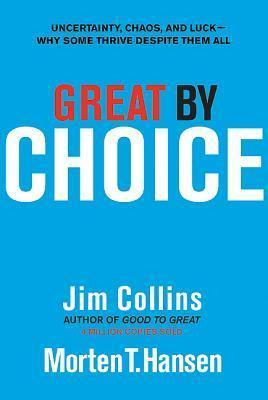
Great by Choice investigates why some companies thrive in chaotic, high-risk environments while others fail. Collins studied “10X companies” that outperformed their industries by at least ten times over long periods.
Contrary to popular belief, these companies were not more innovative or risk-seeking; instead, they were disciplined, empirical, and consistent.
Key ideas include the “20 Mile March” (steady progress regardless of conditions), firing bullets before cannonballs (testing before committing big resources), and building buffers against uncertainty.
The book argues that success in turbulence comes from fanatic discipline and creativity within constraints.
Turning the Flywheel (2019)

This monograph deepens one of Good to Great’s most famous concepts: the Flywheel. Collins explains how sustained success comes from reinforcing a system of interdependent activities that build momentum over time.
Rather than seeking quick wins or dramatic transformations, leaders should focus on consistent execution, learning, and alignment.
The book includes examples from companies like Amazon, Intel, and Vanguard, illustrating how flywheels differ by organization but follow the same underlying logic.
Collins also contrasts flywheels with “doom loops,” where organizations react impulsively to problems. The monograph serves as a practical guide for leaders seeking to diagnose, design, and accelerate their own organizational flywheels.
BE 2.0 – Beyond Entrepreneurship 2.0 (2020)
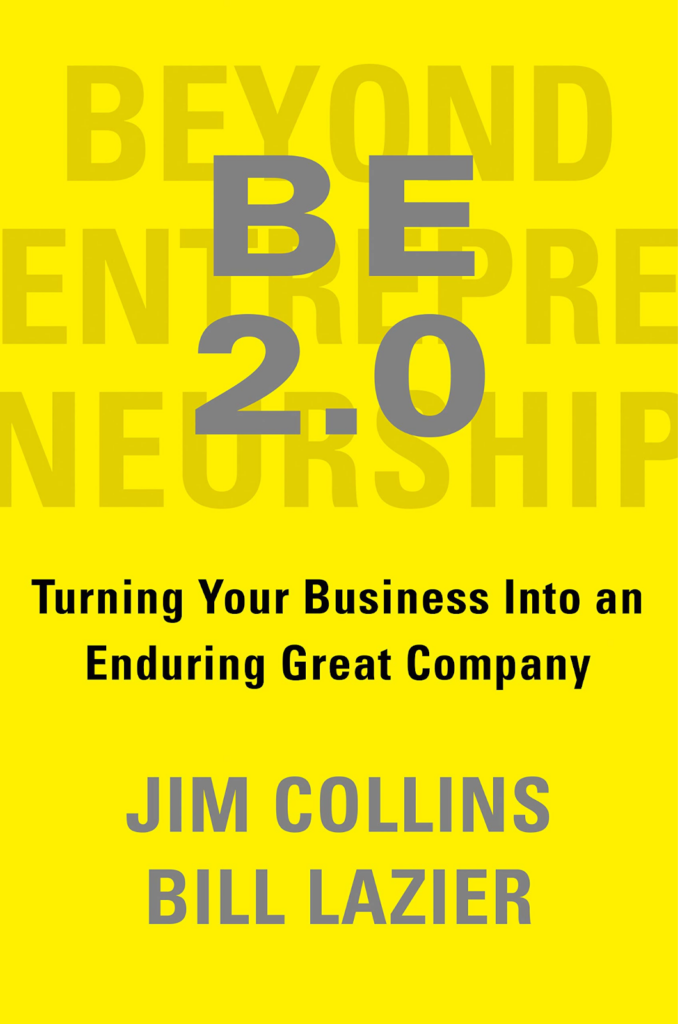
This updated and expanded version of Beyond Entrepreneurship reflects nearly three decades of additional research and leadership insights. While retaining the original book’s focus on building enduring companies, BE 2.0 integrates ideas from Good to Great, Built to Last, and later works.
The book emphasizes value-driven leadership and long-term thinking in an increasingly complex world.
New sections address scaling culture, leading through uncertainty, and balancing performance with purpose.
Aimed at entrepreneurs, CEOs, and leadership teams, BE 2.0 serves as both a practical manual and a philosophical guide for building organizations that last.
Write your own best selling business book
The lasting influence of the Jim Collins books comes from their rare combination of rigorous research and practical application.
Whether you’re leading a startup, scaling a mature company, or building a mission-driven organization, Collins’ ideas continue to offer clear frameworks for disciplined leadership and long-term success. His work reminds us that greatness is not the result of bold luck or flashy moves, but of consistent, intentional effort over time.
At selfpublishing.com, we regularly work with entrepreneurs, executives, and thought leaders who have been inspired by the Jim Collins books to share their own hard-earned insights. If you have a business book idea, we can help you turn that idea into a professionally published book.
From strategy and writing support to editing, design, and distribution, our team is here to help you publish with confidence and authority.