



















TL;DR: A political thriller is a suspense novel where the threat comes from institutional power: governments, intelligence agencies, courts, parties, or the people who control them. The genre splits into 6 recognizable subgenres, and the books that last share one trait. The protagonist can't win by being stronger, only by being right about how the system works.
Political thrillers do something no other genre manages. They take an institution most readers find boring on the news, a committee vote, a procurement contract, a leaked memo, and turn it into the most dangerous object in the book.
That's also why the genre is hard to write. Get the balance wrong and you've produced either a civics lecture with a gun in it, or a generic action novel where the political setting is wallpaper.
This guide covers the whole genre: what defines it, how it splits into subgenres, the political thriller books worth studying, and a 7-step framework for writing one that sells.
What is a political thriller?
A political thriller is a suspense novel in which the central threat comes from institutional power: government, intelligence, law, or the people who control them.
That's the working definition, but the useful test is narrower. Ask one question of your premise:
If you removed the political institution, would the plot still function?
If yes, you've written a thriller with a political backdrop. If the answer is no, because the institution is what creates the danger, protects the villain, or blocks the obvious solution, you've written a political thriller.
Three things follow from that test:
- The antagonist is usually protected. Not by muscle, but by office, immunity, classification, or procedure. The protagonist can see the crime and still be unable to touch it.
- The stakes scale past the protagonist. An individual is in danger, but so is a policy, an election, a treaty, or a population.
- Information is the weapon. Political thrillers turn on who knows what, who can prove it, and who will be believed. That's a very different engine from a chase or a fistfight.
The political thriller genre took its modern shape in the mid-20th century, when the Cold War handed authors a permanent supply of institutional paranoia. It has never really gone away, because the underlying anxiety, that the people with power might not be accountable to anyone, doesn't expire.
Political thriller vs. spy, legal, and techno-thriller
All 4 genres involve institutions. What separates them is where the danger originates and what skill the protagonist uses to survive it.
These categories overlap constantly, and plenty of famous political thrillers sit in 2 of them at once. But knowing which one you're anchored in tells you what your reader expects.
| Genre | Source of danger | Protagonist's main skill | Reader promise |
|---|---|---|---|
| Political thriller | Institutional power and its abuse | Judgment, evidence, nerve | The system will be exposed |
| Spy thriller | A hostile foreign service | Tradecraft and deception | The operation will succeed or collapse |
| Legal thriller | The courts and what they'll allow | Argument and procedure | The case will be won or lost |
| Techno-thriller | A capability or weapon system | Technical mastery | The machine will be understood in time |
| Political drama | Ambition and rivalry | Persuasion | Someone will win power |
The last row matters most. Political drama and political thriller are not the same genre. Drama promises a power struggle. Thriller promises jeopardy, and jeopardy means a clock and a cost. If nobody can die, lose their freedom, or be destroyed, you're writing drama. For more on where thriller ends and its neighbors begin, see our breakdown of the difference between horror and thriller.
The 6 subgenres of the political thriller genre
Political thrillers sort into 6 subgenres by the institution at the center: the executive, the conspiracy, the agency, the court, the military, and the press.
Pick one deliberately. Readers shop by subgenre even when they can't name it, and your categories, cover, and comp titles all flow from this choice.
1. The corridors-of-power thriller
Institution: the executive or legislature · Scale: national
Set inside the White House, Westminster, a parliament, or a campaign. The danger comes from someone who already holds legitimate office and is using it illegitimately. Pacing tends to be tight and dialogue-heavy, because the weapons are votes, appointments, and leaks.
2. The conspiracy thriller
Institution: a hidden network · Scale: escalating
An ordinary person pulls one thread and the whole garment moves. The structure is almost always discovery-driven: each answer reveals a bigger question, and the protagonist's circle of trustworthy people shrinks chapter by chapter. The hardest subgenre to land, because the reveal has to be both surprising and smaller than the reader feared.
3. The espionage-political thriller
Institution: the intelligence service · Scale: international
Where political thriller and spy thriller genuinely merge. The tension isn't only agent against enemy, it's agent against their own service, which has political objectives the agent may not share. Betrayal from above is the defining move.
4. The legal and courtroom political thriller
Institution: the judiciary · Scale: national
A case with constitutional or governmental consequences. The protagonist is usually a lawyer, clerk, or investigator who becomes a target because of what a file proves. Procedure is the pleasure here, so the research bar is high.
5. The geopolitical and military-political thriller
Institution: the state and its armed forces · Scale: global
Multiple viewpoint characters across several countries, a crisis escalating toward conflict, and a clock measured in hours. The subgenre with the highest word counts and the most moving parts. Strong story arc discipline is non-negotiable or the threads come apart.
6. The journalism and whistleblower thriller
Institution: the press against the state · Scale: variable
The protagonist has proof and no power. The entire plot is the struggle to publish, survive, and be believed. Currently the most contemporary-feeling of the 6, because it maps onto live anxieties about platforms, sources, and misinformation.
Not sure your premise is a thriller yet?
The fastest way to find out is to outline it. Our free book outline template walks you through premise, stakes, and structure before you commit 90,000 words to a plot that doesn't have a clock in it. Get the book outline guide
15 best political thriller books (and what each one teaches authors)
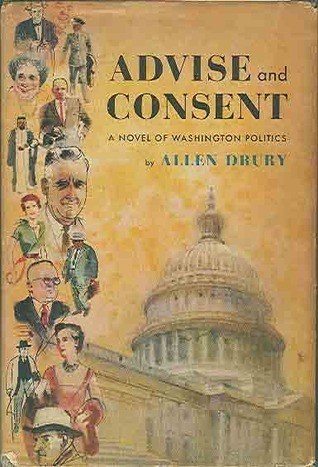
These 15 political thriller novels cover every subgenre above, from the Cold War foundations to contemporary agency fiction, and each one demonstrates a specific craft move.
If you're reading for pleasure, any of these will deliver. If you're reading to write, read the right-hand column first and pick the 3 that match your weakness.
| # | Book | Author & year | Subgenre | What it teaches |
|---|---|---|---|---|
| 1 | Advise and Consent | Allen Drury, 1959 | Corridors of power | How procedure itself becomes suspense. Won the Pulitzer Prize for Fiction in 1960. |
| 2 | The Manchurian Candidate | Richard Condon, 1959 | Conspiracy | A premise so strong the title entered the language. Concept does heavy lifting. |
| 3 | Seven Days in May | Knebel & Bailey, 1962 | Military-political | Compressed timeline. The title is the clock. |
| 4 | The Spy Who Came in from the Cold | John le Carré, 1963 | Espionage-political | Moral flatness between sides. Nobody is clean, and that's the point. |
| 5 | The Day of the Jackal | Frederick Forsyth, 1971 | Corridors of power | Suspense without uncertainty. You know the target survives; you still can't stop reading. |
| 6 | The Bourne Identity | Robert Ludlum, 1980 | Conspiracy | Amnesia as an engine for reader-and-protagonist discovery in lockstep. |
| 7 | The Hunt for Red October | Tom Clancy, 1984 | Geopolitical | Multi-POV crisis management across nations without losing the reader. |
| 8 | House of Cards | Michael Dobbs, 1989 | Corridors of power | An antagonist as protagonist. Ambition rendered from the inside. |
| 9 | Fatherland | Robert Harris, 1992 | Conspiracy | Alternate history as political thriller. The world is the reveal. |
| 10 | The Pelican Brief | John Grisham, 1992 | Legal-political | An outsider protagonist with proof and no protection. |
| 11 | Absolute Power | David Baldacci, 1996 | Corridors of power | The opening-chapter crime that makes the rest of the book inevitable. |
| 12 | Primary Colors | Joe Klein (published anonymously), 1996 | Campaign | Insider texture. The authenticity became the marketing story. |
| 13 | The Constant Gardener | John le Carré, 2001 | Whistleblower | Corporate and state power fused. Grief as investigative motive. |
| 14 | Need to Know | Karen Cleveland, 2018 | Espionage-political | Domestic scale. The institution invades a marriage. |
| 15 | Damascus Station | David McCloskey, 2021 | Espionage-political | Contemporary tradecraft written by a former practitioner. Detail as credibility. |
What the list tells you about political thriller authors
Look at who's on it. The most durable political thriller authors fall into 2 camps, and it's worth knowing which one you're in.
- The insiders. Le Carré worked in British intelligence. Cleveland was a CIA analyst. McCloskey was a CIA analyst. Klein covered campaigns as a journalist. Their advantage is texture nobody can fake, and their marketing hook writes itself.
- The researchers. Forsyth, Harris, and Grisham built authority through reporting and legal training rather than direct access. Their advantage is range, because they aren't confined to one institution.
If you're an insider, lead with it in your author bio and your book description. If you're a researcher, your credibility has to come from the page, which raises the bar on the research plan below.
How to write a political thriller in 7 steps
Start with an abuse of power, set the scale, protect your antagonist with the system, and build a clock the institution itself creates.
1. Start with the abuse, not the politics
Your premise is not "a novel about immigration policy." It's "a mid-level official discovers the deportation numbers are being falsified, and the person falsifying them signs her performance review."
Abuse of power is concrete. Policy is abstract. Readers commit to the first.
2. Set your scale before you outline
Political thrillers work at 3 scales, and mixing them without deciding is the most common structural failure in the genre.
- Personal. One family, one career, one secret. Tightest pacing, smallest cast.
- Institutional. One agency, department, or court. Room for procedure and ensemble.
- Geopolitical. Multiple states. Highest word count, most viewpoint characters.
Pick one as your home scale. You can escalate into a larger one, but the book should start where the reader can hold it.
3. Give your antagonist institutional armor
This is the move that separates the genre from generic suspense. Your villain should be difficult to stop for structural reasons, not just because they're dangerous.
Ask: what protects them? Immunity, classification, a friendly oversight committee, a statute of limitations, the fact that nobody would believe the accusation. That armor is your plot. Removing it, piece by piece, is your structure.
4. Build the clock out of the institution
Weak political thrillers bolt on a bomb. Strong ones use deadlines the institution already generates: a confirmation vote, an election, a treaty signing, a sealed indictment that unseals on a date, a summit, a budget deadline, a extradition window.
An institutional clock does 2 things at once. It creates urgency, and it reinforces that the system is the story.
5. Keep the protagonist outmatched
The reader needs to believe the protagonist could lose. In this genre, that means they're outgunned on resources, access, and credibility, and they win on judgment instead.
A protagonist who has the full backing of a competent agency isn't in a political thriller. They're in a procedural.
6. Control the information release
Because information is the weapon, your revision job is mapping who knows what, when. Build a simple grid: characters down the side, chapters across the top, and mark what each one knows at each point.
Most sagging middles in this genre are information problems, not pacing problems. The reader learned too much too early. Our guide to pacing in writing covers the scene-level fixes once you've sorted the information order.
7. Decide your ending's politics before you draft
Political thrillers resolve in 1 of 3 ways, and each sends a different message:
- The system works. Exposure leads to accountability. Satisfying, increasingly hard to make believable.
- The system survives. The individual villain falls; the machinery continues. The le Carré ending.
- The system wins. The truth comes out and nothing changes. Powerful, and a commercial risk with some readerships.
Choose deliberately. An ending that contradicts the tone of the preceding 300 pages is the most common 3-star review in this genre.
Political thriller character archetypes that still work
The genre runs on 6 recurring roles. Each works when it's specific and fails in a predictable way when it isn't.
| Archetype | Story function | The trap |
|---|---|---|
| The reluctant insider | Provides access the reader couldn't otherwise have | Too competent, so nothing threatens them |
| The protected antagonist | Creates the structural obstacle | Evil for its own sake instead of incentivized |
| The fixer or operator | Executes what principals can't be seen doing | Becomes a plot device with no interiority |
| The journalist or investigator | Assembles and legitimizes the evidence | Serves as the author's mouthpiece |
| The compromised ally | Supplies the betrayal at the midpoint | Telegraphed from their first scene |
| The collateral civilian | Makes abstract stakes physical | Exists only to be harmed |
One rule fixes most of these traps: give every character an incentive that makes sense from inside their own position. A bureaucrat protecting a pension is more believable, and more chilling, than a bureaucrat who enjoys cruelty. Work through motive properly with our character bio template, and see types of characters for how these roles fit the wider cast.
Worth noting: the unreliable narrator is unusually at home in this genre, because political thrillers are already about contested truth.
How real should your politics be?
You have 3 options: real world with real figures, real world with invented figures, or a wholly fictional state. Each trades authenticity against risk and shelf life.
| Approach | Authenticity | Shelf life | Main risk |
|---|---|---|---|
| Real country, real named figures | Highest | Shortest | Legal exposure and rapid dating |
| Real country, invented administration | High | Long | Reader confusion if inconsistent |
| Invented country or near-future state | Moderate | Longest | Reader has to learn your world |
For most authors, the middle option is the right default. You keep real institutions, real procedure, and a recognizable map, and you invent the people who fill the offices. That's the approach behind a large share of the books in the list above.
A note on real people
Writing identifiable living figures into fiction carries real legal considerations around defamation and right of publicity, and those rules vary by country. We're not lawyers, and this isn't legal advice. If your manuscript names or closely resembles a living public figure in an unflattering context, have a publishing attorney read it before you publish.
Avoiding the partisanship trap
Your novel will have a point of view. That's fine, and the genre has always carried politics. The commercial question is different: does a reader who disagrees with you still get a good book?
The test is whether your opposition characters are written with the same care as your protagonists. If every character on one side is stupid or venal, you've narrowed your market to people who already agree with you, and you've also written a less interesting book, because nobody is genuinely opposed to anyone.
The research plan for political thriller authors
Research 5 layers: structure, procedure, texture, language, and the specific case your plot turns on. Then cut 90% of it from the page.
- Structure. How the institution is actually organized. Who reports to whom, who can fire whom, where the real veto sits.
- Procedure. The steps something takes: how a bill moves, how a warrant is obtained, how a classified document is handled.
- Texture. The mundane detail. Badge protocols, what the cafeteria is like, how long the drive from the building to the airport takes.
- Language. How insiders actually talk, including acronyms and the words they'd never use.
- The specific case. One or two real precedents close to your plot, read in depth rather than summary.
Primary sources beat secondary ones: published hearing transcripts, inspector general reports, agency handbooks, memoirs by mid-level staff rather than principals. The mid-level memoir is the underrated one, because principals write about decisions and staff write about how the building works.
The iceberg rule
Research 100%, show 10%. The 90% you cut is what makes the 10% feel effortless. If a passage exists to prove you did the reading, it's an info-dump. Convert it into a decision a character makes, a constraint they hit, or a piece of dialogue that assumes the reader already understands.
6 mistakes that sink political thrillers
Most failed political thrillers share the same 6 problems: no jeopardy, a thesis in a costume, info-dumping, an unmotivated villain, dated detail, and a mismatched ending.
- Politics without jeopardy. Rivalry isn't danger. If the worst outcome is that someone loses an election, add a cost the reader feels in the body.
- The author's thesis in a character costume. When a character delivers 3 paragraphs that could be lifted into an op-ed, readers disengage. Argument belongs in conflict between characters, not in a speech.
- Info-dumping the procedure. See the iceberg rule above. This is the single most common note on political thriller manuscripts.
- A villain with no incentive. "He wants power" is not a motive. What does power get him that he can't get otherwise, and what is he afraid of losing?
- Detail that dates before publication. Specific current officeholders, platforms, and news cycles age fast. Institutions age slowly. Write the institution.
- An ending that resolves the plot but not the system. Readers of this genre want to know what the exposure changed. Arresting the villain on the last page without addressing the machinery feels unfinished.
Publishing and positioning your political thriller
Political thrillers sell on category precision, comp titles, and a cover that signals institutional menace rather than generic action.
Length
Political thrillers run longer than average commercial thrillers because of cast size and procedural detail, with geopolitical entries at the top of the range. Check current genre expectations in our guide to how many words are in a novel, and plan chapter count alongside it using how many chapters are in a novel.
Categories and keywords
Don't stop at "Thriller." The subgenre categories are where discoverability lives, and they're far less crowded. Our data on the most popular book genres on Amazon shows how to pick categories you can actually rank in rather than the largest one available.
Comp titles
Choose 2 comps from the list above and 1 from the last 3 years. The recent one proves there's a live market; the classics position your tone. Avoid comping the biggest name in the genre, which reads as a claim rather than a comparison.
Description and cover
Your book description has to establish the institution, the abuse, and the clock inside the first 2 lines. Work through it with our guide to writing a book back cover that sells. On cover design, the genre's visual language leans on architecture, seals, flags, silhouettes, and desaturated palettes, not explosions.
Political thriller FAQ
What defines a political thriller?
The threat comes from institutional power rather than an individual criminal. Remove the government, agency, or court from the plot and the story stops working. That dependency is what separates a political thriller from a thriller with a political setting.
What is the best political thriller book?
There's no single answer, but the most frequently cited are John le Carré's The Spy Who Came in from the Cold for moral complexity, Frederick Forsyth's The Day of the Jackal for pure suspense mechanics, and Allen Drury's Advise and Consent, which won the 1960 Pulitzer Prize for Fiction. Start with whichever subgenre you want to write.
What's the difference between a political thriller and a spy thriller?
A spy thriller centers on tradecraft against a foreign adversary. A political thriller centers on the abuse of power, often by the protagonist's own institution. Many novels are both, and the espionage-political subgenre exists precisely at that overlap.
How long should a political thriller be?
Longer than the average commercial thriller, because the genre carries a larger cast and more procedural detail. Geopolitical entries with multiple viewpoint characters sit at the top of the range. Check current genre benchmarks before you set a target.
Can you write a political thriller about a real president or prime minister?
Authors do, but naming identifiable living figures raises defamation and right-of-publicity questions that vary by country. The lower-risk approach used by most working authors is a real country with an invented administration. Get legal advice before publishing anything that closely resembles a living public figure.
Are political thrillers still a good genre to write in?
Yes, with one caveat. Reader appetite for institutional suspense is durable, but topical detail dates quickly. Books anchored in how institutions work outlast books anchored in a specific news cycle.
Do I need political experience to write political thrillers?
No. Political thriller authors split roughly into insiders with direct access and researchers who built authority through reporting. Forsyth, Harris, and Grisham came from the second camp. What you need is a research plan and the discipline to keep 90% of it off the page.
Your next step
Write down your premise in one sentence, then apply the removal test: take the institution out and see whether the plot survives. If it does, you have a thriller that needs a political engine installed. If it collapses, you're already in the genre and your next job is the outline.
Either way, structure comes before research. Authors who research first tend to produce 200 pages of accurate, unsuspenseful fiction.
Need help plotting your novel? At selfpublishing.com we offer one-on-one coaching through every step of the writing, editing, marketing, and self-publishing process. Reach out today to schedule a free consult call.