














TL;DR
Becoming a New York Times bestseller means selling 5,000 to 10,000 copies in a single week, from diverse retailers across the country, not just Amazon. It's a specific, editorially curated status, not a raw sales count. This guide breaks down the exact requirements, walks through 4 real author case studies, and gives you 13 proven steps other bestselling authors have used to get there.
You've written the book. Now you want the title: New York Times bestseller.
It's the most recognized credential in publishing, and one of the most misunderstood. Most authors assume selling a lot of copies is enough. It isn't. The Times uses its own methodology, on its own timeline, and plenty of books that hit big sales numbers never make the list at all.
What does it take to become a New York Times bestseller? This guide breaks down the real criteria, walks through 4 authors who've actually done it, and lays out the 13 proven steps their launches had in common so you can learn how to become a New York Times bestseller.
Get Your Free eBook of Published.
The proven path from blank page to 10,000 copies sold - written by 7-time bestselling author, Chandler Bolt
How to become a New York Times bestseller: the big picture
Becoming a New York Times bestseller takes 5,000 to 10,000 copies sold in one week from diverse retailers nationwide, stacked on top of an existing author platform, a pre-order list, and a launch plan built months in advance.
Here's the overview before we get into individual steps.
1. Know what the NYT list wants
A Stanford Business School analysis found that most book buyers treat the Times list as a signal of what's worth reading. That's exactly why the list carries so much weight, and why it pays to understand it before you build a launch around it.
Start with your category (fiction or nonfiction) and your genre (history, political, fantasy, science fiction). Then learn who the major New York publishing houses are, since the Times list still skews toward books from the Big 5 and their imprints, along with the agents who represent them.
2. Build a strong author platform
First-time and lesser-known authors especially need a pre-existing audience before attempting bestseller status. 3 things build that platform fastest:
- Be active on social media. Your future readers, collaborators, and industry contacts are already there. Find them and engage.
- Build credibility in your niche before the book exists. A weekly blog is good practice: it sharpens your writing style, builds your voice, and establishes trust with readers before you ever ask them to buy anything.
- Collaborate with others in your space. Once you've built some credibility, reach out to bigger names in your field. Done well, it benefits you, them, and the audience you both share.
Engagement is the real signal here. Pay attention to what your audience actually asks for, what they've said about your posts, videos, and early ideas, and whether they're telling you they'd buy the book.
3. Have a pre-order list before your launch
Every book benefits from a pre-order list, but for a potential NYT bestseller it's a sales-math necessity. Book marketing consultant Rob Eager notes that pre-orders count toward the Times' first official sales week. So 5,000 pre-orders plus 5,000 first-week sales equals the 10,000 that can put you in bestseller range. A built-in audience makes the pre-order list dramatically easier to fill.
4. Get fast, diverse sales
Digital self-publishing made "bestseller" achievable through Amazon alone. The Times list doesn't work that way. To hit NYT bestseller status, you need 5,000 to 10,000 copies sold in one week, and those sales have to come from different retailers in different parts of the country, not one website or one chain.
The Times doesn't publish which retailers it tracks, partly to prevent gaming the system. And because Amazon accounts for roughly 64% of book purchases, Amazon sales alone will not get you on the list.
5. Trade speaking fees for bulk book purchases
Speaking engagements double as both confidence-building and marketing opportunities. Exchanging your speaking fee for a bulk book purchase is especially valuable during the pre-order phase, since it both grows your reach and satisfies the Times' requirement for geographically diverse sales.
New York Times bestseller criteria: what makes a book a #1 bestseller?
The core New York Times bestseller criteria is selling 5,000 to 10,000 copies of a book in a single tracked week. For a well-known name with an existing audience, that bar can feel reachable. For everyone else, it can feel out of reach, which is exactly why case studies of real authors who've done it matter more than raw formulas.
Most authors trying to hit this on their own get the writing right and the launch math wrong. If you want a second set of eyes on your launch plan before you spend a dollar on marketing, book a free strategy call.
How to become a New York Times bestseller: 4 case studies and 13 steps
There's no guarantee attached to any of this, but studying authors who've actually hit the list tells you more than any theory does. What did their launch prep look like? What did they prioritize in marketing? Below are 4 case studies, starting with Lewis Howes' 13-step framework.
Case study #1: Lewis Howes
13-step framework
29 podcast appearances
500-person street team
Lewis Howes released The School of Greatness in 2015, then went all-in promoting a later title. To understand the marketing side, he interviewed 20 NYT bestsellers and distilled their answers into 13 steps.
1. Bulk book orders
Instead of a flat speaking fee, Lewis asked hosts to order the value of his fee in books. That drove sales and gave every attendee a complimentary copy.
2. Podcast tour
Lewis booked 29 guest podcast appearances, some with friends, most cold outreach. Amy Porterfield used the same tactic to launch Two Weeks Notice, as have many bestsellers who've since appeared on the Self-Publishing School podcast.
3. Street team
A street team (or launch team) is a group of early readers who read the book first and promote it through reviews and social posts. Lewis had over 1,000 applicants and selected the top 500.
4. Bonus offerings landing page
Lewis built a landing page offering bonuses (a free video, extra chapters, a private community invite) to readers who bought more than one copy, pushing his per-buyer unit count up.
5. Press
He started booking press 10 months before release and landed 10 TV interviews. One well-placed influencer or thought leader mentioning a book can single-handedly revive its sales.
6. Guest posts
With his team's help, Lewis placed content on 35 publication platforms, spanning news sites, blogs, and niche websites, reviewing every piece before it went out.
7. Affiliate promotion
Lewis credits his network promoting the book to their own audiences, for free, as one of his biggest levers. He also ran a formal affiliate deal and taught a class through CreativeLive.
8. Book tour
Lewis went on an over 6-week, 15-city book tour, plus a pre-tour masterclass where signups received 10 free copies to distribute, generating word-of-mouth before launch week even started.
9. School of Greatness podcast
Months before release, Lewis used his own podcast to pitch the book, build excitement, and remind listeners to sign up for updates. During launch week, he released new episodes almost daily.
10. Book trailer
His trailer for The School of Greatness has racked up 85,000 views. It centers on the book's idea, not on Lewis himself, in just over a minute, a reminder that your trailer should sell the book, not the author.
11. Social media
Lewis ran a coordinated campaign across every channel, starting before launch and running through the entire release week. "I posted all the big updates when we hit rankings," he said, "like top 10 on Amazon, and of course, the NYT #3 spot after the first week."
12. Online summit
Two weeks after launch, Lewis hosted a free video summit built from 27 interviews he'd already recorded, extending his book's momentum well past release week.
13. Book launch manager
Lewis hired someone to manage the street team and bulk orders specifically, freeing him up to focus on media and content instead of logistics.
Today, Lewis Howes is a New York Times bestselling author, keynote speaker, and host of The School of Greatness, a show with over 500 million downloads. He's been featured on The Today Show, in People, Forbes, ESPN, Entrepreneur, and Men's Health.
Case #2: Dr. Shefali
Dr. Shefali holds a doctorate in clinical psychology from Columbia University and is known for her work on family dynamics and personal development. She's written 6 books, and half of them are New York Times bestsellers.
She credits an Oprah's Super Soul feature for putting 2 of her books on the list, and intensive marketing for the third. She's candid that there's no single formula: she's tried a different marketing approach for each launch.
"You need to train yourself to keep being a vessel for the message."— Dr. Shefali
A Radical Awakening launched during the pandemic, forcing her entire promotion online. For The Parenting Map, her approach looked different again: a seminar, a summit appearance, dozens of podcast interviews, and going live on Instagram.
"You have to talk to death. That's the strategy."— Dr. Shefali
She's never done a traditional book tour, and she's still landed bestseller status 3 times.
Case #3: Jon Acuff
Jon Acuff has 9 New York Times bestsellers to his name, including his most recent, All It Takes Is a Goal. A Christian author focused on nonfiction, his books have been translated into 20 languages, and his writing has appeared in The Harvard Business Review and Time Magazine.
His launch advice comes down to 3 rules:
- Start talking about your book earlier than feels comfortable, and keep talking about it more than feels comfortable.
- Frame everything around the reader: how does this help somebody, how does this serve somebody?
- Stay consistent, and have fun. If you don't enjoy the process, the finish line won't fix that.
"The worst time to start talking about your book is when the book comes out."— Jon Acuff
Acuff has spoken to hundreds of thousands of people, from conference stages to college campuses to corporate teams, and wraps most of his insight in humor, one of the traits that's made his brand recognizable well beyond publishing.
Case #4: Wahida Clark
Wahida Clark wrote 7 books and sold nearly a million copies while incarcerated. 3 things drove that: her story resonated directly with her audience, she understood the prison system as a powerful distribution network, and she was one of the first authors to write in the street literature genre, giving her books room to stand out.
Word of mouth did the rest. Readers inside called home and asked family to buy copies, turning an internal audience into external sales. Wahida is now known as the Official Queen of Street Literature and founded Wahida Clark Presents Innovative Publishing (WCIP) in 2008. She's a 4-time New York Times bestselling author.
New York Times bestseller status vs. writing as a means to an end
Traditional publishing aimed at the Times list and self-publishing aimed at your own goals are 2 different tradeoffs, and self-publishing has removed most of the old barriers (industry contacts, agents, expensive marketing) that made traditional publishing the only path to impact.
Authors like Anita Oommen, Sean Sumner, and Omer Redden weren't chasing the NYT list. They were chasing impact in their own circles, and in Sean's case, inspiring his 8-year-old daughter Emma to write and publish her own book. You can hear Anita's story here.
A published book is a marketing tool with no real substitute, whatever list it lands on. It builds your name, your authority, and often, new consulting or speaking opportunities. Bestseller status outside the Times has landed authors equally real, equally lucrative outcomes.
Best seller lists are evolving
The New York Times bestseller list has changed its rules for a century, and it keeps changing: e-books were added in 2010, and other major lists have shifted just as much over time.
The Los Angeles Times didn't resume counting paperbacks until 1995. In 1961, the Chicago Tribune famously excluded certain high-selling titles it deemed unworthy of its list. Entire genres and classic works have historically been left off the NYT list altogether, and the rise of e-books, self-publishing, and audiobooks has kept reshaping what "evolving" even means for a bestseller list.
Controversy: what writers need to know about the New York Times bestseller list
The Times list has faced repeated accusations of curated elitism, favoritism toward major publishing houses, and questionable methodology, serious enough to reach the courts more than once.
In 1983, William Peter Blatty, author of The Exorcist, sued after his novel Legion sold well but appeared on the list for only a single week. The Times successfully argued in court that the list "did not purport to be an objective compilation of information but instead was an editorial product," and the $3 million suit was dismissed.
More recently, in 2023, James Patterson publicly accused the Times of "cooking the books" after his title outsold others ranked ahead of it.
Think of the list like an Ivy League admissions committee for books: prestigious, selective by design, and shaped by editorial judgment as much as by raw numbers.
How do bestseller lists actually work?
The New York Times list splits into multiple categories (fiction, nonfiction, hardcover, paperback, e-books, audiobooks, and specific genres), and the Times' own published methodology explains exactly what it does and doesn't track.
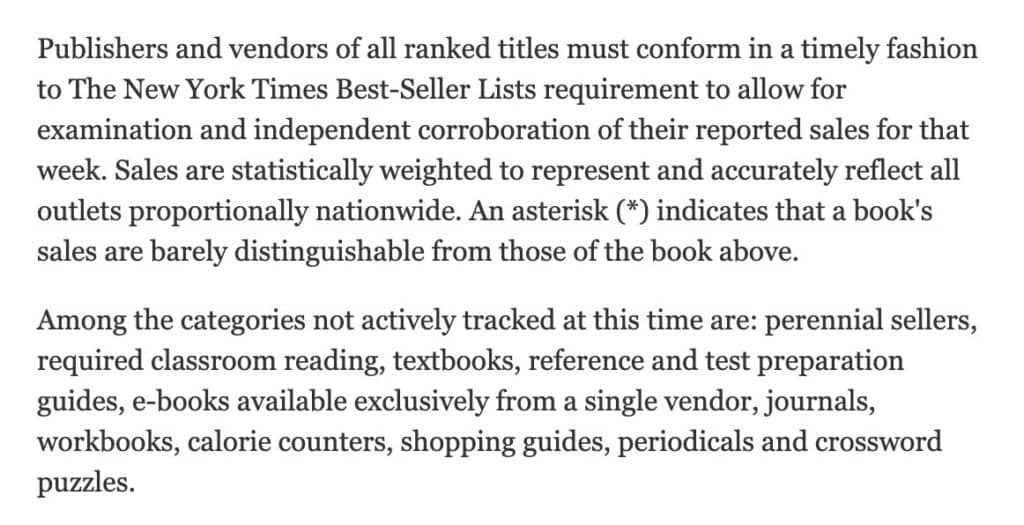
Per the Times, categories not actively tracked include perennial sellers, required classroom reading, textbooks, reference and test-prep guides, single-vendor e-books, journals, workbooks, calorie counters, shopping guides, periodicals, and crossword puzzles. Cookbooks, religion, spirituality, and faith titles are all included, contrary to popular assumption.
FAQs about the New York Times bestseller list
What are the requirements to be a New York Times bestseller?
The core requirement is selling 5,000 to 10,000 copies in a single tracked week, from diverse retailers across different regions of the country. Amazon-only sales don't qualify, since the Times weights bulk orders, ebook-only sales, and single-vendor sales differently.
How does a book become a NYT bestseller?
A book becomes a NYT bestseller by hitting the sales threshold for its category during a single tracked week, from a broad enough mix of retailers that the Times considers it a genuine national bestseller rather than a spike from one channel or one audience.
Is it hard to be a New York Times bestseller?
Yes. Outside of household names with a built-in audience, hitting 5,000 to 10,000 copies in one week from diverse retailers takes months of platform-building, a pre-order strategy, and a coordinated launch, not just a good book.
Why do authors want to get on the New York Times bestseller list?
Published weekly since 1931, it's the oldest and most prestigious bestseller list in the industry. Landing on it can bring future publishing contracts, broader industry recognition, positioning as a thought leader, a sales bump (especially for lesser-known authors), and real bragging rights.
How much money does a New York Times bestseller make?
At a 10% royalty rate on a $20 book, 10,000 copies sold works out to roughly $20,000 in royalties, much of which typically goes toward paying back an advance. A $50,000 advance at that same rate requires 25,000 copies sold before the author sees additional income. Total earnings depend on list price, royalty rate, and advance size.
Is the NYT bestseller list a true measure of bestselling status?
Not in the way most people assume. The list doesn't track cumulative sales (which is why the Bible or classics like Don Quixote never appear on it), and it weighs specific sale types and retailers rather than every unit sold. The New York Times bestseller criteria are editorial and methodological, not a raw leaderboard of total copies moved.
What are the top books on The New York Times bestseller list right now?
The list turns over weekly, but recent #1 fiction titles have included John Grisham's The Widow, Freida McFadden's The Housemaid, and Virginia Evans' The Correspondent, alongside repeat performers like J. D. Robb and Rebecca Yarros. Studying which authors repeat, and how they promote each release, tells you more than any single week's snapshot.
Who are the top New York Times bestselling authors?
Agatha Christie tops the list historically, with over 2 billion copies sold. Among modern New York Times bestselling authors, Jerry Jenkins has hit the list 21 times, and names like James Patterson, Stephen King, and John Grisham repeat regularly. What connects them: consistent output paired with consistent, deliberate marketing around every release.
Who is the longest-running New York Times bestseller?
The Road Less Traveled by M. Scott Peck holds the Guinness World Record for longest run on the list, logging its 598th week on April 14, 1995. Published by Touchstone (a Simon & Schuster imprint), it still has over 5 million copies in print.
Your next step
13 steps is a lot to look at in one sitting. You don't need all of them on day one; no one lands on the Times list by doing everything at once. Pick 1 you can start this week:
- Line up bulk book orders tied to speaking engagements
- Start pitching yourself for a podcast tour
- Launch a street team
- Build a bonus offerings landing page
- Start pursuing press 6 to 10 months out
- Find guest post opportunities in your niche
- Set up affiliate promotion with your network
- Plan a book tour
- Start your own podcast
- Film a book trailer
- Build a pre-launch social media campaign
- Plan a post-launch online summit
- Hire a book launch manager
Not sure which step fits your book?
selfpublishing.com has helped over 7,000 authors to publish their dream books, including many bestsellers. Let's talk through your goals and build a plan for your launch. Book a strategy call today.