


















TL;DR: Pacing is how fast or slow a story feels to a reader, controlled by sentence length, scene structure, and the ratio of action to information. Fast pacing uses short sentences and dialogue-heavy scenes; slow pacing uses longer paragraphs and internal reflection. Every novel needs both. The fix for "my pacing feels off" is almost always to adjust sentence rhythm and scene length, not to cut content.
"My agent says the pacing feels off." "Beta readers keep saying the middle drags." If you've heard either of those notes, you already know pacing in writing is the thing every writer struggles to name and every reader instantly feels.
But what is pacing in a story?
Pacing in writing isn't about how much happens in your story. It's about how fast the reading experience feels, and that's controlled by craft decisions you can make on purpose. And it's one of the hardest things to master when learning how to write a book. This blog will cover what pacing in writing is, some pacing examples in literature, and how to write the perfect blend of fast and slow pacing in your book.
Guide to Self-Editing Mastery
Learn how to avoid the most time-consuming editing mistakes most authors make and self-edit your book like a seasoned professional with our free guide.
What is pacing in writing?
Let's start by talking about pacing meaning in writing. Pacing is the perceived speed at which a story moves, shaped by sentence length, scene structure, and the balance between action and information. It operates at every level of a book: word choice within a sentence, scene structure within a chapter, and chapter rhythm across the whole manuscript.
Readers rarely use the word "pacing," but they feel its absence immediately. A story that's "boring" or that they "can't put down" is really a pacing judgment in disguise.
Fast vs. slow pacing: what causes each
Every scene sits somewhere on a spectrum between action and information. More action reads faster. More information, reflection, or description reads slower. Neither is better; a novel that's only fast exhausts readers, and one that's only slow loses them.
| Fast pacing | Slow pacing | |
|---|---|---|
| Contains | Dialogue, action, physical movement, urgency | Internal monologue, reflection, description |
| Looks like | Short sentences, short paragraphs, more white space | Longer sentences, denser paragraphs, less white space |
| Feels like | Page-turning urgency, tension, racing heart | Contemplative, relaxed, a natural stopping point |
The most effective way to write fast pacing isn't necessarily to write an action scene. It's to strip a scene, any scene, down to short sentences with minimal internal narration. The reverse is true for slow pacing: even a tense moment reads slower once you add a character's internal doubt between every line of dialogue.
See it in action: the same scene, paced two ways
The clearest way to understand pacing is to watch the same event slow down or speed up based purely on how it's written, not what happens in it. Here are some pacing examples:
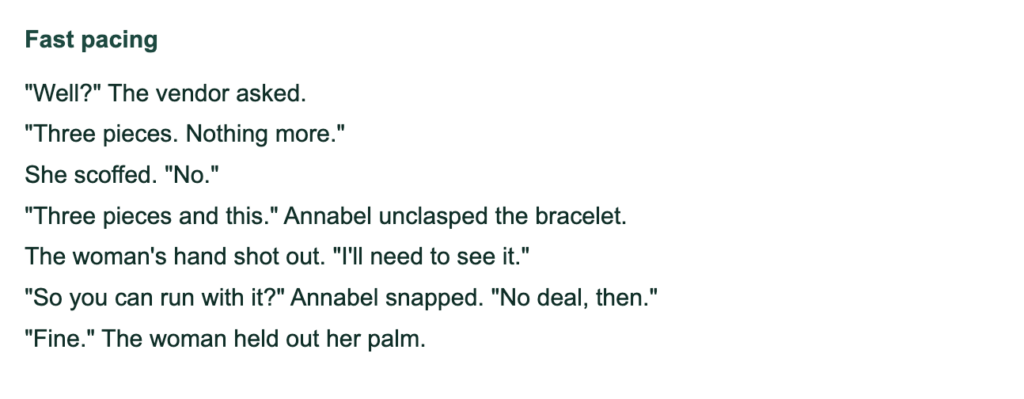
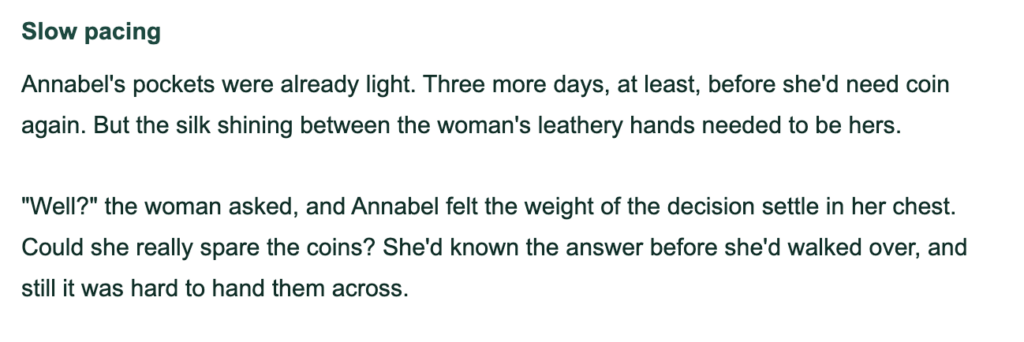
Same event. Same characters. The first version strips out internal thought entirely and lets short, clipped dialogue carry the tension. The second slows down by adding the character's internal calculation between every beat. Neither is wrong, they serve different moments in a story.
7 techniques for controlling pacing
Beyond the general fast/slow rules, these specific tools give you direct control over how a scene reads.
1. Sentence and paragraph length
Short sentences and short paragraphs read faster because the eye moves down the page quickly. Long, complex sentences slow the reading experience even if the content is exciting.
2. Chapter and scene breaks
Ending a chapter mid-tension (a classic cliffhanger) accelerates perceived pace by pulling the reader immediately into the next chapter. Ending on resolution gives readers permission to pause, naturally slowing the book's rhythm.
3. Dialogue-to-narration ratio
Dialogue-heavy scenes read faster than narration-heavy ones, even at the same word count. Stripping out dialogue tags and internal commentary during a tense exchange speeds it up further.
4. Scene vs. summary
Writing a moment out in real-time, beat by beat, slows pacing. Summarizing it in a sentence or two speeds the story forward. Save full scene treatment for your most important beats and summarize the rest.
5. Sensory detail dosage
Rich sensory description slows a scene down because it asks the reader to absorb more per line. Use it deliberately in scenes you want readers to linger in, and strip it out of scenes that need urgency.
6. Foreshadowing and reveal timing
Withholding information creates a question the reader wants answered, which speeds up their reading pace even during a slower scene. Answering that question too early removes the pull forward.
7. White space
Short paragraphs, line breaks, and dialogue-only exchanges create visible white space on the page. Readers perceive pages with more white space as faster reads before they've read a single word.
How to tell if your pacing is off
Pacing problems usually show up as specific, nameable reader reactions. Here's how to diagnose which direction to fix.
| Reader feedback | Likely issue | Fix |
|---|---|---|
| "The middle dragged" | Too much slow pacing without a scene that raises stakes | Cut summary-worthy scenes down; add a complication |
| "I couldn't keep up" / "it felt rushed" | Too much fast pacing without emotional grounding | Add brief internal reaction beats between action |
| "I skimmed this part" | Information delivered in a slow-paced info-dump | Break exposition into smaller pieces across multiple scenes |
| "I didn't feel the emotional weight" | Emotional scene paced too fast | Slow down with internal thought and sensory detail |
Pacing by genre
Genre sets reader expectations for pacing before they even open the book. Matching those expectations is part of delivering on your book's promise.
Romance pacing
Romance runs medium-paced overall, leaning faster for witty banter and slower for emotional-connection scenes. Historical romance tends to run slower than contemporary or paranormal romance. Separation arcs (when the love interests are apart) typically slow down, which is also the best place to deliver plot information, since reader investment is highest.
Fantasy pacing
Fight scenes and ensemble-cast dialogue run fast; knowledge-gathering scenes (magic lessons, lore exposition, investigations) run slow by design, so readers can actually absorb the information. Individual author style varies more in fantasy than almost any other genre.
Thriller and mystery pacing
Thrillers run consistently faster than most genres, using short chapters and cliffhanger breaks to maintain urgency throughout. Investigation and clue-gathering scenes slow down briefly, but rarely for long. Thrillers that sustain slow pacing for more than a chapter or two risk losing the genre's core promise.
Frequently asked questions
What is pacing in writing?
Pacing is the perceived speed at which a story moves, controlled by sentence length, scene structure, and the balance of action versus information. It operates at the sentence, scene, and chapter level.
How do I fix pacing issues an agent or editor flagged?
Start by identifying whether the note points to "too slow" or "too fast." Too slow usually means trimming description or adding a complication mid-scene. Too fast usually means adding brief internal reaction beats so readers can emotionally keep up.
Is fast pacing always better than slow pacing?
No. Every novel needs both. Fast pacing without emotional grounding feels hollow, and slow pacing without payoff feels boring. The skill is knowing which scenes need which speed.
What causes a "saggy middle" in a novel?
A saggy middle is usually too much slow pacing without a scene that raises the stakes. The fix is rarely deleting content; it's usually restructuring existing scenes so at least one mid-book scene escalates the central conflict.
Perfect the pacing in your story
Pacing can be hard to nail down, and you often need another set of eyes on your writing to really get it right. That's one of the reasons we offer one-on-one coaching and five rounds of professional editing at selfpublishing.com, so your book is flawless before it even reaches the beta readers.
Ready to get started? Book a free strategy call today.