














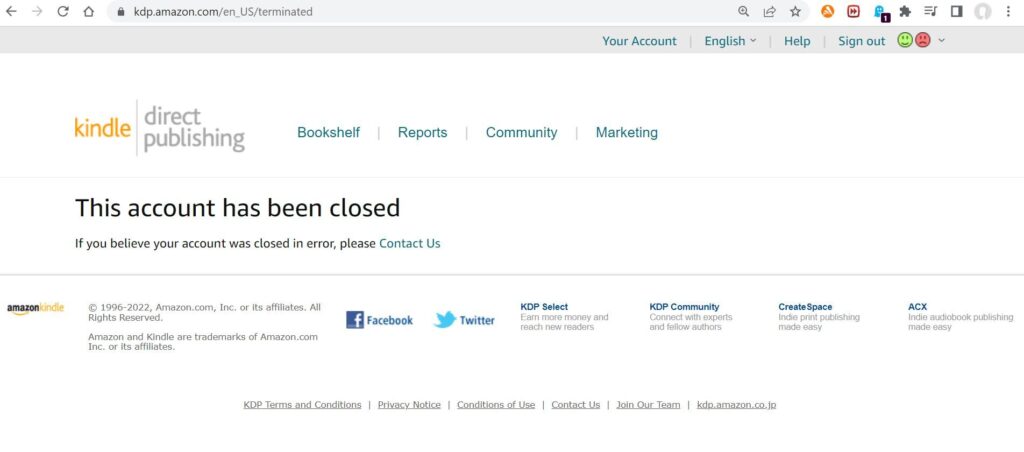
Few things hit an author harder than the notification: “Your Amazon KDP account was closed.”
Whether you’re publishing your first book or you’ve built an entire business on Kindle Direct Publishing, losing access can feel devastating. But before you panic, it’s important to understand why closures happen, what your next steps should be, and how to move forward.
This guide breaks it all down.
Why was my KDP account closed?
Amazon protects the Kindle Store more aggressively than many authors realize. Their automated systems and human review teams are constantly scanning for anything that could harm readers or violate intellectual property rights.
When something appears questionable, Amazon often acts quickly, and sometimes that means suspending or closing a KDP account without giving you much time to respond.
Understanding each major category of violations can help you determine what went wrong and how to prevent the same issue in the future.
1. Copyright or trademark issues
Copyright and trademark violations are among the most common reasons Amazon KDP accounts get closed. Even when an author makes an honest mistake (such as using an image found online, quoting material they thought was public domain, or including a brand name in a subtitle) Amazon treats it as a serious threat.
Their system is especially sensitive to content that looks reused, recycled, or suspiciously similar to existing copyrighted work.
With the rise of AI-generated books and covers, a new layer of risk has appeared: sometimes AI tools inadvertently replicate someone else’s protected content.
If Amazon believes your book infringes on another creator’s rights in any way, they may remove the book or disable the entire account to prevent further violations.
2. Duplicate books
Duplicate content is another major red flag for Amazon. Their platform prioritizes originality, so when they detect multiple books that look nearly identical they may view the activity as spam.
This often happens when authors publish the same manuscript under multiple titles, republish public-domain content without adding meaningful value, or release numerous low-content books that repeat the same templates or layouts.
Even if your intentions were harmless, uploading a large volume of similar material can cause Amazon’s automated systems to assume you’re flooding the marketplace, which can result in account closure.
3. Manipulation of reviews or ranking
Review and ranking manipulation is an area where Amazon has almost zero tolerance. Their goal is to maintain a fair marketplace, so even subtle or unintentional violations can cause major consequences.
Some authors run into trouble by asking friends, relatives, or social media followers to leave reviews. Others unknowingly hire promotional services that use bots or compensated reviews, which Amazon detects instantly.
Even keyword manipulation, such as adding keywords unrelated to your content to boost visibility, falls into this category.
If Amazon sees sudden spikes in downloads, page reads, or reviews that look unnatural, they may interpret it as fraud and shut down the account to protect the store’s integrity.
4. Multiple KDP accounts
KDP generally allows only one account per individual, and they enforce this rule strictly. Problems arise when two accounts appear connected through shared information (such as the same IP address, computer, Wi-Fi network, tax details, or bank account).
Sometimes this happens innocently, such as when a spouse, roommate, or business partner also uses KDP.
But Amazon’s automated system doesn’t always distinguish between legitimate collaboration and an attempt to bypass restrictions. When linked accounts are detected, Amazon often closes all of them at once to prevent potential abuse.
5. Excessive AI-generated, low-quality, or misleading content
As AI publishing grows, Amazon is being increasingly cautious about the quality and accuracy of books uploaded to their platform. Low-quality AI-generated texts, especially those that are rushed, poorly edited, or filled with errors, can cause an account to be flagged.
Books that present misinformation, falsely claim expertise, or use misleading author names also fall under this category.
Additionally, uploading too many AI-generated titles in a short period can make your account seem suspiciously high-volume, which Amazon interprets as a risk. If they believe your catalog harms reader trust or fails to meet minimum quality standards, they may shut down your account.
6. Policy violations related to metadata
Metadata (the titles, subtitles, keywords, categories, and author names associated with your book) is another area Amazon monitors carefully.
Issues arise when authors try to make their books more discoverable by stretching or bending the rules. This can include using misleading titles or subtitles, stuffing keywords into places they don’t belong, claiming author names that aren’t legally yours, or categorizing your book in genres that don’t match its content.
Metadata violations may seem small, but Amazon treats them as intentional attempts to mislead readers, and accounts with repeated or severe offenses can be permanently closed.
7. Payment or tax issues
Sometimes account closures have nothing to do with content at all. They can stem from problems validating your identity or financial information.
If Amazon cannot verify your tax documentation, your legal name, your banking details, or even your country of residence, they may lock or close your account until the issue is resolved.
Mismatched information, incomplete forms, or inconsistencies between your KDP profile and your payment details can all trigger a shutdown. Until Amazon receives proper verification, they may withhold royalties and prevent further publishing activity.
My KDP account was closed – now what?
Regardless of why your Amazon KDP account was closed, here are some steps you should follow:
Read the email carefully
When Amazon closes a KDP account, the notification email is usually your first and most important source of information. Even if the message feels vague or abrupt, Amazon typically includes at least a hint about why the closure happened.
Look closely for phrases such as “significant violations,” “we are unable to verify your identity,” “metadata manipulation,” or “rights and content issues.” These keywords might seem broad, but they can help you determine the general category of the violation.
Sometimes Amazon’s explanation is only a sentence or two, but within that short message is a clue that can guide your next steps.
Before you appeal or take any other action, make sure you fully understand what Amazon believes went wrong.
Appeal the decision
If you believe the closure was a misunderstanding, or if you can correct the issue, your next step is to appeal directly to Amazon’s KDP Account Appeals team at [email protected]
The appeal should be thoughtful and professional. Explain clearly what happened from your perspective, and if you have evidence that supports your case, include it. This might be proof of copyright ownership, confirmation that you hold the rights to particular images, or documentation explaining why your content is original.
If the issue stemmed from a misunderstanding, describe it openly and directly. Amazon wants reassurance that you understand the rules and that you are committed to compliance moving forward.
A precise, respectful explanation gives you a far better chance of reinstatement than an emotional response.
Don’t flood them with emails
Once you submit your appeal, it can feel agonizing to wait, but patience is essential. Sending multiple emails in rapid succession won’t speed up the process; in fact, it often slows it down because your case gets buried under repeated messages.
Amazon’s review teams receive thousands of appeals, and they process them in the order they arrive. Give them time and space to review your materials thoroughly.
If you absolutely need to follow up, wait at least five to seven days before checking in. A single well-written appeal followed by a respectful delay is far more effective than constant messaging.
Fix any issues before re-applying
While you wait for Amazon’s response, take the opportunity to correct whatever may have triggered the closure.
If the issue involved copyright, begin gathering licenses, replacements, or proof of ownership so you can demonstrate compliance.
If metadata was the problem, review your titles, subtitles, and keywords to ensure everything is accurate and appropriate.
In cases involving duplicate content, remove repeated editions or combine them into a single, improved version.
If the concern was low-quality or AI-generated material, revise the manuscripts carefully, improve the structure, enhance readability, and ensure the content meets Amazon’s quality standards.
And if identity verification was the sticking point, gather official documents, such as tax forms, government IDs, or bank statements, so Amazon can confirm your information without further delays.
Taking corrective action shows Amazon you’re serious about maintaining a compliant publishing environment.
If the appeal fails: Decide your next move
Unfortunately, not every appeal results in reinstatement. If Amazon refuses to reopen your account, it’s important to step back and consider your next options.
Some authors choose to start fresh after a waiting period, ensuring that any new account uses accurate, clean information and complies fully with Amazon’s policies. Others explore alternative publishing platforms like Draft2Digital, IngramSpark, Kobo Writing Life, Apple Books, or Barnes & Noble Press.
Another possibility is partnering with a reputable publishing imprint or service that can legally publish your titles through their established KDP account, though this should always be done transparently and with proper contracts.
Regardless of the path you choose, the key is rebuilding carefully, methodically, and with a clear understanding of the policies that protect both authors and readers.
Getting your Amazon KDP account closed is frustrating, frightening, and often confusing. But it doesn’t have to be the end of your publishing journey. Understanding what happened and rebuilding with better compliance can help you come back even stronger.