
















Creative nonfiction is true writing that uses the craft and storytelling techniques of fiction to bring real events to life. It's the bridge between what happened, and how it feels to live through it. And it's one of the most powerful forms of writing you can choose.
More readers than ever are discovering this genre. Memoirs sit at the top of bestseller lists. Literary journalism fills podcasts and long-form magazines. Travel essays go viral.
If you've ever stayed up past midnight finishing a memoir because it felt more gripping than any novel, you've already experienced what creative nonfiction can do. And if you're wondering whether you could write something like that yourself, this guide is for you.
We'll cover what creative nonfiction is, the major types, 10 unforgettable examples, and a clear step-by-step process for writing your own creative nonfiction book.
Need A Nonfiction Book Outline?
Get customizable templates for easy book writing and structuring.
What is creative nonfiction?
Creative nonfiction is factual writing that uses literary techniques usually found in creative writing (such as scene-setting, dialogue, metaphor, and narrative arc) to tell true stories in a way that reads like fiction.
Unlike a news report or a textbook, creative nonfiction prioritizes the emotional truth of an experience alongside the factual record.
The term was popularized by writer and editor Lee Gutkind, who founded Creative Nonfiction magazine in 1993 and has long championed the form as one of the fastest-growing areas in contemporary literature.
What sets it apart from regular nonfiction?
Everything comes down to craft. A history book might tell you that a battle took place in the autumn of 1863. A work of creative nonfiction puts you in the mud, smelling the gunpowder, hearing the orders shouted through the fog.
Both are true. Only one makes you feel something.
The golden rule is simple: the facts must be accurate, but the writing must be alive.
Types of creative nonfiction
Creative nonfiction is a family of related forms, each with its own conventions and possibilities. Here's a breakdown of the most common types:
Literary nonfiction
Literary nonfiction applies the tools of fiction (imagery, theme, structure, point of view) to true subject matter. It can be a single essay or a full-length book. What defines it is the quality of the writing itself: precise, evocative, and deliberately crafted. As such it often contains literary elements.
Works like John McPhee's long-form journalism or Annie Dillard's essays fall into this category.
Memoir
A memoir is a first-person account of a specific period, theme, or set of experiences from the author's own life.
Crucially, a memoir is not an autobiography. It doesn't try to capture an entire life from birth to present. Instead, it zooms in on a particular window of time or a recurring emotional thread, exploring what that experience meant and how it changed the author.
Memoir is one of the most accessible entry points for new writers because you already own the source material: your own story.
Nature writing
Nature writing captures the beauty and power of the natural world through personal observation and lyrical prose. At its best, it explores the human relationship with the environment.
Writers like Annie Dillard (Pilgrim at Tinker Creek), Robert Macfarlane, and Robin Wall Kimmerer have elevated nature writing into some of the most celebrated literature of our time.
Travel writing
Travel writing places the reader alongside the author on a physical journey, but the deeper journey is always internal. The best travel writing reveals not just where someone went, but who they became in the going. It blends reportage, personal reflection, cultural observation, and vivid scene-building.
Narrative journalism (literary journalism)
Narrative journalism uses the immersive storytelling techniques of fiction to report on real events, real people, and real issues.
Think of Truman Capote's In Cold Blood or the long-form pieces published in The New Yorker or Rolling Stone during their golden age. The facts are rigorously verified; the telling is utterly compelling.
Personal essays
The personal essay is a shorter, more intimate form of creative nonfiction. It typically explores a single idea, moment, or question through the lens of the writer's own experience.
Personal essays don't need to reach a tidy conclusion. In fact, the best ones sit comfortably with ambiguity. They think on the page, and they invite the reader to think alongside them.
Speeches
The great speeches of history are works of creative nonfiction, They are true in content, and artful in form. From Frederick Douglass to Nelson Mandela to the Gettysburg Address, speeches that endure do so because they marry factual grounding with emotional power and literary craft.
Biography
A biography tells the story of another person's life. When done with the techniques of creative nonfiction, it becomes something far richer than a Wikipedia entry. A well-written biography can make a historical figure feel present, flawed, and fully human.
10 unforgettable examples of creative nonfiction
1. In Cold Blood by Truman Capote (1966)

Capote's account of the 1959 murder of a Kansas farming family is widely considered the founding text of literary nonfiction in its modern form.
Capote spent six years interviewing everyone connected to the case (victims' neighbors, investigators, and the killers themselves) and shaped the raw material into something that reads with the pace and texture of a thriller.
In Cold Blood proved that true events, reported with rigor and written with artistry, could produce literature as powerful as any novel.
Why it matters for writers: Capote shows how deep research and narrative structure can transform journalism into art. Every scene is grounded in fact, yet nothing feels dry.
2. A Moveable Feast by Ernest Hemingway (1964)

Hemingway's posthumously published memoir of his early years in Paris is a masterclass in atmosphere and restraint. Written in his signature spare style, it conjures 1920s Paris (the cafés, the Seine, the literary friendships with Fitzgerald and Gertrude Stein) with extraordinary precision.
The prose is deceptively simple. Every sentence is doing real work.
Why it matters for writers: A Moveable Feast demonstrates that a memoir doesn't need dramatic plot twists to be gripping. Emotional texture and sensory detail are enough.
3. I Know Why the Caged Bird Sings by Maya Angelou (1969)
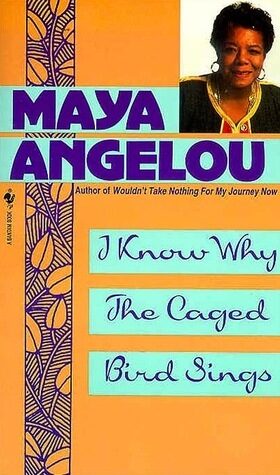
Angelou's autobiographical account of her childhood in the American South is one of the most celebrated memoirs ever written. It’s a testament to the power of language to transform suffering into something transcendent.
I Know Why The Caged Bird Sings covers her early years in Stamps, Arkansas, including experiences of racism, trauma, and the silence she chose after a devastating assault. Yet the book is ultimately a story of resilience, identity, and the discovery of her own voice.
Why it matters for writers: Angelou proves that vulnerability, when rendered with unflinching craft, becomes strength on the page. Her voice is unmistakable from the first paragraph.
4. Hiroshima by John Hersey (1946)
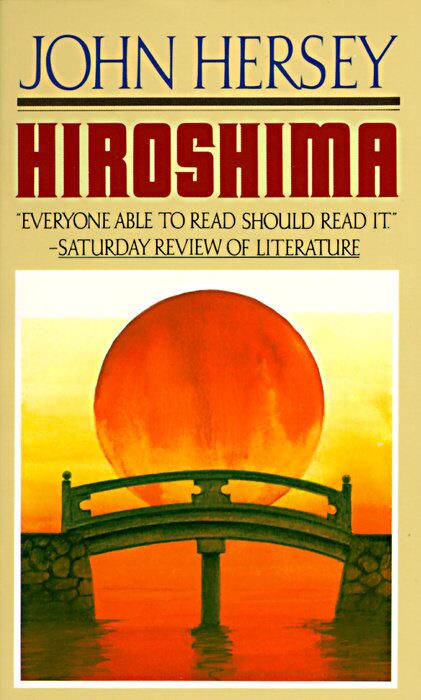
Hersey's account of the atomic bombing of Hiroshima, told through the experiences of six survivors, changed the way the world understood what had happened on August 6, 1945.
Originally published in a single issue of The New Yorker, Hiroshima abandons the detached language of war reporting and instead follows six specific human beings through the moments before, during, and after the blast. The effect is devastating and unforgettable.
Why it matters for writers: Hersey shows how focusing tightly on individual human experience can make vast historical events emotionally comprehensible. Statistics don't move people. People move people.
5. The Glass Castle by Jeannette Walls (2005)

Walls' memoir about growing up with deeply unconventional, often neglectful parents is a stunning example of how to handle complicated material with grace and complexity.
Her father was a brilliant, charismatic dreamer undone by alcoholism.
Her mother was a free-spirited artist who resisted anything that felt like responsibility.
Walls neither condemns nor excuses in The Glass Castle. She simply shows, with extraordinary clarity and occasional dark humor, what her childhood actually was. The result is a book readers finish in a single sitting and think about for years.
Why it matters for writers: The Glass Castle is a lesson in narrative fairness. The most powerful memoirs resist the urge to cast family members as villains.
6. Eat, Pray, Love by Elizabeth Gilbert (2006)

Gilbert's memoir about spending a year traveling through Italy, India, and Indonesia after a painful divorce became one of the bestselling memoirs of the 21st century. It's a book about pleasure, spirituality, and learning to receive love told with wit and disarming honesty.
Whatever one thinks of its cultural footprint, the commercial success of Eat, Pray, Love demonstrated that readers have an enormous appetite for deeply personal, first-person narrative nonfiction.
Why it matters for writers: Gilbert shows that interior journeys are just as compelling as external adventures, when rendered with enough candor.
7. A Walk in the Woods by Bill Bryson (1998)
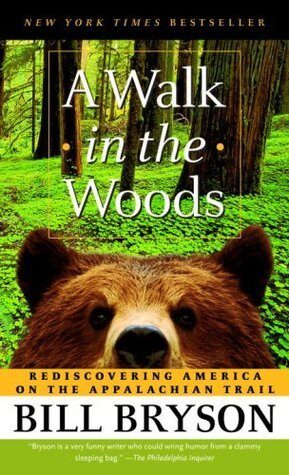
Bryson's account of attempting to hike the Appalachian Trail is both a love letter to the American wilderness and a wickedly funny self-portrait of a middle-aged man profoundly out of his element.
Part travel writing, part nature writing, part comic memoir, A Walk in the Woods demonstrates how humor can serve as a Trojan horse for serious ideas. Tucked inside the laughs are sharp observations about conservation, American culture, and the particular beauty of forests left alone.
Why it matters for writers: Bryson proves that nonfiction doesn't have to be solemn to be meaningful. A light touch, deployed with intelligence, can carry real weight.
8. World of Wonders by Aimee Nezhukumatathil (2020)

Nezhukumatathil's essay collection uses the natural world as a lens for exploring race, belonging, and what it means to feel at home in your own body. Each short essay is anchored by a plant or animal and radiates outward into memory and meaning. The writing is lyrical without being precious, personal without being self-indulgent.
Why it matters for writers: World of Wonders is a masterful example of the braided essay where a concrete subject (nature) and an abstract subject (identity) are woven together until each illuminates the other.
9. Me Talk Pretty One Day by David Sedaris (2000)
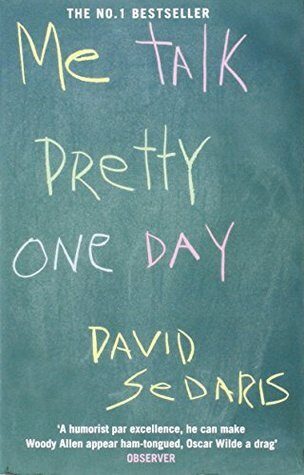
Sedaris' essay collection (centered largely on his bewildering experience learning French in Paris) is one of the funniest books in the creative nonfiction canon. His particular gift is finding the precise comic detail that makes a moment feel both singular and universal. He is ruthless about his own failings and endlessly observant about the failings of everyone around him.
Why it matters for writers: In Me Talk Pretty One Day, Sedaris demonstrates that the personal essay can make readers laugh until they cry, and that self-deprecating honesty is one of the most effective tools a nonfiction writer has.
10. The Gettysburg Address by Abraham Lincoln (1863)
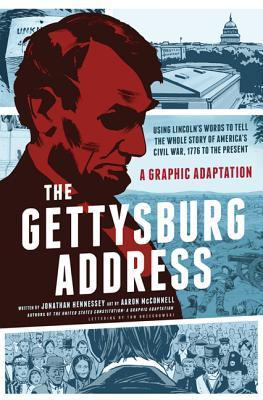
In just 272 words, Lincoln transformed a dedication ceremony for a military cemetery into one of the most resonant statements of democratic purpose ever written.
The speech is a work of extraordinary compression: every word earns its place. It redefined the meaning of the Civil War and, many argue, of America itself.
That it accomplished this in under three minutes is a reminder that creative nonfiction doesn't require length, it requires intention.
Why it matters for writers: The Gettysburg Address is the ultimate lesson in economy. Say what needs to be said, in the fewest words possible, with the greatest possible care.
What makes creative nonfiction different from fiction?
The key difference is that creative nonfiction is bound by fact. Every event, quote, and detail must be true, but the writing techniques used to convey them come from the world of literary fiction.
This creates a unique tension that many writers find creatively energizing. You cannot invent a scene. You cannot imagine a dialogue. You must work with what actually happened, and your job is to find the story already living inside the facts.
This is why research is so central to creative nonfiction. The richer your raw material, the more you have to work with when the writing begins.
How to write creative nonfiction: a 5-step process
Step 1: Choose your form and find your focus
Before you write a single sentence, get clear on two things: what form you're working in, and what specific territory you're exploring.
A travel memoir about six weeks in Southeast Asia is too broad. A travel memoir about the week you almost didn't come home from Cambodia (and what that fear taught you about yourself) has a center of gravity.
Study the form you've chosen. Read widely within it. Notice what the writers you admire do with structure, voice, pacing, and scene.
Step 2: Gather your material ruthlessly
Creative nonfiction runs on specificity. The name of the café. The color of the light. The exact words someone said. This level of detail doesn't come from memory alone, it comes from notes, interviews, photographs, diaries, documents, and research.
If you're writing a memoir, dig into your archive: old emails, journal entries, photographs, text messages.
If you're writing narrative journalism, conduct interviews and take meticulous notes.
The more raw material you gather, the more choices you'll have when you sit down to write.
Step 3: Find the structure before you start drafting
One of the most common mistakes in creative nonfiction is starting to write without knowing where you're going. Unlike genre fiction, creative nonfiction doesn't have a default structure. You have to build one.
Ask yourself: Where does this story actually begin? (Often not at the chronological beginning.) What is the emotional arc? Where does tension build, and where does it resolve? What does the reader need to know, and when do they need to know it?
You don't have to outline in detail, but you need a through-line. A sense of destination. Without it, even the most beautifully written pages will feel like they're going nowhere.
Step 4: Draft fast; perfect later
The first draft of any creative nonfiction project is permission to discover what you're actually writing about. You may think you're writing about a hiking trip. By the time you finish the first draft, you realize you're writing about grief. That's fine. That's how it works.
Don't let perfectionism slow you down at the drafting stage. Get the story out. Let it be messy. There will be time to shape it.
Step 5: Revise with a reader’s eye
Once you have a complete draft, step away from it. Then come back and read it as a stranger would - someone who wasn't there, who doesn't know you, who has no reason to keep reading unless you give them one.
Ask: Is every scene earning its place? Is the pacing right? Does it slow down where it should linger, and accelerate where it should drive? Is the voice consistent? Are there places where you're telling the reader what to feel instead of showing them something and letting them feel it themselves?
Revision is where creative nonfiction is truly made. Most published memoirs and essays went through five, ten, or twenty drafts before they became what they are.
Frequently asked questions about creative nonfiction
What is the difference between creative nonfiction and a memoir?
A memoir is one specific type of creative nonfiction. It’s a first-person account drawn from the author's own life.
Creative nonfiction is the broader category that includes memoir, but also travel writing, nature writing, personal essays, narrative journalism, biography, and more.
All memoirs are creative nonfiction, but not all creative nonfiction is memoir.
Can creative nonfiction include dialogue?
Yes, and the best creative nonfiction often does. The rule is that the dialogue must be accurate to the best of the writer's knowledge.
You can reconstruct conversations from memory or interviews, but you cannot invent words someone never said. If you're uncertain, the common practice is to note that dialogue has been reconstructed.
Does creative nonfiction have to be in first person?
No. While memoir and personal essays are typically first-person, many forms of creative nonfiction (particularly narrative journalism and biography) are written in third person.
The defining characteristic isn't the point of view; it's the combination of factual accuracy and literary craft.
What topics work best for creative nonfiction?
Almost any subject can be explored through creative nonfiction. The key is not the topic itself but the writer's relationship to it. Think about the angle, the stakes, the question being explored.
Creative nonfiction has been written about food, war, mathematics, grief, insects, addiction, architecture, and even chess. What matters is that the writer brings genuine curiosity and emotional engagement to the subject.
How long should a creative nonfiction piece be?
It depends entirely on the form. A personal essay might run 1,000 to 5,000 words. A memoir is typically 70,000 to 100,000 words. A travel narrative can fall anywhere in between. The right length is whatever the story actually needs, no more, no less.
Is creative nonfiction popular right now?
Yes, enormously. Memoir and narrative nonfiction have been among the fastest-growing categories in publishing for over a decade.
Readers are increasingly drawn to true stories told with the emotional power of fiction, and platforms like podcasts and long-form digital journalism have expanded the market significantly.
If you have a compelling true story and the craft to tell it well, there has never been a better time to write creative nonfiction.
Is creative nonfiction right for you?
Creative nonfiction suits writers who are drawn to the real world. People who find themselves more interested in what actually happened than in imagining what might happen.
It suits people with a story they can't stop thinking about. It suits writers who want their work to matter in the way only truth can matter.
If any of those descriptions feel familiar, your next step is simple: choose a form, find your focus, and start gathering material. The story is already there. Your job is to find it, and then tell it as well as you possibly can.
Ready to write your nonfiction book? Explore our nonfiction programs at selfpublishing.com, or grab a free copy of our nonfiction book outline templateto get started today.