




















TL;DR
Character development is the process of building a character with enough depth, contradiction, and internal logic that readers believe they're real. Strong development runs on 5 elements: outer struggle, inner struggle, setbacks, a change in perspective, and conquering both struggles at once. Do the work before chapter 1, not during revisions.
Readers don't finish books because the plot was clever. They finish because they needed to know what happened to someone. That's the whole game.
Most first novels fail at exactly this point. The author knows their story cold, beat by beat, and still gets beta reader feedback that says some version of: the plot was interesting but I didn't care about anyone in it. That feedback is devastating because it isn't a line-edit problem. It's a foundation problem.
Here's the good news. Character development is one of the few parts of fiction craft that responds directly to systematic effort. You can't force inspiration. You can absolutely sit down and answer 50 questions about a person until they start behaving like one.
A bad plot can be saved by amazing characters. The best plot in the world will not save a book with bad character development.
This guide walks the full process: what character development actually is, the 5 structural elements underneath it, 12 steps to build a character from nothing, and how to give them an arc worth following. By the end you'll know how to write good characters on purpose rather than by accident.
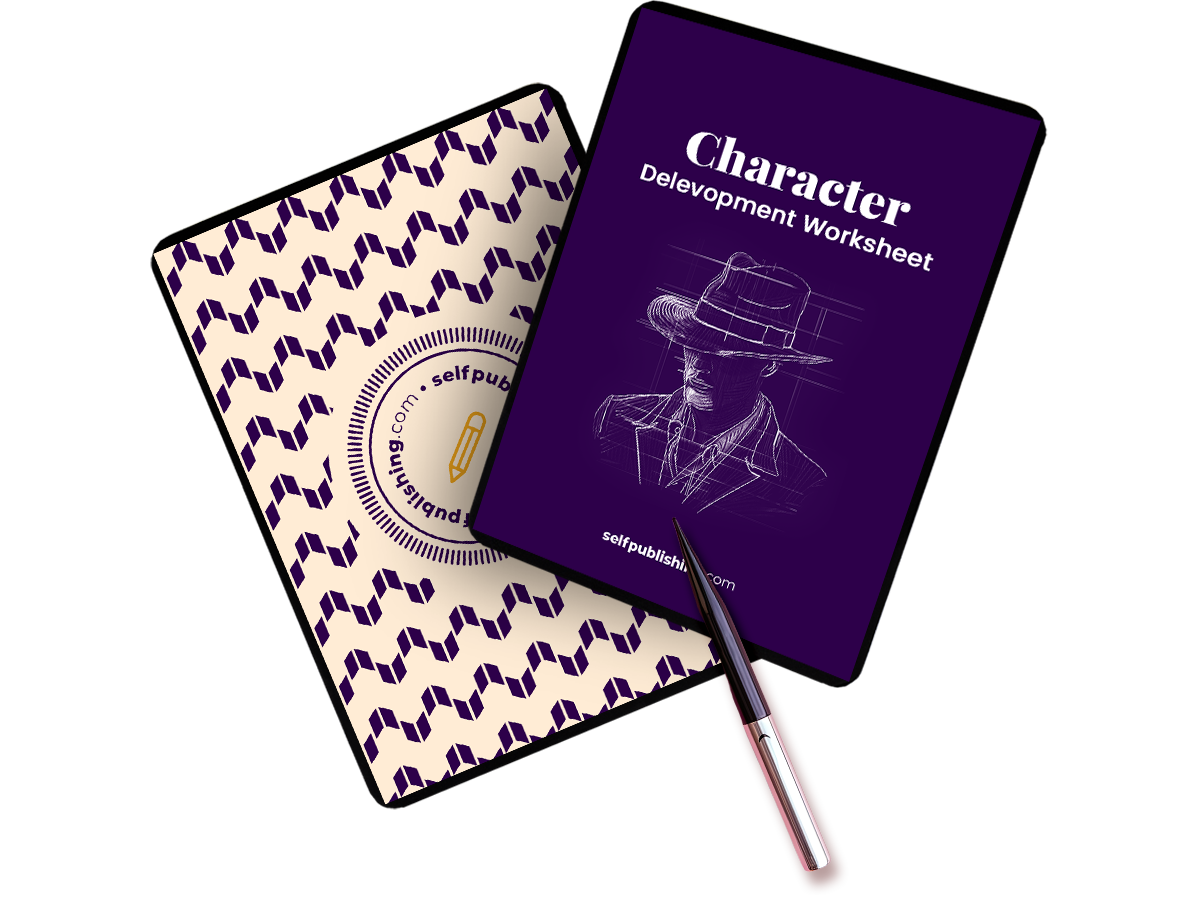
Get The Free Character Sheet!
Unlock Your Character's Full Potential with Our Free Character Sheet.
Get your character development sheet
A character development sheet is a single document tracking every character's traits, history, and voice, so you catch inconsistencies and overlapping personalities before they reach the page.
Nearly every author who skips this step pays for it in revisions. You write 40,000 words, then realize two of your secondary characters are functionally the same person with different hair. Or your protagonist's stated fear in chapter 3 contradicts how she behaves in chapter 19.
A tracking sheet solves both problems. It also lets you zoom out and see whether you've accidentally built three character types who all serve the same narrative function.
Start with the 200-question version
Our character bio template is the most thorough version of this tool we've built: 200 questions across 10 categories covering appearance, personality, health, career, family, relationships, backstory, and story role. Fill it out for your protagonist and your antagonist before you draft.
What is character development?
Character development is the process of creating a complex, lifelike character, and then changing that character measurably over the course of your story so readers stay invested in their journey.
The term does double duty, which is why it confuses people. It means both:
- The pre-writing work. Building a character who has coherent history, motives, contradictions, and a distinct voice before you write them.
- The in-story change. The transformation that character undergoes from page 1 to the final page.
Both matter. A character can be richly detailed and still boring if they never change. A character can change dramatically and still feel hollow if the change isn't grounded in who they were.
Think of character development as the paper your book is printed on. Without it you don't have a book. You have ink smeared between two covers.
Why character development sells books
Readers buy the next book because of the characters, not the plot. Deep character investment is what converts a single sale into a loyal series reader.
There's more happening psychologically here than most authors realize. It isn't about whether readers like your character. It's about what your character lets them do.
Part of the satisfaction of reading is that in getting to know a character deeply, we get to know ourselves. Characters enter situations we'll never face, and because fiction deals in love, loss, right, wrong, good, and evil, readers get to live those stakes vicariously.
Watching a character overcome a flaw is satisfying because it suggests we could overcome ours. That's why the hero's journey has survived a few thousand years. People want to believe they can act well under pressure. Others gravitate to morally gray characters for a related reason: if a deeply flawed person can still do something good, maybe the reader can too.
This is the commercial argument, not only the artistic one. A reader who connects with your protagonist will buy everything you publish with that character in it. Character development is the most direct lever you have on series read-through and lifetime reader value.
What is a well-developed character?
A well-developed character has complex personality traits, real flaws, competing desires, and a backstory that explains all of it, and they grow across the story rather than staying static.
The test isn't complexity for its own sake. The test is whether the character's choices feel inevitable in hindsight and surprising in the moment. That only happens when you know them well enough that their internal logic drives the scene.
A well-developed character typically has:
- A backstory that produced their present self. Not trauma for decoration. Cause and effect.
- Flaws with consequences. Not charming quirks. Things that cost them.
- Competing desires. What they want and what they need should not be the same thing.
- A distinct voice. You could identify their dialogue with the attribution tags removed.
- Room to change. They begin as someone who could not do what they do at the end.
The failure mode has a name: the Mary Sue. A character with no meaningful flaws, no real opposition, and no cost to their success. Readers don't find perfect characters aspirational. They find them irritating, because perfection reads as unearned.
Types of character development
There are 7 character types to develop, and the depth of development each one needs depends entirely on their function in the story.
Before you can develop a character, you have to know what job they're doing. These are the types of character development you'll be managing across a novel:
| Character type | Function in the story | Development depth needed |
|---|---|---|
| Protagonist | Drives the story, carries the primary arc | Full. Complete bio, full arc. |
| Antagonist | Opposes the protagonist, creates the central conflict | Full. A villain with no interior life is a plot device. |
| Secondary | Significant page time, supports or complicates the protagonist | Substantial. Voice, motive, and a small arc. |
| Dynamic / round | Changes measurably across the story | Full. Change requires a starting point to change from. |
| Static / flat | Stays internally consistent while the plot moves around them | Moderate. Consistency matters more than growth. |
| Foil | Contrasts the protagonist to reveal their qualities | Moderate. Built in deliberate opposition. |
| Stock | Fills a recognizable role for efficiency | Light. A few defining details. |
Most protagonists should be dynamic. They grow, and by the final chapter they act differently than they did in chapter 1 because they've overcome something internal.
Some genres run on the opposite. Serialized thrillers and mystery series often use a flat protagonist on purpose. Internally, the detective is the same person in book 9 as in book 1. What changes is the case and the world around them. That's a legitimate structural choice, not a craft failure, and it's why long-running series work.
Character development examples
The most memorable character development examples fall into two patterns: characters who transform into someone different, and characters who grow into more of who they already were.
Fans go feral for a well-built character. Not a morally good one, necessarily. A well-written one. Here are four character development examples readers consistently obsess over, each working through a different mechanism.
1. Damon Salvatore, The Vampire Diaries
The morally gray engine. Damon starts as a heartless, reckless vampire and gradually begins to care about the people closest to him, which changes his behavior even while his actions stay ethically questionable. The development is real without being a redemption. Readers stay because they can't predict him.
2. Jaime Lannister, A Song of Ice and Fire
The redemption arc, contested. Jaime begins as a spoiled man who cares for nearly no one and ends humbled, having paid real costs and developed empathy that would have shocked anyone who knew him early on. There's legitimate debate over whether he's redeemable, and that debate is itself proof the development landed.
3. Katniss Everdeen, The Hunger Games
The reluctant symbol. Katniss transforms from someone focused entirely on her own family's survival into the face of a rebellion. The Games force her to confront her beliefs and motivations, and the arc satisfies because she never stops resisting the role she grows into.
4. Frodo Baggins, The Lord of the Rings
The cost of endurance. Frodo starts as an ordinary hobbit and becomes resilient and compassionate enough to sacrifice himself for something larger. The deepening of his loyalty is what makes readers want to be like him.
Notice the pattern. Jaime changes into someone else. Frodo becomes more fully himself. Both are satisfying. Development does not have to mean reversal.
5 key elements of character development in a novel
The 5 elements of character development in a novel are outer struggle, inner struggle, setbacks, a change in perspective, and conquering both struggles simultaneously.
Good character development follows a recognizable shape across almost every story. The timing shifts by genre and structure, but the sequence holds. This is the mechanism underneath every example above.
1. Outer struggle
The outer struggle is plot. What the character is doing, how they're doing it, and what they have to accomplish. Most often it forces them into direct contact with their biggest weakness.
Weakness here means the thing they can't get past but must, in order to succeed. Example: your character can't work with other people because she takes over everything and dismisses input. The plot will require collaboration.
2. Inner struggle
The internal world matters more than anything else on this list. The inner struggle is what creates the weakness.
Your character doesn't take over because she's selfish. She takes over because she can't trust anyone. And that still isn't deep enough. She has to understand why she can't trust anyone. That's where real character development lives.
3. Setbacks
This is where the weakness and the flaw start costing her. Plural, not singular.
First, the outer struggle bites: she alienates people, can't get help, and fails a plot goal. Readers need to meet the external problem before the internal one. Then she tries again, makes progress, and the inner struggle surfaces. Maybe she manages to collaborate, and then her inability to trust sabotages it worse than the first failure.
Run 2 or 3 of these before moving on.
4. Change in perspective
Rock bottom. Your character has to see both struggles for what they actually are. This is the dark night of the soul: the moment all hope appears gone and the goal appears unreachable.
The change in perspective is not the solution. It's the willingness to consider one.
5. Conquering both at once
The climax works when it requires addressing the outer and inner struggle simultaneously. She has to collaborate and trust. Which is why climaxes built this way so often turn sacrificial: you'll see her hand the decisive action to someone else and trust them with her life to do it.
Nail this sequence and you have character development readers will remember. If you want to see how this maps onto plot structure, our guide to story arcs covers the narrative side of the same architecture.
How to develop your characters in 12 steps
Build characters in this order: background first, then strengths and flaws, then distinguishing features, then voice, then diversity and stereotype checks last.
Now that you know which type of character you're working with, here's the practical sequence. This is the core of how to write good characters, and every step includes an exercise you can run today.
1. Create a background for each character
Our realities are shaped by where we've been, where we are, and where we want to go. The strongest influence is almost always the past.
The same holds for your character. Based on their life before page 1, they'll carry different interests, quirks, and fears. Your job is to fill in everything that happened before your novel starts.
Character development exercise
Fill out a character sheet covering:
- Their childhood, and what its texture was
- Their parents, and whether they were present
- Their friendships, then and now
- Their hobbies and interests as a kid versus today
- Their motives for feeling the way they do about a given situation
- Their personality type and how it shapes their actions
2. Know your characters’ strengths and weaknesses
Strengths and weaknesses shape how a character reads events, which actions they take, and the whole shape of their arc.
If your character's strength is winning strangers' trust, that's an asset throughout the journey. If that same skill is her weakness and the plot forces her to use it anyway, you have conflict. Know these cold before drafting, because they determine plot as much as character.
Character development exercise
List 3 strengths and 3 weaknesses per character. Every one of them should be able to create conflict in your plot. If a trait can't cause a problem, it isn't earning its place.
3. Create nervous ticks or habits
Watch people long enough and you notice everyone has a tell they don't know about. Nail biting, a phrase they repeat, a thing they do with their hands when cornered.
These small physical signatures do enormous work. They make a character feel observed rather than invented, and observed characters are the ones readers write 5-star reviews about.
Character development exercise
Write down 2 odd habits per character. Decide which is their default (done without thinking) and which intensifies under stress or anxiety.
4. No character can be perfect
It's genuinely hard to give your favorite fictional person real flaws. You want readers to love them. But a flawless character isn't lovable, they're unbearable, because nothing about them is recognizable.
The more you polish a character toward perfect, the less readers can find themselves in her. Build in flaws the way real people carry them, and let your characters fail.
Character development exercise
List 3 major flaws that can become actual plot problems. Look at bad habits, situations they avoid, and traits that aren't considered admirable. If none of the 3 can derail a scene, go deeper.
5. All characters need realistic motives
Every character needs a reason for wanting what they want that holds up under pressure. Take Voldemort. He wants Harry dead, which everyone knows. But if he were killing a child for no reason beyond being evil, the story would collapse.
He has to kill Harry because Harry is the only person who ever defeated him, and because the prophecy names him. Those are motives with structural weight.
When minor characters lack coherent motives, readers get pulled out of the story and start questioning events. This is where most plot holes are born.
Character development exercise
For your antagonist, list at least 2 ways their motive is valid on its own terms. They should have 2 strong, history-grounded reasons for opposing your protagonist.
6. Give each character a unique feature
This matters most in books with large casts, and it still matters in small ones. Readers need to visualize and differentiate your cast instantly.
Harry has glasses. Hermione has prominent front teeth. Ron has red hair. Three distinct anchors, three separate mental images.
You don't need wild hair colors on everyone. You need to avoid a cast that looks interchangeable. If your protagonist has brown wavy hair, give the next character something else entirely. Siblings can absolutely look alike, on purpose.
Character development exercise
Build a spreadsheet listing every character and their features. Any 2 characters who share significant page time and look similar get changed until they're distinguishable at a glance.
7. Develop a wide variety of personality types
Don't write everyone as dark and sarcastic, or everyone as the tough one. Real rooms contain range.
You can ground this in actual psychology. Two characters can share a tragic background and process it completely differently: one withdraws, the other deflects with humor. Same history, opposite personalities.
Character development exercise
Go back to your backstories and research plausible coping mechanisms for each one. Build the personality out from the coping strategy rather than choosing a personality first.
8. Match your character’s history with the effects of it
This step requires research, which good fiction requires anyway. Understanding the documented psychological effects of specific experiences lets you write consequence accurately instead of guessing.
Not every character has trauma, but everyone has formative events. A character raised by very strict parents may read as a rebel and also struggle with decision-making, because someone else made every decision for 18 years.
Character development exercise
Take each character's specific backstory and research how that particular reality shapes a person's psyche. Write the behavior from the research, not from instinct.
9. Make secondary characters foil types
Foils create contrast, which creates definition. If you're giving every character a distinct personality this often happens naturally, but it's worth doing deliberately.
Build your secondary characters, the ones with real page time who aren't leads, to run counter to your protagonist. It generates diversity of voice and, more usefully, conflict that isn't plot-driven.
Character development exercise
Identify your secondary characters, then ask what would irritate your protagonist most. Give some of those habits or traits to the secondary cast.
10. Give each character a distinct voice
Everyone speaks differently. Region, education, generation, and temperament all leave fingerprints on dialogue.
Think of a friend for 10 seconds. You can probably name a phrase they overuse. That's how specific character voice should be.
If you write 2 characters from opposite corners of the world and they sound identical, readers disengage. Voices have to be consistent and non-interchangeable.
Character development exercise
- Assign each character a slang word or filler they favor
- Vary phrasing for identical meaning: "apologies" versus "I'm sorry" versus "my bad"
- Give each one a different sentence rhythm and length
- Match vocabulary to education and background
- Invent region-specific phrases with in-world meaning
- Read every line aloud in the voice you hear, then revise what doesn't fit
Pair this with show, don't tell and strong verbs to keep voice on the page rather than in your notes.
11. Create a diverse cast in every way
Your book should be as varied as the world it's set in. That means range in skin tone, hair, eye color, body type, ability, and mental health, not as themes but as facts about people.
You do not have to write a book about any of these things to include them. A character can have significant anxiety without his storyline revolving around anxiety, while the anxiety still shapes what he does under pressure.
Character development exercise
Audit your cast on appearance and personality. Where there's no meaningful variation, create it, so readers across your audience find someone recognizable on the page.
12. Avoid stereotypes
This is the one "do not" on the list. Stereotyping usually happens when an author needs a character to fill a slot and skips the development work, producing a shorthand version of a real group of people that can do harm the author never intended.
The safeguard is straightforward: use a sensitivity reader, or assemble a beta reader group with the lived experience to speak to the characters you've built. Then act on what they tell you.
Character development exercise
For every character outside your own experience, name the specific research or reader who is checking your work. If you can't name one, that character isn't finished.
What is a character arc?
A character arc is the inner and outer journey, physical, mental, or emotional, that a character travels across the full length of a story.
You thought you were done. You're not.
Development and arc are related but distinct. Development is the depth you build. The character development arc is the shape that depth moves through. You can have a richly developed character with no arc, and it will read as a character study rather than a story.
Every character development arc needs 3 things: a starting position, a force that makes staying there impossible, and an ending position the character could not have occupied at the start.
How to create a character arc
At minimum, give your protagonist an arc. Define where they start, what forces the change, and who they've become by the final page, then build plot events that require that change.
Harry Potter's arc inside the first book alone is a clean example. He begins as an 11-year-old living with emotionally abusive relatives after his parents' deaths. By the end he's discovered he's a wizard, learned his place in a world he didn't know existed, and confronted Voldemort directly.
Mentally and emotionally, the Harry on the last page could not have been the Harry on the first. That's the test. And it holds across every book in the series, which is why the arcs stack instead of repeating.
To build one:
- Name the starting belief. What false thing does your character believe about themselves on page 1?
- Name the ending belief. What replaces it, and what did believing the first thing cost them?
- Design the pressure. Build plot events that make the false belief untenable. If your plot would work identically with a different protagonist, the arc isn't load-bearing yet.
- Place the turn. Identify exactly where the change in perspective happens, and make sure a setback earns it.
- Pay it off. The climax should be impossible for the version of the character who existed at the start.
Slot this against your book outline so the arc and the plot are built together rather than reconciled later.
Character development questions
Character development questions are the fastest way to move a character from a concept into a person, because they force specificity you'd otherwise leave vague.
The mechanism is straightforward. Vague characters stay vague because nothing forces the author to decide. Questions force decisions. Here are 50 to work through for every major character.
Identity and family
- What is their full name?
- Why did their parents choose it?
- What are their parents like?
- Do they have siblings?
- What are their siblings like?
- Were they bullied by their siblings?
- What birth order are they?
- What do they look like, head to toe?
Habits and reactions
- Do they have quirks or nervous habits?
- What do they do when they get angry?
- What do they do when they're happy?
- Do they have close friends?
- What are those friends like?
- What's their worst habit?
- What's their best habit?
Strengths, weaknesses, and education
- What's their biggest weakness?
- What's their biggest strength?
- What do they want to improve about themselves?
- What do they excel at?
- Did they go to school or an equivalent?
- What were they like there?
- Do they like learning?
- Are they a rebel?
- Are they a people-pleaser?
- Are they internally motivated?
Decision-making and stress
- Do they ask others for help under stress?
- What is their stress response?
- Do they decide logically or emotionally?
- Can they decide clearly while emotional?
- What are their beliefs about religion?
- Do they have a strong moral compass?
- What do they value most in life?
- What would trigger irrational behavior?
- Are they introverted or extroverted?
- Do they play by the rules or break them?
Purpose, relationships, and daily life
- What fulfills them?
- Do they know their life's purpose?
- Who causes emotional struggle in their life?
- Who do they go to when they're upset?
- What weather do they prefer?
- What are their sleeping habits?
- What are their eating habits?
- What would they change about their world?
- Do they speak up for themselves?
- Are they passive?
Best, worst, and future
- What are they like at their absolute worst?
- What are they like at their best?
- Where do they picture themselves in 10 years?
- What do they want for their old age?
- What does a perfect life look like to them?
Want the expanded version? These 50 cover the essentials. Our 200-question character bio template goes 4x deeper across appearance, health, career, lifestyle, relationships, backstory, beliefs, and story role, plus genre-specific add-ons for fantasy, romance, thriller, and memoir.
Character development ideas and exercises
The best character development ideas get your character out of the plot and into unscripted situations, where you discover how they behave rather than deciding it.
Questions build the file. These character development ideas pressure-test whether the person in the file actually holds together.
- Write a scene that will never appear in the book. Put your character in a grocery store, a waiting room, a broken elevator. No stakes. You're listening for voice, not plot.
- Write their worst day, then their best. If both read the same way, the character isn't specific enough yet.
- Interview them in first person. Ask hard questions and answer as them. Note where you hesitate. Hesitation marks the parts you haven't built.
- Give them a small unfair thing. Not the central wound. A parking ticket, a canceled flight. Petty pressure reveals character faster than catastrophe.
- Force a values conflict. Design a scene where 2 things they care about cannot both survive. Whatever they pick is who they are.
- Rewrite one scene from your antagonist's point of view. If the antagonist doesn't sound like the hero of their own story, they need more work.
- Strip the dialogue tags. Take a page of dialogue and remove every attribution. If you can't tell who's speaking, go back to step 10.
- Name what they'd never do. Then build a plot event that pushes them toward it. That's your climax pressure.
Character building of this kind is not procrastination, though it can feel like it. It's the work that prevents a 3-month rewrite. Pair it with a character name that fits their era and class, and the person starts arriving on the page fully formed.
Common character development mistakes to avoid
The most common character development mistakes are skipping the antagonist, confusing quirks for flaws, and putting the bio work directly into the prose.
After thousands of coaching calls with fiction authors, these are the errors we see most often.
Skipping the antagonist
Antagonists need the same depth as protagonists. A villain with no interior life is a plot device wearing a costume. The antagonists readers remember have complete, coherent inner worlds, which is exactly why they're frightening.
Mistaking quirks for flaws
Clumsiness is not a flaw. Being late is not a flaw. A flaw is something that costs your character what they want. If the trait can't lose them the plot, it's set dressing.
Dumping the bio into the prose
Authors who do thorough character work often want credit for it on the page. Resist that. The bio is for you. Readers should discover the character through behavior, choice, and dialogue.
Building the character before the outline
Do the story structure first, then the deep character work. Reverse that order and you'll generate rich detail that doesn't fit the story you end up telling.
Treating the template as a checklist
The goal isn't filling in blanks. It's understanding a person. When a question surprises you, that's the signal to slow down, because that's where the actual character is hiding.
Giving every character the same emotional register
If your whole cast is wry, or everyone is earnest, the book flattens regardless of how well individual characters are built. Range across the cast is its own craft skill. Our breakdown of the elements of fiction covers how character interacts with the other moving parts.
Character development FAQ
What is character development in writing?
Character development is the process of building a character with enough depth, history, and internal logic that readers believe they're real, and then changing that character measurably across the story. It covers both the pre-writing preparation and the in-story transformation.
How do you develop a character?
Start with background, then define their strengths, flaws, and motives. Give them a distinguishing feature and a distinct voice. Then decide what false belief they hold at the start and what replaces it by the end. Reveal all of it through action and dialogue rather than exposition.
Why is character development important?
Readers stay for characters, not plot. Well-developed characters make tension matter, drive plot decisions that feel inevitable, and convert single-book readers into series readers. It's the most direct lever an author has on read-through.
What are the key elements of character development?
The 5 structural elements are outer struggle, inner struggle, setbacks, a change in perspective, and conquering both struggles at once. On the build side: background, flaws, motives, distinguishing features, and voice.
How do you create a strong character arc?
Name the false belief your character starts with, name what replaces it, then design plot pressure that makes the original belief impossible to hold. Place the turn after a real setback, and make the climax something the starting version of the character could not have done.
Can you give an example of character development?
A withdrawn character who can't ask for help faces escalating problems she cannot solve alone. Each failure costs more. At her lowest point she understands the fear underneath the self-reliance, and the climax requires her to depend on someone completely.
What is the difference between static and dynamic characters?
Static characters stay internally consistent while the plot changes around them, which suits serialized mystery and thriller series. Dynamic characters undergo measurable internal change. Most protagonists should be dynamic, though a static lead is a legitimate structural choice.
How can I make my characters more relatable?
Give them flaws with real consequences, contradictions they haven't resolved, and desires that conflict with each other. Then show them struggling and failing before they succeed. Readers connect to effort and doubt far more than competence.
How long should character development take before I start writing?
Complete your story outline first, then spend focused time on your protagonist and antagonist bios, typically a few sessions rather than weeks. If character prep is running past a couple of weeks, it's usually avoidance rather than preparation.
Ready to write characters worth reading?
Great characters are built, not born. The authors who create unforgettable protagonists do it through deliberate development work before the first sentence, and most of them had someone experienced telling them where the gaps were.
At selfpublishing.com, we offer one-on-one coaching and guidance through every step of the publishing process, from outlining to editing to marketing and getting your book on the best-seller list. If you want to learn more, book your free strategy call today!