

















TL;DR
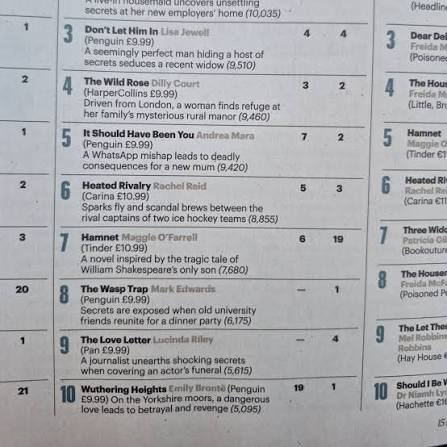
The Sunday Times bestseller list ranks UK print book sales for a single week, using point-of-sale data from Nielsen BookScan across roughly 6,500 retailers. The sales week closes Saturday night and the chart publishes the following Sunday. Charting typically takes 1,000 to 3,000 hardback copies or 5,000+ paperback copies in that one week.
Most articles about the Sunday Times bestseller list list will tell you it is prestigious and that you should write a great book and market it well. That is not information. It is a greeting card.
Here is what authors actually want to know: what counts, what does not, how many copies it takes, and whether someone without a Big 5 publisher behind them has any realistic path onto it.
This guide answers those questions with numbers, including the mechanic that decides most chart positions before a book is even on sale.
What is a Sunday Times bestseller?
A Sunday Times bestseller is a book that ranked in the top 10 of one of the paper's weekly UK sales charts. The title is earned for a single week, not for lifetime sales.
The Sunday Times has published a books chart since 1974, which makes it the longest-running list of its kind in the UK and celebrated its 50th anniversary in 2024. The paper describes it as the UK's definitive book sales chart, and the industry treats it that way.
The single most misunderstood thing about the label: it measures velocity, not volume. A book that sells 2,000 copies in one concentrated week can chart. A book that sells 200,000 copies steadily over 8 years never will. This is why you see "instant Sunday Times bestseller" on covers of books you have never heard of, and no such badge on genuine long-term sellers.
The list runs in separate charts rather than as one ranking:
- Hardback fiction
- Hardback non-fiction
- Paperback fiction
- Paperback non-fiction
- Children's
- Audiobooks (reported separately from the print charts)
That segmentation matters. Charting at number 7 in hardback non-fiction during a quiet February week is a very different achievement from charting in paperback fiction in October, and both earn the identical cover badge.
How does the Sunday Times bestseller list work?
Retailers report till-level sales to Nielsen BookScan each week. Nielsen compiles the national chart, and The Sunday Times publishes the top 10 in each category the following Sunday.
The chart is built on Nielsen BookScan TCM (Total Consumer Market), which collects data at the point of sale from roughly 6,500 UK retailers, capturing an estimated 85% to 90% of UK print book sales. It is a measurement service, not an editorial panel. No one is voting on your book.
The weekly cycle
| When | What happens |
|---|---|
| Thursday | Most UK books publish on a Thursday. Pre-orders release and land as sales on this day. |
| Saturday, midnight | The sales week closes. Anything that crosses a till after this belongs to next week's chart. |
| Sunday night to Monday | Retailers submit their sales files to Nielsen inside a narrow reporting window. |
| Midweek | Nielsen releases data to subscribing publishers. This is when publishers know, and when authors start getting nervous emails. |
| The following Sunday | The chart runs in The Sunday Times Culture section. |
The part week: the mechanic almost nobody explains
Because UK books publish on a Thursday and the sales week closes on Saturday, a new release's first chart appearance is built on 3 days of sales, not 7. The industry calls this the part week, and Nielsen logs it as week 0.
Two consequences follow, and they explain most of what happens to debut authors:
- Pre-orders are the whole game. Every pre-order placed over months lands in that 3-day window as a single spike. An author with 1,200 pre-orders starts the week at 1,200 and needs a few hundred more. An author with 40 pre-orders is not in the race.
- You get 2 realistic shots. The part week, then the first full week. After that, sales almost always decline and a book that missed is unlikely to climb.
What this means for you
If you are hoping to chart, the work is finished before publication day. A launch plan that starts on release day has already missed the window that decides the outcome.
How many books do you need to sell to be a Sunday Times best seller?
There is no fixed threshold. The bar is set weekly by whatever else is selling, and it typically lands between 1,000 and 3,000 hardbacks or 5,000 and 10,000 paperbacks.
This is the question every author asks and almost no article answers, because the honest answer is uncomfortable: the number moves every single week. You are not clearing a bar. You are beating 10 other books.
Figures reported by UK editors, agents, and charting authors put the recent ranges here:
| Chart | Typical top 10 entry | Notes |
|---|---|---|
| Hardback non-fiction | 1,000 to 1,800 copies | Usually the lowest bar of any chart. Benchmarks as low as 1,200 have been reported in 2026. |
| Hardback fiction | 1,600 to 3,000 copies | Swings widely by season. |
| Paperback fiction | 5,000 to 10,000+ copies | Higher volume format, so a higher bar. Number 1 can exceed 20,000 in a strong week. |
| Peak weeks (Sept to Dec) | Add 30% to 50% | Major names publish into Christmas gifting. The same sales that chart in February miss in October. |
Two things follow from those numbers. First, the bar is lower than most people assume. Second, and more importantly, timing is worth more than raw sales. Publishing into a quiet week is a legitimate strategy that publishers use deliberately.
These ranges come from publishing insiders reporting on recent weeks, not from an official Sunday Times or Nielsen threshold. No such published threshold exists. Treat them as working estimates.
What the Sunday Times best sellers charts do not count
The main Sunday Times best sellers charts count UK print sales only. Ebooks, most audiobook activity, international sales, and library borrows are excluded.
This is the part that reframes the whole list for a modern indie author, and it is left out of nearly every guide on the subject.
| Does count | Does not count |
|---|---|
| Print sales through UK retailers reporting to BookScan | Ebook sales, including Kindle |
| Pre-orders, on the day they release | Sales outside the UK and Ireland |
| Online print sales (Amazon UK, Waterstones, Bookshop) | Library borrows |
| Event sales, if run through a reporting till | Stock sitting in a warehouse or on a shelf |
| Supermarket and independent sales, where reported | Sales from retailers not reporting to BookScan |
A large share of UK reading has moved to digital and audio, and none of it registers on the main charts. An author can out-earn a charting title several times over and never appear on the list. If your book is primarily an ebook, the Sunday Times chart is not measuring your business.
Can a self-published author make the Sunday Times bestseller list?
Yes, but it requires physical UK retail distribution and registration with Nielsen so your sales are counted. Both are unusual for a typical self-published title.
Two hard requirements sit in front of any indie author:
- Your sales have to be reported. If your book sells through channels that do not report to BookScan, those copies are invisible to the chart no matter how many you move. Getting your title into the reporting system is a step most self-published authors never take.
- You need print distribution into UK retail. Print on demand through Amazon UK counts, but the charts are dominated by titles with physical placement in Waterstones, supermarkets, and independents. That placement is bought and negotiated by publishers, which is the real barrier.
The case that shows how thin the margin is
In 2020, indie author Mark Dawson charted at number 8 on the hardback fiction list with The Cleaner, published by the independent house Welbeck. Nielsen's midweek data showed the book at number 13 on roughly 1,300 copies, just outside the top 10. Dawson bought 400 copies of his own book, at a cost of around £3,600, and charted.
He disclosed this himself on his podcast, which is why we can discuss it. Two takeaways, and they point in opposite directions:
- The bar really is that low. A top 10 hardback slot was roughly 1,700 copies in that week. That is reachable.
- Buying your way on is a bad plan. It cost real money for a badge, publishers and Nielsen scrutinise unusual buying patterns, and it converts a sales achievement into a purchase. Our position is that the marketing value does not justify it.
The broader point stands regardless. Chart position is a function of distribution and timing at least as much as reader demand.
Sunday Times vs New York Times vs Amazon
The Sunday Times measures UK print sales, the New York Times uses a weighted and partly editorial US methodology, and Amazon ranks hourly within categories.
| Sunday Times | New York Times | Amazon | |
|---|---|---|---|
| Market | UK and Ireland | United States | Per storefront |
| Data | Nielsen BookScan point of sale | Confidential retailer panel, weighted | Amazon's own sales |
| Formats | Print, audio charted separately | Print and ebook | All formats |
| Rough threshold | 1,000 to 10,000 per week by chart | 5,000 to 10,000 per week, geographically spread | 10 to 20 copies a day in a narrow category |
| Editorial discretion | Minimal, sales-driven | Yes, titles can be excluded | None, algorithmic |
| Realistic for indies | Difficult, needs UK retail distribution | Very difficult | Achievable |
For proof of what independent authors achieve without any of these charts, our roundup of the 40 best-selling self-published books of all time is a useful corrective.
What actually moves the needle
Chart position comes down to 6 controllable inputs: pre-orders, publication timing, retail placement, concentrated launch sales, reported channels, and format choice.
1. Build pre-orders for months, not weeks
Pre-orders are the single highest-leverage input because they all land inside the 3-day part week. Everything else is noise by comparison.
2. Publish into a quiet week
January, February, and midsummer carry meaningfully lower bars than September through December. Same book, same sales, different result.
3. Get your sales counted
Confirm your title is registered and that your selling channels report to Nielsen BookScan. Uncounted sales are invisible sales.
4. Concentrate, do not spread
50 sales a week for 20 weeks is a healthier business and will never chart. 1,000 sales in 3 days will. Decide which outcome you are optimising for before you build the plan.
5. Build the email list first
Every charting launch runs on an audience that existed beforehand. There is no version of this where the audience is assembled during launch week. Our 150 book marketing ideas covers the channels that build one.
6. Be honest about format
If your book is ebook-first, the Sunday Times chart is structurally closed to you, and chasing it means spending money to move print copies you may not otherwise sell. Run the numbers with our book royalty calculator before committing.
Frequently asked questions
How often is the Sunday Times bestseller list published?
Weekly, every Sunday, in The Sunday Times Culture section. Each chart covers the 7-day sales week ending the previous Saturday at midnight.
Do ebook sales count towards the Sunday Times bestseller list?
No. The main print charts are compiled from physical book sales only. Audiobooks are reported in a separate chart. Kindle and other ebook sales do not contribute to a print chart position.
Do pre-orders count?
Yes, and they matter more than almost anything else. Pre-orders register on release day, which means they land inside the 3-day part week that determines a new book's first chart appearance.
Can you call yourself a Sunday Times bestselling author forever?
In practice, yes. One week in the top 10 of any category earns the description permanently, and publishers use it on every subsequent book. It describes one week of sales, not a career.
Is the Sunday Times list the same as The Times list?
They are related but not identical. Both draw on Nielsen data, and The Times charts have historically covered a somewhat different mix of formats and titles. The Sunday Times chart is the one authors and publishers mean by default.
How is the Sunday Times list different from a bestseller on Amazon?
Amazon ranks hourly within categories, so 10 to 20 sales in a day can produce a number 1 in a narrow sub-category. The Sunday Times ranks national weekly print sales across an entire format. They are not comparable achievements, though both get called bestseller.
Does buying your own books to chart work?
It has worked, and authors have disclosed doing it. We do not recommend it. It costs real money for a marketing label, buying patterns are scrutinised, and it does not produce the readers a book needs to keep selling.
Write the book that earns, then worry about lists
Charts reward a single week. A well-launched book pays for years. If you want to have a successful book launch, talk to a coach about the plan that gets you there. Book a free strategy call today.