






















TL;DR To write a soliloquy, put one character alone, give them a decision they can't make, and let them think out loud until they land somewhere new. Most soliloquies run 20–40 lines (roughly 150–300 words) and follow a five-part structure: trigger, question, argument, counter-argument, and turn. The speech must change the character, not just describe them.
Most writers who try to learn how to write a soliloquy end up with a character standing alone, narrating things the reader already knows.
That's the trap.
A soliloquy isn't a summary delivered in a fancier voice. It's a decision happening in real time. It's the one moment where a character stops performing for everyone else and argues with themselves.
Get it right and it becomes the passage readers quote. Get it wrong and it's the passage they skip.
This guide walks through the exact process: what a soliloquy is, how to structure one, how long it should be, and how to start it, with classic and modern soliloquy examples you can study line by line.

Get Your Free eBook of Published.
The proven path from blank page to 10,000 copies sold - written by 7-time bestselling author, Chandler Bolt
What Is a Soliloquy?
Quick answer: A soliloquy is a speech a character delivers while alone on stage or on the page, revealing private thoughts no other character can hear.
The word comes from the Latin solus (alone) and loqui (to speak). The defining condition is isolation: the character believes no one is listening, so there's no reason to lie.
That's the whole engine.
A soliloquy works because the audience gets access no other character has. We hear the version of the person that exists when the performance stops.
Soliloquy vs. monologue vs. aside
These three get confused constantly. The difference comes down to who is listening.
| Device | Audience within the story | Length | Purpose |
|---|---|---|---|
| Soliloquy | None - the character is alone | 20–40 lines | Reveal unfiltered private thought |
| Monologue | Other characters are present and listening | Varies widely | Persuade, confess, explain, perform |
| Aside | Audience only, mid-scene, others unaware | 1–3 lines | Quick ironic comment or reveal |
The practical test: if another character could plausibly respond, it's a monologue. If a response would break the spell, it's a soliloquy.
Step 1 - Understand the Purpose of a Soliloquy
A soliloquy exists to show a character deciding something. If it only describes feelings, cut it and use narration instead.
Soliloquies do three jobs well. Any speech that doesn't do at least one of them isn't earning its space.
- Character revelation. The reader learns something the character would never admit out loud to another person (a fear, a motive, a shameful want).
- Dramatic tension. The reader now knows something other characters don't. Every scene afterward carries that weight.
- Thematic pressure. The speech articulates the question the whole book is actually asking, in the voice of someone living it.
Hamlet delivers seven soliloquies across the play, and each one moves him. He doesn't restate his grief. He argues himself from paralysis toward action. That progression is why the speeches survive four centuries of performance.
Here's the rule worth taping to your monitor: a character must exit a soliloquy in a different position than they entered it. New decision, new resolve, new despair. If they end where they started, you've written a mood piece.
Step 2 - Select the Right Character
Choose the character carrying an unresolvable internal conflict. It should be someone whose public behavior contradicts their private belief.
Not every character can hold a soliloquy. Score your candidates against these four criteria:
- Do they have a secret? Something they're concealing from every other character in the book.
- Are they at a decision point? A soliloquy needs a fork in the road, not a straight highway.
- Is their public self different from their private self? The gap between the two is the content of the speech.
- Do they have the interiority to sustain it? Some characters think in paragraphs. Some think in grunts. Only one of those gives you 250 words.
Villains and antiheroes tend to make the best candidates because their private logic is the most surprising. Macbeth's dagger speech works precisely because a decorated soldier is talking himself into murder.
Struggling to find that character? That's usually a signal the problem is upstream and the character's core want and fear aren't defined yet. Our guide to writing a novel covers how to build characters with enough interior conflict to carry a scene like this.
Step 3 - Create Authentic Inner Dialogue
Write the soliloquy in the character's private vocabulary. These should be the words they'd use with no one listening, not your best writing voice.
The most common failure in soliloquy writing is that every character sounds like the author being eloquent. Three controls fix that.
Voice and diction
Match vocabulary to background, education, and era. A dockworker and a bishop don't reach for the same metaphors under stress. Read the speech aloud and ask: would this person really say that word?
Emotional range
Real thinking isn't one note. It jumps from anger to self-pity to bargaining to cold clarity, sometimes inside three sentences. A soliloquy with a single emotional temperature reads as flat.
Conflict and resolution
Give the character an opposing voice inside their own head. The speech should feel like an argument with two sides, both of which the character believes.
How to start a soliloquy: 4 opening moves that work
Openings matter more here than almost anywhere else, because you're asking the reader to accept a sudden shift into private thought. These four openings earn that shift fast:
- Open on the question. State the dilemma directly in the first line. "To be, or not to be, that is the question" is the template. Hamlet names the fork before he explores it.
- Open on a physical object. Let the character notice something in the room and build outward. Macbeth starts with a hallucinated dagger, not with abstract guilt.
- Open mid-argument. Start as though the character has already been thinking for a while: "Fine. So I'm the villain, then." This creates immediate momentum.
- Open on a denial. Have the character reject the thing they're about to admit. The rest of the speech dismantles the denial.
What doesn't work: starting with scene-setting or a description of how the character feels. Both signal to the reader that nothing is at stake yet.
Step 4 - Consider Structure and Rhythm
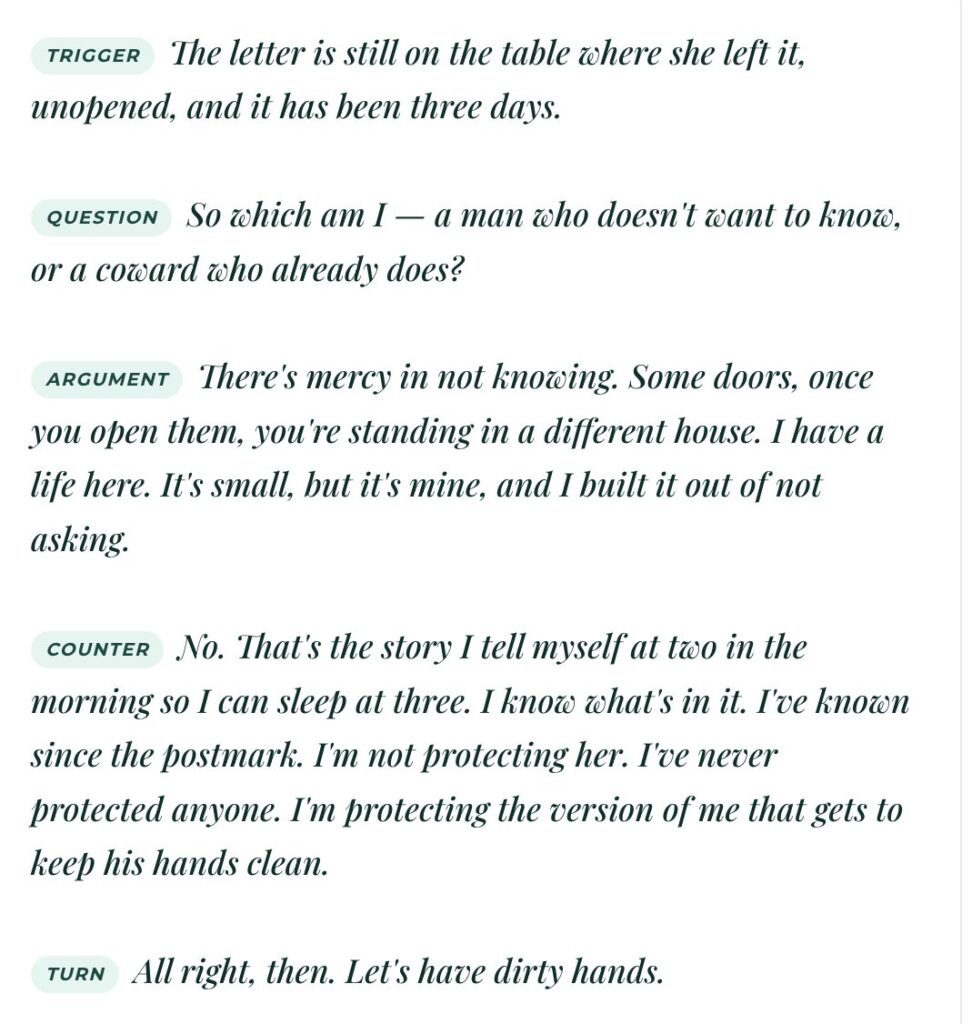
Effective soliloquy structure follows five beats: trigger, question, argument, counter-argument, and turn. The turn is non-negotiable.
Most guides tell you there are no rules for soliloquy structure. That's technically true and practically useless. Here's the shape the memorable ones almost always take.
The 5-part soliloquy structure
| Beat | What happens | Approx. share |
|---|---|---|
| 1. Trigger | Something just happened that forces the character into thought | 10% |
| 2. Question | The character names the dilemma out loud | 15% |
| 3. Argument | They build the case for one side | 25% |
| 4. Counter-argument | They attack their own reasoning | 30% |
| 5. Turn | They land on a decision, a resolve, or a deeper despair | 20% |
Notice that the counter-argument is the largest section. That's deliberate. The reason weak soliloquies feel like speeches is that the character never seriously argues against themselves.
Here is a short soliloquy example broken down:
Beyond structure, three rhythm controls raise the quality of any soliloquy writing:
- Vary sentence length. Long sentences for spiraling thought, short ones for the moments of clarity. The turn should almost always be the shortest sentence in the speech.
- Use strategic repetition. Repeat a phrase two or three times with variation to build pressure. Never more than three. Past that, it reads as a tic.
- Anchor abstraction in image. Every philosophical claim needs a physical object attached to it. Hamlet's death anxiety becomes an "undiscovered country." Abstraction alone puts readers to sleep.
How long is a soliloquy?
Most soliloquies run 20–40 lines or roughly 150 to 300 words. It should be about 1–2 minutes of spoken performance.
The benchmarks are consistent across the canon. Hamlet's "To be, or not to be" is about 33 to 35 lines depending on the edition, totaling roughly 262 words. Macbeth's dagger soliloquy runs a similar length. Both take two to three minutes on stage.
For novelists, the practical ceiling is lower. A soliloquy in prose competes with the reader's option to skim, so:
- 150–250 words - the safe range for most novels
- 250–400 words - workable at a genuine climax, if the voice is strong
- 400+ words - almost always needs cutting or breaking with physical action
Length is a symptom, not a cause. A soliloquy that runs long is usually one where the character isn't actually deciding anything.
Step 5 - Contextualize the Soliloquy
Place the soliloquy immediately after the event that makes the decision unavoidable, and make sure the plot changes because of it.
A soliloquy dropped into a calm stretch of story reads as an interruption. Two placement rules keep it load-bearing:
Plot progression
The speech must produce something the story needs. A choice made, a plan formed, a truth admitted. If you could delete the soliloquy and the next chapter would be identical, it's decoration.
Dramatic timing
The strongest placement is directly after new information lands and directly before the character acts on it. That's the narrow window where a reader will accept a pause because they're waiting to find out what the character will do.
Practically: put your soliloquy at the end of a chapter. The white space does half the work, and the reader turns the page carrying the character's decision with them.
Step 6 - Edit and Refine Your Work
Read the soliloquy aloud, cut every line that restates something the reader already knows, and sharpen the final sentence.
Run your draft through this five-pass edit:
- The redundancy pass. Delete every sentence conveying information already on the page. This alone typically cuts 20–30%.
- The voice pass. Highlight any word the character wouldn't use. Replace each one with their word, even if yours was prettier.
- The verb pass. Swap weak verb-plus-adverb pairs for single precise verbs. Our list of strong verbs is built for exactly this pass.
- The aloud pass. Read it standing up, out loud, at performance pace. Anywhere you stumble, the rhythm is broken.
- The last-line pass. The final sentence carries the turn. It should be short, decisive, and quotable. Rewrite it at least five times.
One more check worth running: does the speech show the character's state, or just report it? If it reports, our guide to show, don't tell covers the fix.
Soliloquy Examples
The strongest soliloquy examples come from stage drama, but modern novels use the same device through sustained first-person interior narration.
3 classic stage soliloquy examples
- Hamlet - "To be, or not to be" (Hamlet, Act 3, Scene 1). The definitive soliloquy example. Roughly 33 lines, 262 words. Hamlet opens on the question, argues both sides of existence, and is interrupted before landing a clean turn (which is itself the point).
- Macbeth - "Is this a dagger which I see before me" (Macbeth, Act 2, Scene 1). A masterclass in the trigger beat. Macbeth starts with a hallucinated object and rides it into the decision to kill.
- Iago - "And what's he then that says I play the villain?" (Othello, Act 2, Scene 3). Proof that villain soliloquies land hardest. Iago tells the audience exactly what he'll do, and the dread of watching it happen carries the rest of the play.
5 modern soliloquy examples from novels
Prose fiction rarely labels these as soliloquies, but the mechanism is identical. You get a character alone, thinking without a filter, with the reader as the only witness.
- Holden Caulfield - The Catcher in the Rye by J.D. Salinger. The entire novel functions as extended soliloquy. Holden addresses the reader directly and contradicts himself constantly, which is the honesty.
- Captain Ahab - Moby-Dick by Herman Melville. Ahab's speeches are staged like theater, complete with dramatic apostrophe. Melville was borrowing from Shakespeare deliberately.
- Esther Greenwood - The Bell Jar by Sylvia Plath. Interior narration that tracks a mind coming apart in real time, using flat declarative sentences to devastating effect.
- Offred - The Handmaid's Tale by Margaret Atwood. Offred's interior voice is the only space in the novel where she isn't surveilled, which makes every private thought an act of resistance.
- Meursault - The Stranger by Albert Camus. A study in withholding. The soliloquy power comes from what Meursault refuses to feel, not what he articulates.
Study these for one thing specifically: how each character's private voice differs from how they speak to others in the same book. That gap is the technique.
5 Common Soliloquy Writing Mistakes
Most failed soliloquies share the same flaw: the character describes their situation instead of arguing with themselves about it.
1. The recap
The character summarizes plot events the reader just watched.
Fix: cut to the one thing they haven't admitted yet, and start there.
2. The author's voice
The speech is beautifully written, and sounds nothing like the character.
Fix: rewrite it in their vocabulary, then add back only the imagery they'd plausibly reach for.
3. No opposing voice
The character makes one argument, uninterrupted, and agrees with themselves throughout.
Fix: build the counter-argument beat until it's the longest section.
4. No turn
The speech trails off in the same emotional position it started.
Fix: write the last line first, then work backward to earn it.
5. Wrong placement
It lands during a lull, so the reader skims it.
Fix: move it to directly after the moment that makes the decision unavoidable, ideally at a chapter break.
Soliloquy FAQ
What is the format of a soliloquy?
A soliloquy is a single uninterrupted speech delivered by a character who is alone. In verse drama it's typically written in blank verse with unrhymed iambic pentameter, and ten syllables per line. In prose fiction it appears as an unbroken block of interior narration with no dialogue tags and no other speakers.
What are the key elements of a soliloquy?
Four elements are essential: the character must be alone, the thoughts must be private and unfiltered, there must be a genuine internal conflict, and the character must reach a new position by the end. Remove any one and the speech stops functioning as a soliloquy.
Can you write a soliloquy in a novel?
Yes. In prose it takes the form of sustained interior monologue with the character alone, thinking without narrative interruption. Keep it to 150–250 words and place it at a chapter break so the pause reads as deliberate rather than as a stall.
What is the difference between a soliloquy and a monologue?
A soliloquy is delivered alone, so the character has no reason to perform. A monologue is delivered to other characters who can hear it, which means it may be strategic, dishonest, or persuasive. The presence of a listener is the whole distinction.
How do you start a soliloquy?
Open with the dilemma itself, a physical object in the room, a mid-argument fragment, or a denial. Avoid opening with scene description or a statement of how the character feels. Both stall the speech before it starts.
Now That You Know How to Write a Soliloquy
Strip away the Shakespeare and a soliloquy is simple: one person, alone, arguing with themselves until something changes.
Give them a real dilemma. Let them make the case for the wrong choice. Let them tear it down. Land the turn in as few words as possible.
Then do the harder work. Put that scene inside a finished book. A brilliant soliloquy in an unfinished manuscript changes nobody's life. A decent one in a published book can change 1,200.
If you're ready for that part, grab a free copy of Published. the proven path from blank page to 10,000 copies sold, or book a free strategy call with our team to start your journey to the next bestseller with one on one coaching and professional help every step of the way.