















TL;DR
To start a story that hooks readers, your opening sentence needs to do at least two of four things: connect readers to a character, produce intrigue, elicit an emotion, or paint a vivid image. From there, your first paragraph makes a promise, your last paragraph plants a hint, and every chapter ending gives readers a reason to keep turning pages. Follow the 10 steps below to build an opening that sells your book from page one.
Nobody owes your book their attention. Not your best friend, not your book club, not even your mom (she'll cheer you on, but "supportive" and "actually going to read it" are two different things).
That means the desire to keep reading has to be built, one sentence at a time, starting with the first one. Your opening page is the only pitch most readers will ever give you a chance to make.
The good news: learning how to start a story is a teachable skill, not a mystery. Get these 10 steps right, and your opening will hook the reader, promise them something worth sticking around for, build a real connection to your character, and set up the sale, whether that sale happens on a bookstore shelf or an Amazon product page.

What makes a strong story opening
A strong story opening hooks the reader, promises them something worth their time, builds a connection to your character, and sets up the sale, all within the first page.
Remember: the first page isn't the first page you wrote. It's the first page someone reads. If your original opening doesn't do these four jobs, it's the first thing to cut when you revise.
1. Write a strong opening sentence
A strong opening sentence is well-aimed, not a warning shot. It sets the tone and pulls the reader directly into your character's world.
Your opening sentence should include at least two of these four elements:
- Connect the reader to a character
- Produce intrigue
- Elicit an emotion
- Paint a vivid, snapshot-worthy image
One reliable technique is diving straight into the action, a device screenwriters call "in medias res" (Latin for "in the middle of things"). It works because it forces the reader to accept what's happening right now, while inviting them to find out what happens next, or how the character got here. To pull this off, know your setting well enough to deliver it with confidence. Don't over-explain, and don't linger.
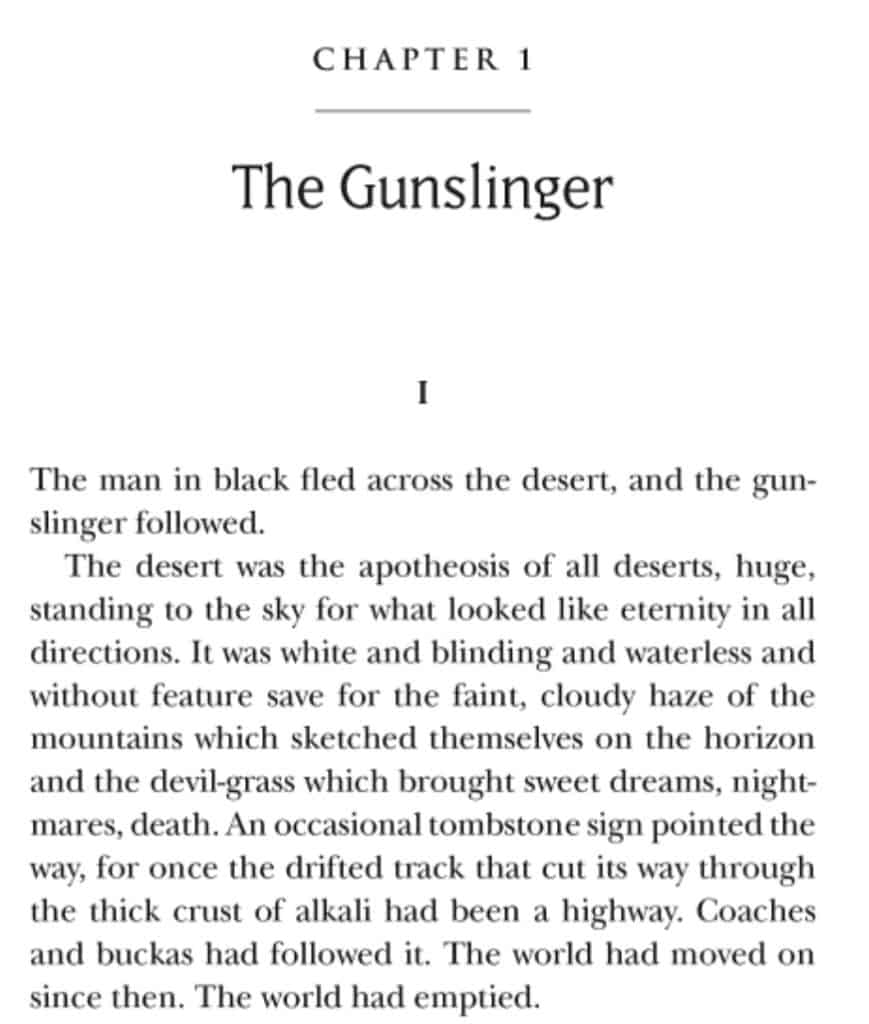
"The man in black fled across the desert, and the gunslinger followed." Opening line, The Gunslinger by Stephen King

2. Connect the character to the reader
Readers buy in when they care about your character. Show a strength, a weakness, or an in-character insight to build that connection fast.
Fantasy author Brandon Sanderson teaches a simple rule in his writing lectures: give your opening character two of these three traits, never all three.
- Sympathetic
- Likeable
- Competent
Give a character all three and you risk a "Mary Sue," a character so perfect readers stop believing they're real. This is also why fully developing your character before you draft the opening pays off.
"Locke Lamora's rule of thumb was this: a good confidence game took three months to plan, three weeks to rehearse, and three seconds to win or lose the victim's trust forever." Opening line, The Lies of Locke Lamora by Scott Lynch
3. Produce intrigue
Producing intrigue means leaving more questions than answers. The more you know about your story, the more precisely you can plant that first hint.
Avoid vague prophecy. Instead, hit readers with a detail that will echo later, once they reach your resolution.
"Chris Mankowski's last day on the job, two in the afternoon, two hours to go, he got a call to dispose of a bomb."
4. Elicit an emotion
Eliciting emotion means placing the reader in a specific feeling, not just using emotional words. Trigger phrases and juxtaposition do this well.
You're not aiming to make readers feel for the character yet, that comes later. You're setting an emotional headspace for the page that follows. In the example below, "dead" and "sky" create a juxtaposition that pulls readers in immediately.
"The sky above the port was the color of television, tuned to a dead channel." Opening line, Neuromancer by William Gibson

5. Create a strong visual snapshot
A visual snapshot is a picture painted in a few words, the highlights of a scene, not the whole landscape.
Three techniques make this work:
- Show, don't tell
- Use strong verbs
- Learn how to use imagery
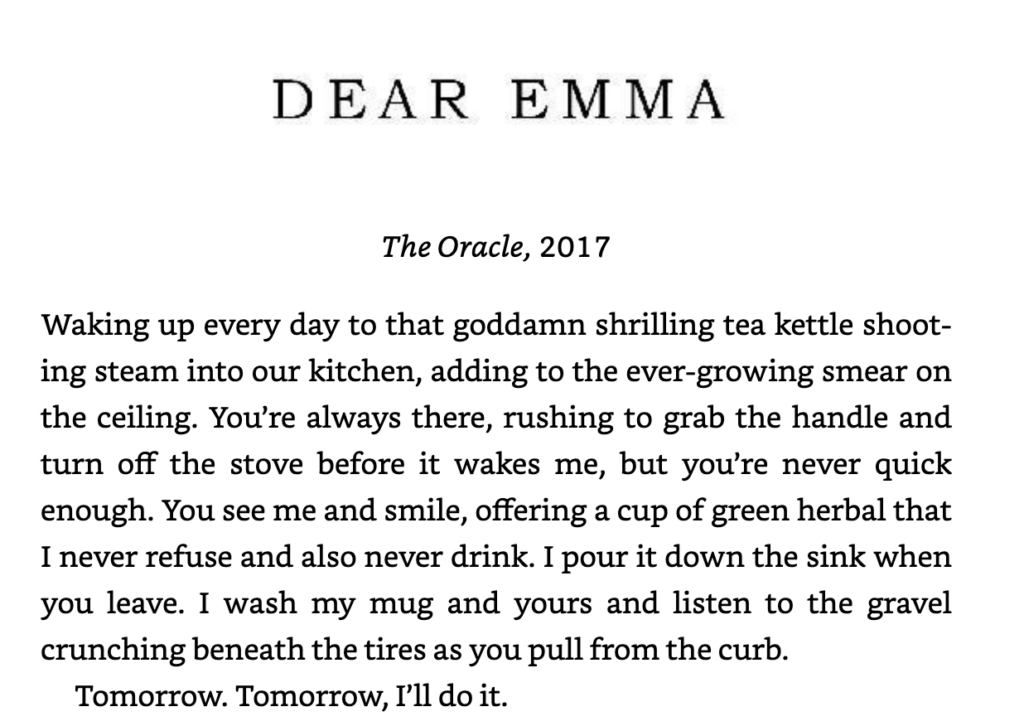
"Waking up every day to that goddamn shrilling tea kettle shooting steam into our kitchen, adding to the ever-growing smear on the ceiling." Opening line, Little Birds by Hannah Lee Kidder
6. Construct a compelling first paragraph
Your first paragraph has three options: stay the course, ramp up gradually, or double down. Pick one and don't shake the hook loose with too much pull.
Staying the course
Keep the same tone and attention from your opening sentence. This works best for mystery stories, or any story that opened with a dive into action. Stephen King uses this in The Gunslinger: the paragraph after that famous opening line is a slow, deliberate snapshot of the desert, holding the reader rather than yanking them further in.
Ramping up gradually
Add detail through the paragraph to build interest, separating your character or setting from others of its type. E.M. Forster's A Passage to India opens with a wide panoramic shot of a city, a technique modern film calls an aerial establishing shot, written years before film existed.
Double down
The hardest technique: pull hard and fast to build on the momentum of your first sentence. In The Night Circus by Erin Morgenstern, a mysterious circus appears in the first sentence, and the first paragraph complicates that mystery by suggesting the circus didn't just appear unannounced. It may have materialized out of nowhere.
Avoid the Goldilocks paradox
Whichever approach you choose, avoid two failure modes:
- Too obvious: readers recognize the plot instantly (the fetch quest, the star-crossed lovers) and put the book down
- Too obscure: readers have no investment because nothing is grounded in familiar territory
Land in familiar territory with a new spin. Don't reinvent story structure in your first chapter. Earn the reader's trust before you start pulling the rug out from under them.
7. Leave a hint in the last paragraph
Your last paragraph should introduce a new idea while limiting resolution. Aim for one of four moves: a hint, a roadmap, a cliffhanger, or a bookend.
Each of these gives readers a reason to keep going. When you drop a hint, make it broad enough to be interesting but narrow enough that your resolution, within the next chapter or two, satisfies it completely. If you're building a large world that needs several things set in motion before the major plot kicks in, a roadmap earns the reader's patience. Show them the road ahead before you ask them to walk it.
8. End the chapter on a cliffhanger
A cliffhanger ending demands the reader turn the page. Pulp serials of the 1930s built entire careers on this technique.
Four reliable cliffhanger triggers:
- Someone appears: a new character enters with weight, like the faery-door baby at the end of chapter 1 of Stardust by Neil Gaiman
- A lingering question: readers wonder about something unresolved and want an answer
- A sudden insight: a character understands something the reader didn't, raising the stakes
- The depths appear: larger forces are hinted at, common in science fiction, horror, and fantasy
9. Try a bookend for the first chapter
A bookend ending mirrors your first sentence to show how far the story has already turned. It works especially well when you start in a familiar, known world.
Dorothy isn't in Kansas anymore. Alice ends up down the rabbit hole. The once-bright sky is now overcast with the trouble to come. That's the bookend at work.
10. Avoid clichés
Avoid mundane world-building, tired tropes dressed up as clichés, and the classic "he woke up" opening. Readers want something genuine, not familiar filler.
Don't spend your opening explaining what your world isn't. Establish what it is, and trust the reader to know mundane information without repeating it. A trope is fine in an established book genre, a cliché is the same idea expressed the same way every time. Your fantasy world can have a dungeon and a dragon, just don't introduce them in the same breath everyone else does.
And skip the "waking up" opening. It's tempting to start at a character's first conscious moment, but you don't remember the first few minutes of your own day, so why would a reader want your character's? Even Alien 3 couldn't make it work
"The thing was big and white and hairy, and it was eating all the ice cream in the walk-in freezer." Opening line, Monster by A. Lee Martinez
FAQ
What is the best way to start a story?
The best openings connect readers to a character, produce intrigue, elicit an emotion, or paint a vivid image, ideally combining at least two of these in the first sentence.
What is in medias res?
In medias res means starting your story in the middle of the action, dropping the reader directly into an event already underway.
Should you start a story with dialogue?
You can, as long as the dialogue produces intrigue or reveals character right away. Dialogue without context can leave readers confused about who is speaking and why it matters.
Why shouldn't you start a story with a character waking up?
Waking up is a mundane moment nobody remembers clearly in real life, and it delays the actual hook. Start where the story's tension begins instead.
How long should a story's opening be?
Your opening sentence and paragraph should be long enough to hook, promise, and connect, usually just a few sentences, not a full page of setup.
What is a bookend ending?
A bookend ending mirrors your opening sentence at the close of the first chapter, showing readers how far the story has already shifted.
Start your next bestseller today
You know how to start a story now. Writing it, editing it, and publishing it are the next steps, and selfpublishing.com has helped over 7,000 authors through every step of the self-publishing process. Could your book be next? Book a free strategy call to learn more today.