

















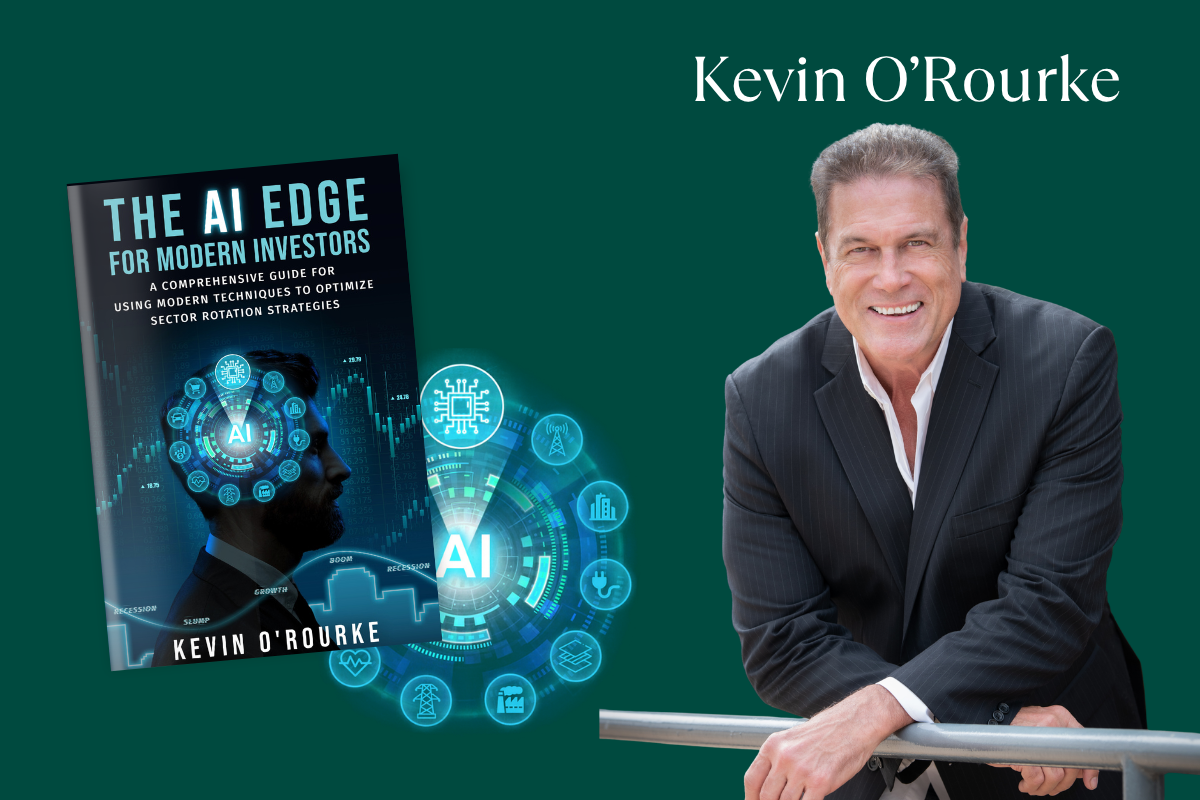
Most books give you either a timeless investing framework or an AI pitch—this one gives you both: the actual history of how professionals read market cycles and the exact prompts to run that analysis yourself.
In The AI Edge for Modern Investors, financial strategist and West Point graduate Kevin O’Rourke delivers a groundbreaking roadmap for navigating today’s rapidly evolving markets using AI-enhanced strategies. As economic cycles shorten and data floods every corner of the financial world, traditional investing methods fall short. This book shows you what comes next.
Today, we sat down with Kevin to talk about the book, his experiences, writing process, and why every entrepreneur and investor should read this book.
Book Title: The AI Edge for Modern Investors,A Comprehensive Guide for Using Modern Techniques to Optimize Sector Rotation Strategies
Genre: Business & Economics / Investments & Securities / Analysis & Trading Strategies
Website: www.the-aiedge.com
Hey, Kevin! Can you start by sharing a bit about what inspired you to write about this book?
My four years at West Point and a Bachelor of Science in Engineering prepared me to lead men in combat or, in theory, design an artillery weapons system from scratch. What I struggled with, standing in my first house as a newlywed Second Lieutenant at Fort Sill, Oklahoma, was figuring out where my paycheck was going every month. There was no personal finance course at the Academy, nothing that prepared me for managing a mortgage or building an investment account on a lieutenant's salary. I wasn't careless with money; I just didn't have the tools to think clearly about it. And this was before the internet existed, so even the basic act of researching my own decisions meant evenings spent hunting through whatever printed material I could find.
That gap has stuck with me for forty years: elite technical training and real financial competence are two completely different educations, and almost nobody gets both. Most investors today are in some version of that same position; they’re plenty capable in their own field, genuinely underprepared for the specific judgment calls investing requires. That's the gap I think AI is finally positioned to close, not by replacing that judgment, but by giving people access to the kind of sophisticated, structured analysis that used to require years of formal training to develop.
Why was now the right time to share this idea?
I was contemplating a significant reallocation of some client's assets. I began to gather and analyze a variety of inputs from economic, fundamental, and global data points. I thought, "Why not plug them all into an LLM and see what comes out?" The level of deep analysis and sophisticated output made me realize I had the makings of a powerful book.
Who would you say must read this book?
Two-part answer: The self-directed investor who's outgrown generic advice, consumes financial data, and likely manages their own portfolio. Also, the capable professional with a blind spot around money who is likely excellent in a demanding field (engineering, medicine, the military, or tech) who never got formal financial education and knows it. This could also be an advisor or junior analyst building AI fluency fast who's shopping for a structured, defensible way to get their team or their own practice up to speed on AI-assisted research.
What are the top 3 things someone will learn from reading your book?
- The reader will internalize the four-phase framework (Expansion, Peak, Contraction, Trough) tied to specific, checkable signals (yield curve slope, PMI, credit spreads, inflation trends) rather than vibes or news-cycle reaction. The reader doesn't finish knowing trivia about business cycles; they finish with a repeatable way to look at real data and locate themselves in the cycle before deciding where capital should move next.
- The reader doesn't just come away believing "AI is useful for investing"; they come away with the literal muscle memory of how to do it: a specific prompt-chaining sequence (read the regime → rank the sector tilts → stress-test the result), the eight Appendix B templates to run it with, and the discipline of treating a model's output as a first draft that needs verification against real numbers, not a finished answer. That's the difference between finishing a book with an impression and finishing it with a process you can actually run the same afternoon.
- "AI is a partner, not a prophet" isn't just a nice line; it's the thing standing between a reader using this book well and a reader mistaking a stress-test output or a sector ranking for a guarantee. The reader who's internalized that AI-assisted analysis always needs independent verification and that no framework herein promises outperformance.
What was one of your favorite parts of the process?
I learned more about AI and its capabilities and advancements than I could have by just reading and studying the literature. I also learned so much about writing a book that I want to almost immediately begin another one.
What are your plans for the future with this book and/or your business?
I want to teach individuals and businesses the power and quality of using AI to make better investment management decisions. I plan on being very public about advancing that goal and reaching as wide an audience as possible.
More about Kevin O’Rourke:
Kevin O'Rourke graduated from the United States Military Academy at West Point with a Bachelor of Science in Engineering and competed on both the football and track teams. He was commissioned as a Field Artillery officer in the U.S. Army and, while stationed at Fort Sill, Oklahoma, completed his MBA at the University of Oklahoma with a concentration in International Finance. During that MBA, a grant sent him to Oxford to study under Sir Geoffrey Howe, the former UK Chancellor of the Exchequer, just as the European Economic Community was becoming the European Union. The experience gave him a firsthand education in how slow-moving structural shifts eventually reshape markets that, on any given day, seem to react to something else entirely.
After his military service, Kevin moved to the leading edge of technology, working in relational database management systems and global packet-switched networking systems as those fields quietly rewrote how information moved.
He then began a four-decade career in financial services, starting at the bottom as a stockbroker and advancing to Vice President roles with two major brokerage firms, Thompson McKinnon and Prudential-Bache Securities. He later became Managing Director at Chase Manhattan Bank. After leaving the bank, Kevin served as Senior Portfolio Manager at a prestigious investment firm in San Diego, overseeing more than $1 billion in client assets. During this time, he earned his Chartered Financial Analyst (CFA) charter, one of the most rigorous and respected credentials in investment management. Shortly thereafter, he formed his own asset management firm and became one of the few money managers who not only predicted the 2007-2009 market meltdown but also made money for his clients during those years (third-party audit verified).
In 2024, Kevin was included in Marquis Who's Who in America, recognizing a career spent translating complexity into something a client could act on. He is the author of The AI Edge for Modern Investors, a book that pairs a business-cycle investing framework with a practical guide to using AI tools responsibly in investment research. This reflects four decades spent learning the principles and strategies the book shares.
Connect with Kevin: https://www.linkedin.com/in/kevin-o-rourke-bab4828
Has Kevin’s story inspired you to share your own? Learn more about the book writing support, editing services, book coaching, and more she received as a part of the Author Advantage Accelerator Elite Program? Schedule a consultation today or take the quiz above to find the right program for you and your book!
Other related selfpublishing.com articles: