











TL;DR
Project Gutenberg is a free digital library of nearly 79,000 public domain ebooks, founded by Michael Hart in 1971. There's no cost, no account required, and no catch. You download or read in plain text, HTML, ePub, or Kindle format. It's best for classic literature, research, and readers who want free, legal access to books with expired copyrights. It's not a self-publishing platform for making money from new work.

Most "free ebook site" reviews are really just directories dressed up as content. This one isn't. We tested the search tools, checked the copyright process against current law, and compared Project Gutenberg against six real alternatives, so you know exactly what you're getting before you spend an afternoon browsing it.
What is Project Gutenberg?
Project Gutenberg (gutenberg.org) is a volunteer-run digital library of nearly 79,000 free ebooks, most of which are in the public domain because their copyright has expired.
Michael S. Hart founded Project Gutenberg in 1971, making it the oldest digital library in existence, predating the World Wide Web by nearly 20 years. Hart's original idea was simple: type up the Declaration of Independence and make it available to anyone with computer access. That single file became the seed of a project now approaching 79,000 titles.
Project Gutenberg is run entirely by volunteers and funded by donations through the Project Gutenberg Literary Archive Foundation. There's no ownership model, no ad revenue, and no paywall. The collection stays free because the people who built it wanted it that way.
What’s in the Project Gutenberg collection?
Project Gutenberg books focus on public domain classics (novels, historical documents, and reference works) spanning dozens of languages, with new titles added daily by volunteer transcribers.
The library skews heavily toward English-language novels, simply because that's what most volunteers choose to digitize. But you'll also find Finnish, Swedish, Dutch, and dozens of other languages represented, since anyone can contribute a public domain work in their own language.
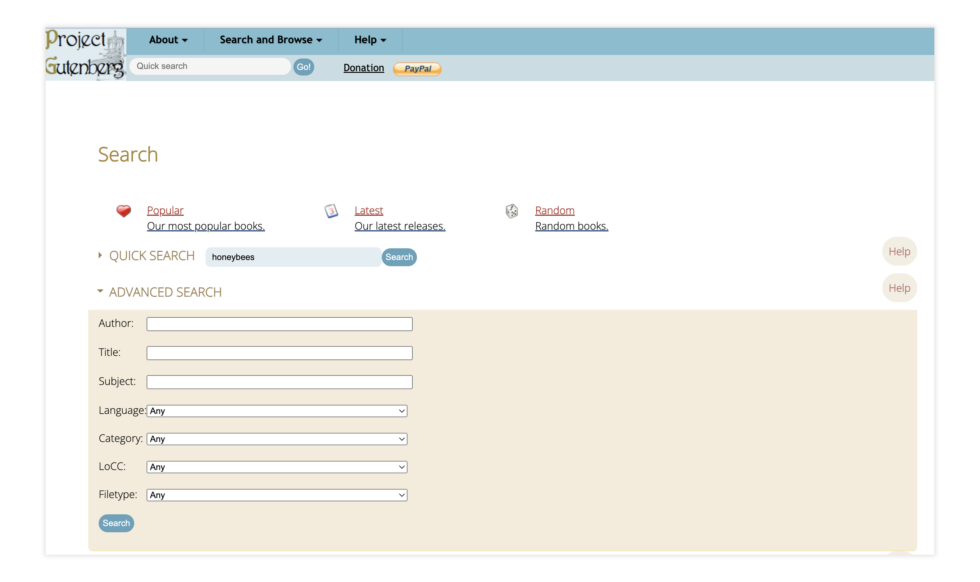
You can find a book in one of three ways:
- Book Search: search by title, author, subject, or language
- Bookshelves: browse hand-curated categories, similar to genre shelves at a physical bookstore
- Frequently Downloaded: a running Top 100 list, useful for finding what's actually being read right now
Search is fast and the advanced filters (by language, popularity, or release date) work well. This is one of the few places where the site's dated visual design undersells how functional it actually is.
What formats does Project Gutenberg offer?
Every ebook is available in plain text, HTML, ePub, and Kindle-compatible format, so it works across nearly any device without needing a dedicated app.
This matters more than it sounds. A lot of "free ebook" sites lock you into one file type or a proprietary reader. Project Gutenberg's multi-format approach means you can read the same title on a Kindle, an iPad, or straight in a browser, no conversion tool required.
How much does Project Gutenberg cost?
Project Gutenberg is completely free. There are no subscription tiers, download limits, or paywalled titles anywhere in the catalog.
The project runs on voluntary donations to the Project Gutenberg Literary Archive Foundation, but giving is never required to read or download. If you use the library regularly, a small donation is a fair way to support the volunteers who digitize and proofread every title by hand.
Who can use Project Gutenberg?
Anyone, anywhere, at no cost. There's no account creation, age restriction, or geographic limitation to access the catalog.
Students, researchers, and casual readers all use the same open catalog. The one practical caveat: public domain status is determined by U.S. copyright law, so a small number of titles legally available in the U.S. may not be public domain in other countries.
How does copyright work on Project Gutenberg?
Nearly every title on Project Gutenberg has an expired copyright, meaning it's legally free to distribute; a small number of newer works are hosted with the copyright holder's direct permission.
Project Gutenberg verifies copyright status against U.S. law before adding any title, and keeps a record of that clearance. For copyrighted works it does distribute (such as some Cory Doctorow titles) the author has explicitly authorized free distribution, often under a Creative Commons license.
One nuance worth knowing: what counts as public domain varies by country. A title cleared for free U.S. distribution isn't automatically public domain everywhere else.
Does Project Gutenberg have audiobooks?
Yes. Project Gutenberg partners with LibriVox for volunteer-narrated audiobooks, and has also used AI narration to expand its audio catalog by tens of thousands of hours.
As of 2023, Project Gutenberg had used AI-generated narration (built on Microsoft Azure) to produce roughly 35,000 hours of audiobooks from its public domain catalog, a scale volunteer narration alone couldn't reach as quickly. If you'd rather listen than read, this is one of the most overlooked features of the platform.
Should authors use Project Gutenberg Self-Publishing Press?
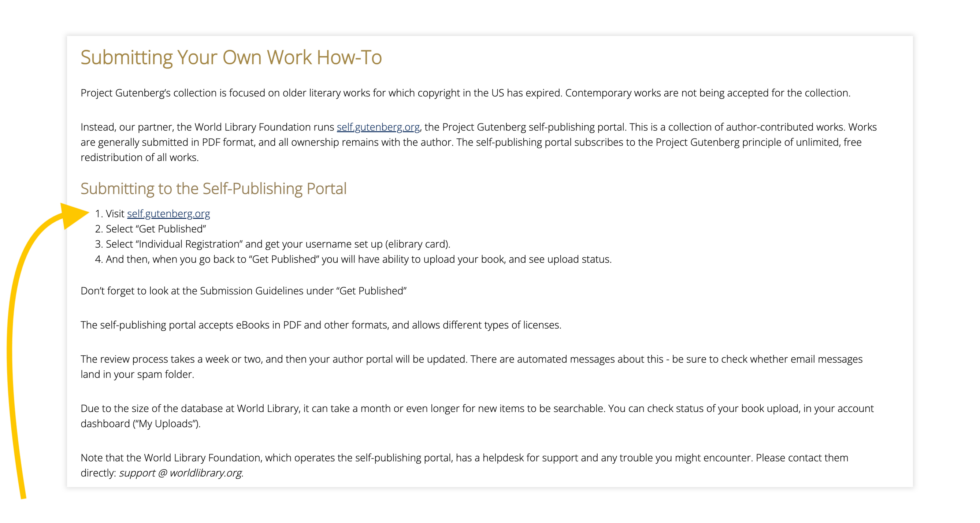
Project Gutenberg Self-Publishing Press lets authors submit new or self-published work for free distribution, but it's a separate organization from Project Gutenberg itself, and it won't generate you any income.
This is the detail most reviews get wrong: the Self-Publishing Press (also called the Project Gutenberg Self-Publishing Portal, at self.gutenberg.org) is run by the Project Gutenberg Consortia Center, a separate entity that licenses the Project Gutenberg name. It's not an arm of the original Project Gutenberg Literary Archive Foundation.
Submitting your book there gets it in front of readers for free, which can help with word-of-mouth and discovery, but it's not a monetization channel. There are better self-publishing companies out there.
If your goal is to actually earn from your writing, giving away every copy for free works against that goal from day one.
Project Gutenberg pros and cons
What it does well
- Completely free, no account or payment ever required
- Nearly 79,000 titles and growing daily
- Multiple formats (text, HTML, ePub, Kindle) work on any device
- Transparent, well-documented copyright clearance process
- Fast, filterable search despite a dated interface
Where it falls short
- Almost entirely older, public-domain titles (don't expect current releases)
- Interface and site design feel dated compared to modern ebook apps
- English-language and Western classics are overrepresented
- Self-Publishing Press won't help you earn money from your book
Project Gutenberg alternatives
Internet Archive, LibriVox, and Open Library are the closest free alternatives, each with a different focus, from audiobooks to lending to scholarly access.
| Alternative | Best for | Cost |
|---|---|---|
| Internet Archive | Books, audio, video, and web archives in one place | Free |
| LibriVox | Volunteer-narrated audiobooks of public domain titles | Free |
| Open Library | Borrowing ebooks, including some in-copyright titles | Free |
| ManyBooks | Simple browsing by genre with multiple download formats | Free |
| Google Books | Searching and previewing a huge index, not all fully free | Mixed |
| HathiTrust | Academic and research access, including print-disability accommodations | Free / institutional |
Project Gutenberg FAQ
Is Project Gutenberg safe? Is Project Gutenberg legal to use?
Yes. Project Gutenberg only distributes titles after verifying their copyright status under U.S. law, and it has operated transparently as a nonprofit since 1971.
Is Project Gutenberg actually free?
Yes, fully. Every ebook is free to download or read online, with no subscription, account, or hidden fee. Donations are welcomed but never required.
Can I make money publishing on Project Gutenberg?
No. Project Gutenberg (and its affiliated Self-Publishing Press) exists to distribute work for free, not to generate author income. If earning from your book matters to you, it needs to launch through a sales channel, not a free-distribution library.
How many books does Project Gutenberg have?
The catalog sits at nearly 79,000 free ebooks as of early 2026, with new titles added daily by volunteer transcribers through Distributed Proofreaders.
Final verdict: is Project Gutenberg worth using?
Yes, for readers and researchers who want free, legal access to classic literature, but it isn't a path to publishing income for authors with new work.
Project Gutenberg earns its 4.5-star rating on what it was built to do: preserve and distribute public domain literature at zero cost, in formats that work everywhere.
Where it falls short is for authors chasing a business from their book. tThat's a different goal, and it needs a different platform.
If you are hoping to build income from your book and not just an audience, selfpublishing.com can help. We offer one-on-one coaching and full support through every step of the publishing process from writing to editing to book cover design to marketing. If you'd like to learn more, book a free consultation call with our team today.