













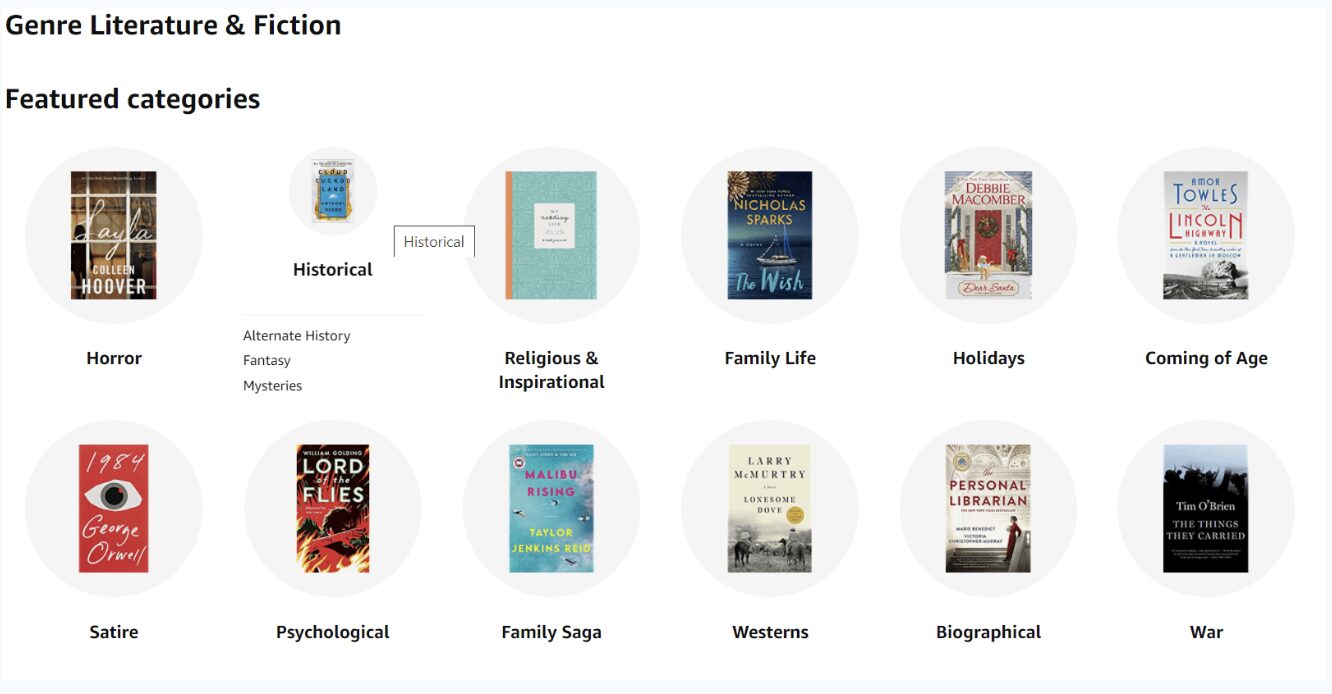

TL;DR: The most popular book genres on Amazon
Romance is the best-selling and highest-grossing fiction genre on Amazon, followed by fantasy (especially "romantasy") and mystery, thriller, and suspense. In nonfiction, memoir and biography, self-help and personal development, and business and money lead. Romance alone generates roughly $1.44 billion a year, nearly double the next-closest fiction genre.
Most first-time authors pick a genre based on the book they want to write, then wonder why it never sells. The truth is harsher and more useful: Amazon is a marketplace, and some shelves have far more buyers standing in front of them than others. If you write into a crowded-with-readers genre, you give your book a fighting chance before you've sold a single copy. If you write into a dead one, even a great book struggles.
This guide breaks down exactly which book genres sell most on Amazon right now, the real numbers behind them, how to find this data yourself in under five minutes, and how to use it to build a full-time author career.
What are the most popular book genres on Amazon?
Romance, fantasy, and mystery/thriller are the three best-selling book genres on Amazon in fiction. Memoir, self-help, and business lead nonfiction. Romance is the single highest-grossing genre overall.
Here's where most articles get it wrong. They list fantasy or science fiction first because those genres feel culturally dominant. The sales data tells a different story.
Romance is the highest-grossing fiction genre, generating roughly $1.44 billion in revenue in a single year, nearly twice the next bestselling genres according to industry sales tracking. It accounts for almost 1 in 5 adult fiction books sold in the United States, and U.S. print romance climbed to roughly 51 million units over a recent 12-month stretch.
Translation: if you're choosing a genre to sell rather than just to write, romance and its neighbors are where the readers already are.
Amazon sorts books into more than 16,000 categories, so "genre" and "category" aren't the same thing (more on that below). But at the genre level, the demand is concentrated in a predictable handful of fiction and nonfiction buckets.
The most popular fiction genres on Amazon
Romance leads fiction by a wide margin, followed by fantasy and romantasy, then mystery, thriller, and suspense. These three genres capture the majority of fiction sales and reader demand.
Fiction is where the money and the momentum are. Adult fiction unit sales rose 4.8% in 2024, and romance and fantasy drove most of that growth.
| Fiction genre | Why it sells | Worth knowing |
|---|---|---|
| Romance | Voracious, repeat readers who finish a book a week and buy entire series | Highest-grossing fiction genre (~$1.44B/year); ~40% of self-published Kindle titles are romance |
| Fantasy / Romantasy | Deep world-building plus emotional payoff; binge-able series | "Romantasy" (romance + fantasy) is the fastest-growing subgenre, fueled by BookTok and authors like Rebecca Yarros and Sarah J. Maas |
| Mystery, Thriller & Suspense | Page-turning plots and a hook in the first 10 pages | Mystery and thriller print sales topped 42 million U.S. units in a recent year - the highest unit count of any fiction category |
| Science Fiction | Loyal readership; strong indie foothold | Roughly half of sci-fi ebooks on Kindle are self-published, meaning lower competition from traditional publishers |
| Young Adult (YA) | Crossover adult readership; trend-setting | Drives culture and spawns entire subgenres (see: paranormal teen romance after Twilight) |
| Horror | Devoted niche; surges around film and TV releases | Reliable, format-flexible, and friendly to fast-releasing indie authors |
Beyond the top tier, adventure, detective fiction, historical fiction, LGBTQ+ fiction, and children's fiction all maintain steady, sizable audiences.
The trend you can’t ignore: BookTok and romantasy
The biggest shift in fiction over the last few years isn't a genre, it's a discovery channel. Roughly 59 million print book sales in a single recent year were tied to BookTok influencers. That community has pushed romantasy and dark romance to the front of the line, especially among readers aged 13 to 34.
For you as an author, this means two things: visual, emotional, series-based fiction has an unusually clear path to going viral, and the genre you choose affects how discoverable you'll be before you spend a dollar on ads.
The most popular nonfiction genres on Amazon
Memoir and biography, self-help and personal development, and business and money are the top-selling nonfiction genres on Amazon. Self-help is the most consistent performer in the top charts.
Nonfiction sells differently than fiction. Readers buy it to solve a problem, learn a skill, or understand a life, which makes it especially powerful for entrepreneurs, coaches, and professionals using a book to build authority.
| Nonfiction genre | Why it sells | Best fit for |
|---|---|---|
| Memoir & Autobiography | Real, specific human stories resonate and get shared | Authors with a transformation or a life worth documenting |
| Self-Help / Personal Development | Evergreen demand; readers buy repeatedly | Coaches, speakers, and experts (self-help is a ~$12 billion global market) |
| Business & Money | High-value readers; strong authority-building potential | Founders and consultants who want a book that generates leads |
| Biography | Curiosity about notable lives never goes out of style | Writers covering influential people or movements |
| Cooking | Visual, giftable, and endlessly nichable | Authors with a specific cuisine, diet, or method |
| Health & Fitness | Problem-aware buyers ready to act | Practitioners with a clear, credible system |
Strong secondary nonfiction genres include history, families and relationships, religion and spirituality, true crime, self-improvement adjacent motivation and inspiration, and humor and entertainment.
If you're writing nonfiction to grow a business, self-help, business, and memoir are the three genres where a single book can pay for itself many times over in clients and credibility.
Genres vs. categories: what’s the difference?
Genres are broad reader-facing labels like "romance" or "thriller." Categories are Amazon's thousands of niche subgenres that function as search terms and feed the recommendation algorithm.
This distinction is where most authors leave sales on the table.
Amazon has more than 16,000 categories, and they get extremely specific. (think Historical French Fiction or World War II Historical Fiction rather than just Fiction.) Categories do three jobs at once:
- They act as keywords and search terms readers use to find books.
- They tell the algorithm which books to recommend alongside yours.
- They create smaller bestseller lists that are far easier to top than the main charts.
Ranking #1 in a niche category earns you an orange "#1 Best Seller" badge and a visibility boost, and niche categories are winnable even for a brand-new book.
These high-traffic Kindle categories illustrate where demand concentrates (note that exact rankings shift constantly):
- Romance → Contemporary
- Romance → Romantic Comedy
- Romance → Fantasy
- Literature & Fiction → Contemporary Fiction → Women
- Literature & Fiction → Genre Fiction → Coming of Age
- Science Fiction & Fantasy → Fantasy → Epic
- Mystery, Thriller & Suspense → Mystery → Police Procedurals
- Literature & Fiction → Literary Fiction
The pattern is clear: romance and its subgenres dominate the high-traffic categories, just as they dominate the genre-level data.
How to find the most popular book genres on Amazon
Open Amazon Best Sellers, filter to the Kindle Store, open any bestselling book, and read its Best Sellers Rank to see the exact genres and niche categories it ranks in.
You don't need a paid tool to do basic genre research. Here's the five-step process:
1. Go to Amazon Best Sellers. From the homepage, navigate to the "Best Sellers" page.

2. Filter to the Kindle Store. On the left-hand ribbon, scroll to "Kindle Store" and click it. You can further sort by Nonfiction, Short Reads, and Prime Reading.
3. Open a bestselling book. Click any title to see its full listing. The breadcrumb above the book (for example, Books → Literature & Fiction → Genre Fiction) shows its genre path from broadest to most specific.
For this example, I’m going to click on The Keeper of Happy Endings by Barbara Davis.
You’ll also see, on the left-hand side, a few options for sorting these results. This includes Newsstand, nonfiction, short reads, and Prime Reading. Feel free to click around and explore different results for different types of reading.
When I click on The Keeper of Happy Endings, here’s what comes up:
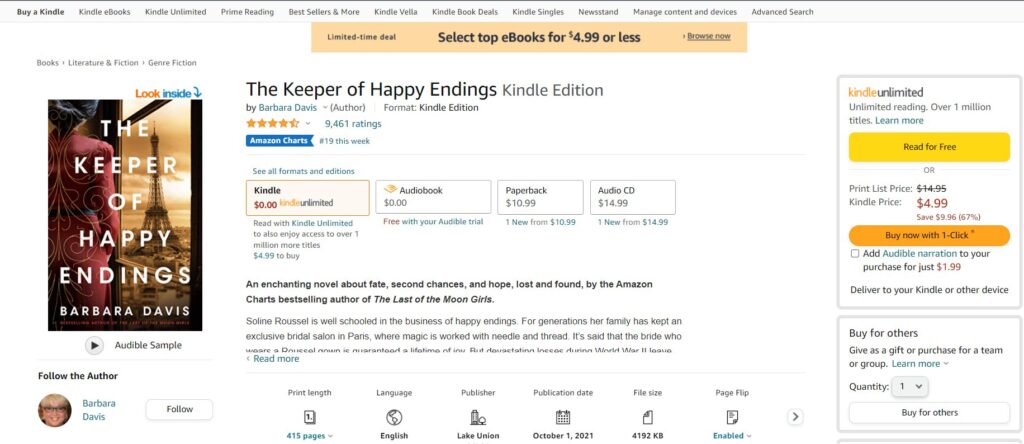
4. Scroll to Product Details. Find the "Best Sellers Rank." This reveals the book's overall Kindle Store rank and its rank inside specific niche categories, which are exactly the categories you'll want to target.

5. Click into those categories. Each links to its own bestseller list, showing you what's selling in that precise niche so you're not guessing from the top-level charts.
Repeat this across 10 to 15 bestselling books in your target genre and patterns emerge fast: which categories the winners share, how competitive each list is, and where a well-positioned new book could break in.
Writing to market using popular genres
Writing to market means deliberately choosing a genre and tropes that already have proven reader demand, then writing a book you genuinely care about inside that demand.
Writing to market works. The entire "paranormal teen romance" category exists because authors rushed to meet the demand Twilight revealed. But it has one real risk: traditional publishing is slow, and a trend can cool before your book ever reaches a shelf.
Self-publishing solves most of that problem. Indie authors can release several books a year and stay ahead of trends instead of chasing them.
Three rules for writing to market without burning out
- Use trends as inspiration, not handcuffs. Let a hot category spark a story idea you're actually excited to write. If a passion project doesn't fit today's market, don't trash it. Markets cycle, and the right moment usually comes back around.
- Be versatile and fast. Write across multiple subgenres within your lane. A romance author might run a historical series, a small-town contemporary series, and a sci-fi romance series at once, diversifying readership and raising the odds of landing in a trending category.
- Choose categories strategically, not dishonestly. Categories are search tools. Pick the accurate categories with the most traffic and the most winnable bestseller lists. Never miscategorize your book, but do study the lists above and place yourself where readers are looking.
The best genres for self-published authors on Amazon
For self-published authors, romance, romantasy, fantasy, and mystery/thriller offer the strongest combination of high reader demand, series potential, and binge-buying behavior (the ingredients that compound royalties).
Genre choice hits your income harder in self-publishing than almost anywhere else, because indie economics reward read-through. When readers binge a series, one new release lifts sales across your entire backlist.
The genre breakdown among self-published authors backs this up. Romance is the primary genre for about 21% of indie authors, fantasy follows at 14%, and science fiction and thriller round out the top tier. Romance accounts for roughly 40% of all self-published Kindle titles — and those readers are the most reliable repeat buyers in publishing.
A few realities worth setting expectations around:
- Amazon KDP pays up to 70% royalties on ebooks, far above traditional publishing.
- Most one-book KDP authors earn under $1,000 a year. Active authors who publish multiple books, invest in a professional cover and editing, and run ads typically earn between $1,000 and $50,000 a year.
- Six- and seven-figure indie authors almost always have 10 or more books, a loyal readership, and real marketing systems.
The lesson: the genre gets readers to your book, but a backlist and a business mindset are what turn a book into income.
What are the most popular digital book genres on Amazon right now
What genre of books sell the most? The best-selling ebook categories on Amazon are mystery/thriller, romance, and general fiction, with self-help and business/money leading the nonfiction side. These categories consistently rank highest for both sales volume and reader demand, according to Kindle marketplace data.
Kindle eBook Market Intelligence tracks the 30 main Kindle categories by the sales rank of each category's #1 bestseller. Mystery, Thriller & Suspense, Literature & Fiction, and Science Fiction & Fantasy currently sit at the very top of that list, with Romance close behind. In other words, when people ask what are the most popular digital book genres, the honest answer is that a small handful of fiction categories account for a disproportionate share of Kindle sales.
The picture looks a little different when you ask authors instead of readers. A January 2026 survey of 450 self-published authors found nonfiction is the most common genre they write in (34.9%), followed by fantasy (26%), romance (23.6%), and mystery/thriller/crime (22%). That gap between what readers buy most and what authors write most is worth paying attention to. It's part of why the best-selling ebook categories aren't always the easiest ones to break into.
If you're choosing a category for your own book, don't just chase the biggest genre. Amazon has more than 16,000 categories, and the smaller, more specific ones (like "Historical French Fiction" instead of just "Fiction") are far easier to rank #1 in, even for a brand-new author.
Common genre mistakes that kill author sales
- Writing into a genre with no proven demand because it's the book you assumed you "should" write.
- Confusing genre with category and never optimizing the niche categories that actually drive discovery.
- Publishing one book and stopping. Single-title authors rarely earn meaningful income, regardless of genre.
- Chasing a trend you don't enjoy. Writing a full book you hate is a slog that shows up on the page.
- Ignoring series potential in genres (like romance and fantasy) where readers want to binge.
Turn genre research into a published, profitable book
Knowing the most popular genres is step one. The authors who actually build full-time careers are the ones who pair smart genre selection with a proven writing, publishing, and marketing process, and who don't try to figure it all out alone.
That's exactly what we do at selfpublishing.com. We've helped thousands of authors go from blank page to published. Whether you're writing romance, a memoir, or your first business book, the right genre, categories, and launch plan make the difference between a book that disappears and one that sells.
Ready to write a book readers actually buy? Book a call with our team to find the program that fits your book and your goals.
Your book is closer than you think.
Most popular Amazon book genres: FAQ
What genre of books sells the most on Amazon?
Romance is the best-selling and highest-grossing genre on Amazon, generating roughly $1.44 billion a year. Fantasy (especially romantasy) and mystery/thriller follow. In nonfiction, memoir, self-help, and business lead.
What is the most profitable genre for self-publishing on Amazon KDP?
Romance and romantasy are the most profitable for self-published authors, thanks to voracious repeat readers, strong series read-through, and BookTok-driven discovery. Mystery, thriller, and fantasy also perform reliably well.
What sells fast on Amazon KDP?
Books in high-demand, binge-friendly genres - romance, romantasy, thriller, and self-help - sell fastest, especially when released as part of a series with a strong cover and a hook in the first pages.
How many book categories does Amazon have?
Amazon has more than 16,000 categories. They function as both subgenres and search terms, and ranking in niche categories is one of the most effective ways to boost a new book's visibility.
Does writing to market actually work?
Yes. Writing to market means choosing a genre with proven demand and writing a story you care about inside it. Self-publishing makes it especially effective because indie authors can release books quickly enough to ride trends instead of missing them.
Which genre is best for a first-time author?
Choose a genre where you have both genuine interest and clear reader demand. For fiction, romance and its subgenres offer the largest, most reliable audience. For nonfiction, memoir, self-help, and business work best for building authority and a business.