



















TL;DR Spines isn't a scam, it's a real, venture-backed AI publishing platform that does deliver a finished book fast. But it's a three-year subscription, not a one-time purchase: it takes 30% of your royalties, you don't control your own Amazon listing, and the ongoing renewal fee isn't published anywhere. For most authors, that's a bad trade. For a narrow group, it's the right one. Below is the full breakdown.
Reviewed and fact-checked by the selfpublishing.com editorial team · Updated September, 2026 · We are a competing publishing company. Our conflict of interest is disclosed below, every claim below is sourced, and Spines is welcome to respond.
What is Spines Publishing?

Spines is a venture-backed, AI-assisted publishing platform founded in 2015 that produces and distributes books for a flat upfront fee plus an ongoing royalty cut and a recurring membership subscription.
Spines is led by CEO Yehuda Niv, with U.S. headquarters in Boynton Beach, Florida. The company has raised roughly $22.5 million in venture funding, a $6.5 million seed round and a $16 million Series A (Sources: Calcalist, eWeek).
In November 2024, Spines announced a plan to publish 8,000 books in 2025 using AI-driven production, which drew significant pushback from the traditional publishing industry (Source: The Bookseller).
What you actually get
Spines combines AI-assisted production with human account management:
- AI-assisted proofreading, formatting, cover generation, and audiobook narration
- Human editors and account managers on higher-priced tiers
- Distribution to up to 100 retail and library channels, including Amazon, Barnes & Noble, and Apple Books
- A published book in weeks rather than months
The publishing model, in plain terms
Most people arguing about Spines online can't actually place it in a category. Here's the honest breakdown:
| Model | Who pays | Who owns it | Your royalty |
|---|---|---|---|
| Traditional publishing | The publisher pays you an advance | The publisher holds the rights | Roughly 10–15% |
| True self-publishing (KDP, direct) | You pay production costs once | You own everything | 100% of the retailer royalty |
| Paid / hybrid publishing (Spines' category) | You pay upfront | Shared, or unclear | They take a recurring cut |
| Vanity press | You pay, often a lot | You get little in return | Varies, thin services |
Fair point for Spines: paying for publishing services isn't inherently a scam. Every serious self-published author pays something for editing and cover design. Spines explicitly rejects the "vanity press" label, and the argument isn't unreasonable—they point to real distribution, real marketing support, and author-retained copyright. The question isn't whether you pay. It's what you get for it, and what you give up.
For the fuller picture of how these categories differ, see our guide to vanity publishing and self-publishing vs. traditional publishing.
How Much Does Spines Publishing Cost?
Answer: As of September 1, 2026, Spines' plans range from $4,450 to $9,820 for adult fiction and nonfiction, plus a 30% royalty cut and a three-year membership subscription that auto-renews at an undisclosed price.
Current pricing (pulled from spines.com/pricing, September 1, 2026)
| Plan | Fiction/nonfiction | Children's | Term included |
|---|---|---|---|
| Signature | $4,450 | $3,600 (Sprinkle) | 3 years |
| Paramount | $6,739 | $5,689 (Splash) | 3 years |
| Horizon | $9,820 | $10,410 (Starlight) | 3 years |
Every plan advertises "70% net royalties," meaning Spines keeps 30% of your net sales, on top of what you already paid upfront.
The price has already moved once
Earlier in 2026, Spines' tiers were priced at $1,498, $3,299, and $5,999. The packages have since been renamed and reconfigured, so this isn't a clean apples-to-apples price hike, but the direction is worth knowing before you sign anything. Always check the live pricing page and screenshot the date.
The second price nobody puts in the comparison chart
The sticker price buys production plus a bundled three-year membership subscription, and the terms are explicit that this is a subscription, not a one-time purchase:
- It automatically renews. Spines' own service terms state that "Subscription Plans shall automatically renew for successive monthly periods, at the then-current Fees set out at our pricing page"
- The renewal price can increase. You'll be notified before a renewal and can cancel before the new fee applies, but the fee itself isn't fixed
- The annual renewal amount is not published anywhere—not on the pricing page, not in the terms and conditions, not in any comparison article we could find. The only documented dollar figure is a $499 renewal charge, disputed by an author in an April 2026 Better Business Bureau complaint (BBB profile). Treat this as one data point, not a confirmed price
- You don't fully own your files until you've paid six years of membership fees. Per the terms: digital production files "belong to Spines" unless you pay production fees plus "an amount equal to six years of the applicable annual Membership Subscription Plan Fees" (spines.com/terms-and-conditions)
- If you stop paying, distribution stops. The terms state: "Upon termination of these Terms and/or your Subscription Plan, we will cease providing you with any Services," and distribution is a service. In practice, a book can stay listed on retailers for weeks or months after that before it disappears, based on the terms and on author complaints describing exactly this delay
- Cancelling doesn't cancel the bill. If you cancel, you still owe "the full remaining Production Plan Fees," and unpaid balances "may be reported to credit bureaus"
To be precise about what's confirmed and what isn't: the three-year subscription, the auto-renewal, the fee-can-change language, and the six-year file buyout are all direct quotes from Spines' own published terms. The exact ongoing annual cost is not published, so treat any specific number (including "$300–$500/year") as an estimate, not a documented fact, until Spines discloses it.
What's genuinely fair here
Two things work in Spines' favor. Production fees on a book you've already bought don't get raised mid-contract, which is more protective than a lot of the industry. And the terms confirm authors "retain all of your ownership rights in and to your Books." You keep the copyright. What you may not keep, without paying for it separately, is the files, the account, and the distribution.
Spines reviews
While the majority of Spines reviews are positive, there are some negative reviews that give cause for concern.

It’s not good when there aren’t human professionals to catch grammar errors in your manuscript.
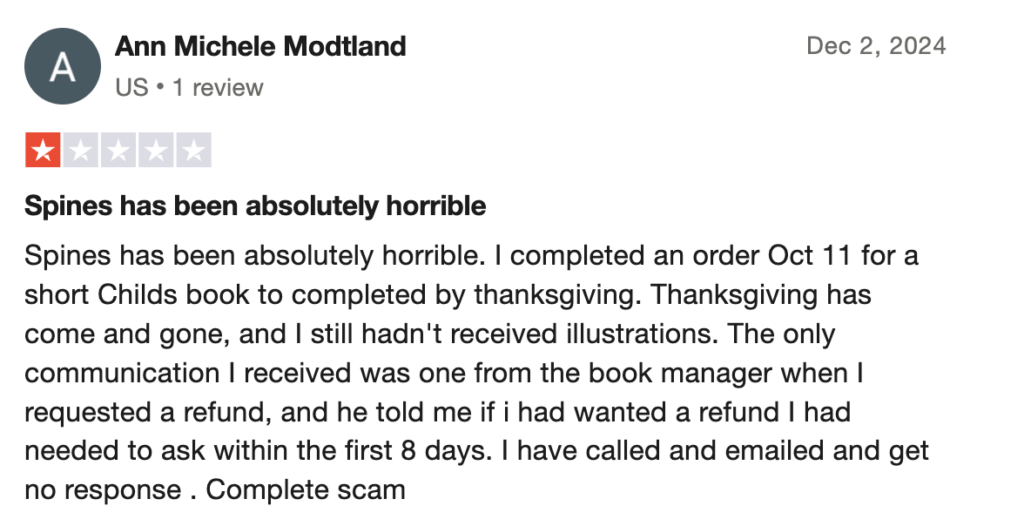
While Spines promises a one month turnaround from payment to publishing, it seems like they aren’t always able to keep it. If you are unhappy with their services, there is no way to get a refund after seven or eight days. How much work will they even turn out in the first week for you to know if you are happy with them or not?
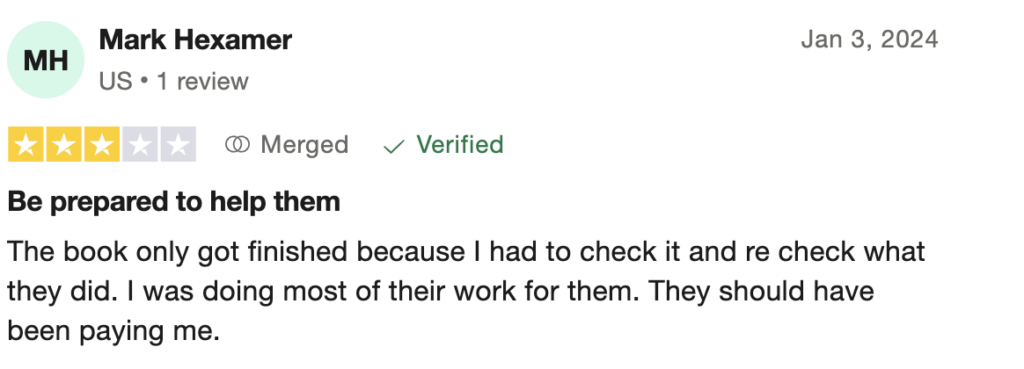
It sounds like the client had to really check in with Spines Publishing during the whole publishing process. When paying for done-for-you services, this is really frustrating. What were they actually paying for?
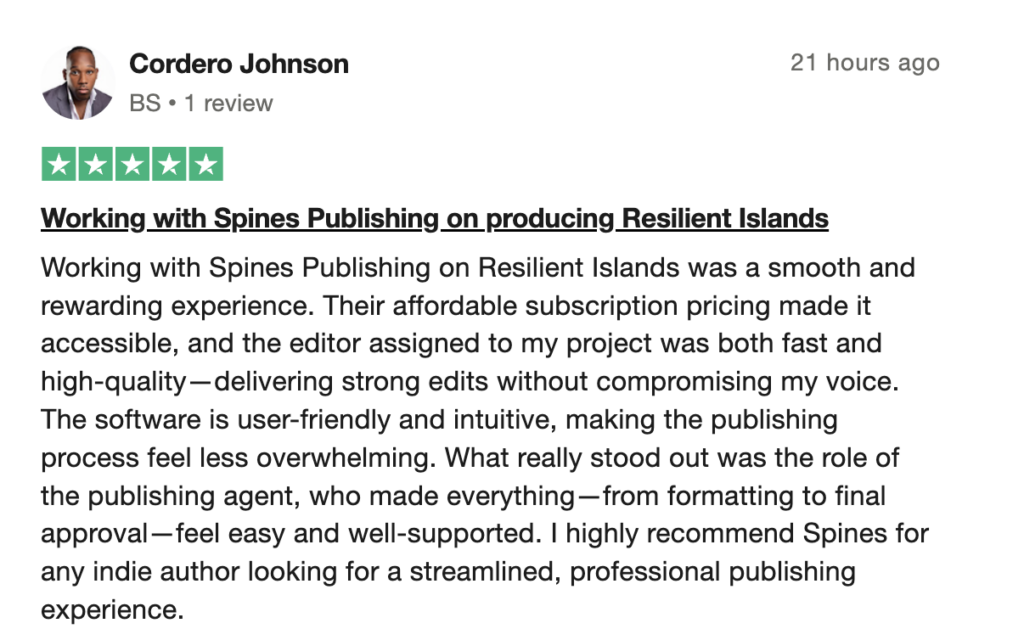
The majority of Spines Publishing reviews look like this one. It sounds like maybe they used the Paramount package since they had an editor assigned to their book.

Here is another positive review of Spines Publishing. As you can see, some people have a good experience with them and receive swift communication, while other reviews claim they are impossible to contact.
It seems like as long as you are happy with the service they will work with you, but as soon as you complain they refuse a refund and ghost you.
Other contract terms worth knowing
| Clause | What it actually means |
|---|---|
| 30-day refund window, with a catch | The window closes the moment you authorize publishing or distribution. After that, "no refunds are given and you must pay any remaining fees." |
| Refund ≠ keep the work | If you do get a refund, "Trial Deliverables will not be delivered or transferred to you." |
| $25 royalty floor | You can only request a payout "once such Net Sales Royalties exceeded, in the aggregate, US $25," and you have to manually submit the request |
| Content license for AI training | Spines' terms grant the company a "worldwide, non-exclusive, royalty-free" license to use your book, including "to train Large Language Models." |
| Removal rights | Spines can "monitor, censor, edit, remove, and/or delete" any book at its "sole discretion." |
Want the full cost math? See our breakdown of what it actually costs to publish a book across every path, including true self-publishing.
Is Spines Publishing Legit, or Is It a Scam?
Answer: Spines is a legitimate, operating company, not a fraud, but "legit" and "a good deal" aren't the same thing.
The honest answer: not a scam, but a bad deal for most authors.
Calling Spines "a scam" outright isn't accurate, and it isn't necessary to make the case against it. Spines delivers a real, finished, distributed book. The company is well-funded, has staff members, and real customers who are satisfied with the production experience. The problem isn't fraud, it's the structure of the deal: what it costs long-term, what you don't control, and how little of that is disclosed up front.
The rating puzzle, and how to read it
Spines holds a 4.6-star rating across roughly 926 Trustpilot reviews, with about 83% five-star (Trustpilot). That's a legitimate number, you can't manufacture that volume of reviews cleanly. Both things below are true at once:
- The production experience is often genuinely good, and reviewers frequently praise their assigned account manager by name
- The contract is where the problems show up—and contract problems surface after the book ships, which is exactly when most people stop writing reviews
How to actually evaluate any publishing review page (this works on us too):
- Sort by most recent, then read the one- and two-star reviews first. That's where renewal and ownership issues show up
- Check the Better Business Bureau separately—people go there when a review site didn't resolve it
- Read the contract, not the sales page. Search the PDF for "term," "renewal," "royalty," and "license"
The complaint pattern
Spines is not BBB-accredited. Over the past three years, the BBB lists 28 complaints, 19 closed in the last 12 months—categorized as product issues, service/repair, billing, order issues, and customer service. Documented disputes include a $1,638 refund demand over editing delays (January 2026), a $434.36 charge called erroneous (March 2026), a $499 renewal fee (April 2026), and a $1,300+ refund request (June 2026).
In fairness: 28 complaints against a company claiming thousands of authors is not, by itself, an alarming volume—most companies this size have more. What matters is the pattern: billing and auto-renewal disputes are exactly what you'd expect from a three-year term with an undisclosed backend fee. That's the more accurate read than "look, there are complaints."
An independent 2026 industry alert also raised operational red flags worth knowing about: Spines previously operated under the name BooxAI before rebranding, and shares an address with another publishing brand, Velon Book Publishing (Source: WritersWeekly). This doesn't make Spines a scam on its own, but it's worth knowing who you're contracting with.
Who Controls Your Book After Spines Publishes It?
Answer: Authors who work with Spines report they don't get direct login access to their own Amazon KDP account, meaning no control over price, keywords, or categories. We can't confirm this from Spines' public terms, but it's consistent with what we hear directly from authors and with third-party reviews.
This is one of the most common things we hear on our own sales calls from authors who've used Spines: no access to the KDP dashboard, no ability to set or drop the price, and no control over the keywords or categories that determine whether readers can find the book at all. We're flagging this clearly as customer-reported, not contract-confirmed—Spines' public terms and conditions don't spell out account-access mechanics one way or the other, and we invite Spines to clarify.
That said, it lines up with what we found independently: a Trustpilot reviewer described being unable to get direct account access to even request a takedown after cancelling, and had to go through customer service to get her book removed from retailers (Trustpilot). If account control genuinely sits with Spines rather than the author, that matters. Price is your single biggest marketing lever, categories are how readers browse to you, and keywords are how Amazon's algorithm ranks you. You can't run a launch discount, a Kindle Countdown Deal, or a category push if you can't log in.
If you're evaluating Spines, ask this directly before you sign: "Will I have my own login to my KDP dashboard, with the ability to change price, keywords, and categories myself?" Get the answer in writing.
On the "can't find the books" question
We also looked into whether books credited to Spines are actually findable on Amazon. Spot-checking a handful of titles attributed to Spines through a third-party publisher catalog, the results were mixed: some titles were live on Amazon.com, while others turned up only on Amazon's international storefronts (Spain, Ireland) and not on the U.S. site. That's not proof of a pattern, and we're not asserting one, but it's inconsistent enough that we'd tell any prospective Spines author to search for their own exact title and ISBN on Amazon.com, not just spines.com, before, during, and well after production wraps.
For more on what "unpublished" or "delisted" actually looks like on Amazon's side, see our guide on how books get unpublished on Amazon and what to do if your KDP account gets closed.
The Pros of Spines Publishing
Answer: Spines' strengths are speed, convenience, and bundled production—one invoice and one point of contact instead of managing five vendors yourself.
If we only wanted to make Spines look bad, we'd skip this section. We're not skipping it, because some readers will finish this review and still decide Spines is the right call, and that decision should be made with the good parts on the table too.
- One vendor, one invoice, one person to call. For a busy professional with no time to manage five separate vendor relationships, that convenience has real value
- Speed. Weeks instead of months matters if you have a conference, a launch date, or a keynote on the calendar
- Every format bundled. Hardback, paperback, ebook, and audiobook in one package—a professionally narrated audiobook alone can otherwise run into the thousands
- Wide distribution. Up to 100 channels, including retail and library channels most first-time authors never set up themselves
- Real account managers on upper tiers. Trustpilot reviewers frequently name and praise their production managers directly—not a pattern you typically see from bot-generated reviews
- No gatekeepers. If you've queried dozens of literary agents with no luck, Spines will publish the book. That has genuine value after years of rejection
- Translation is bundled on upper tiers—a feature almost nobody else in this price range includes
The Cons of Spines Publishing
Answer: The core downsides are a permanent 30% royalty cut, a three-year subscription with an undisclosed renewal fee, and no confirmed control over your own Amazon listing.
Ranked by what they actually cost you, not by outrage:
1. Thirty percent of your royalties, indefinitely
You pay $4,450–$9,820 upfront and hand over 30% of net royalties for as long as Spines distributes your book (Reedsy's comparison describes the same structure independently). Compare that to true self-publishing on Amazon KDP directly, where you keep 100% of the retailer royalty forever, on a book you paid to produce once.
2. The three-year clock
The pricing page advertises "three years of membership included." The terms describe an auto-renewing subscription. That's not a book purchase with a bill due in year four—it's a subscription with three years prepaid, and the meter doesn't stop. Compare that to a book on your own KDP account, which stays live indefinitely at zero ongoing cost, and which nobody but you can take down.
3. You may not control your own listing
Per the section above: authors report no access to the KDP dashboard controlling price, keywords, or categories. Get this in writing before you sign, not after.
4. Broad rights and licensing terms
Spines' terms grant the company a royalty-free license to use your book, including for AI/LLM training, and the terms don't guarantee confidentiality for anything you upload. You also may not own your finished production files for years, and AI-generated covers may not be unique to you.
5. The proof problem
Spines has claimed over 10,000 books published and 1,200 bestsellers. When The Bookseller asked for evidence, Spines could supply seven titles—one with over 70 ratings, the rest with 7 to 22 (Reedsy, citing The Bookseller). That's a big gap between the marketing claim and what's been independently verified.
6. A billing-heavy complaint pattern
See the complaint breakdown above—the recurring themes are missed deadlines, difficulty reaching account managers, and automatic renewal charges.
Who Is Spines Actually Right For?
| Genuinely a good fit | Wrong fit (and it will cost you) |
|---|---|
| You have money and no time, and you value both accurately | The book is a business asset meant to generate leads or clients |
| It's one book, not a career—a memoir, a legacy project, a conference giveaway | You plan to run price promos, ad campaigns, or a real launch |
| You don't want to learn the publishing business, and never will | You want to write more than one book—the economics compound against you |
| Being published matters more to you than the royalty rate | You want to own the files and the account outright |
| You want a hardback and audiobook without managing five vendors | You expect the book to still be live and earning in 10 years |
The Three Real Paths to Publishing Your Book
| Path | What it costs you | What you keep |
|---|---|---|
| Do it all yourself | Months of your time and a steep learning curve | Everything—100% royalties, full control |
| Pay a done-for-you service (Spines and similar) | $4,000–$10,000+, plus a royalty cut and control | Your time, and a finished book |
| Learn it with guidance | Money and some of your time | 100% royalties, your own account, and the skill for the next book |
At selfpublishing.com, we built our model around path three: your KDP account stays yours, you set your own price, keywords, and categories, and you keep 100% of your royalties—no cut, ever, and no three-year clock. We're an INC 5000 company with over 250,000 community members and authors published in 91 countries since 2015. If you want a second opinion before you sign anything with any publishing service, see how our approach compares or talk to our team.
Spines Publishing FAQ
Is Spines Publishing a scam?
No. Spines is a real, operating, venture-backed publishing company. It's not fraudulent—but its royalty cut, three-year subscription structure, and undisclosed renewal fee make it a poor value for most authors.
How much does Spines Publishing cost?
As of September 1, 2026, Spines' fiction/nonfiction plans run $4,450 to $9,820, plus 30% of net royalties and a three-year membership that auto-renews at an unpublished price. Children's book tiers run separately, from roughly $3,600 to $10,410.
Does Spines take down your book after three years?
Spines' terms confirm the membership is a three-year, auto-renewing subscription, and that services—including distribution—stop if you don't keep paying. The exact renewal cost isn't published; the only documented figure is a disputed $499 charge from an April 2026 BBB complaint.
Do I own my book if I publish with Spines?
You retain copyright under Spines' terms. You may not own the finished production files (formatted manuscript, audiobook, etc.) unless you pay production fees plus the equivalent of six years of membership fees.
Is Spines a vanity press?
Spines rejects that label, and the argument has some merit—it offers real distribution and marketing support beyond what a classic vanity press provides. It's more accurately categorized as a paid hybrid publisher: you pay upfront, and the company also takes an ongoing royalty cut.
What's the alternative to Spines?
True self-publishing through your own Amazon KDP account keeps 100% of your royalties and full control, but requires you to manage editing, design, and formatting yourself or hire freelancers individually. A guided self-publishing service—where you keep your own account and royalties but get support and a system—is the middle path.
Spines is not a criminal enterprise. It's an expensive, restrictive deal, and for most authors reading this, it's the wrong one. The question was never whether Spines can publish your book. The question is whether you still own it—and control it—in year four.
Have you worked with Spines? We invite Spines to respond to the claims in this review and will update this post with any reply. If you have documentation (a contract, an invoice, a renewal notice) that adds to or corrects anything above, contact our editorial team.