





















TL;DR: Proper manuscript format follows a clear set of industry standards: 8.5 x 11-inch pages, 12-point Times New Roman font, double spacing, 1-inch margins, and a formatted title page. Whether you are submitting to literary agents or preparing for self-publishing, getting your manuscript format right signals professionalism and gives your book a fair shot.
There is a mistake authors make long before anyone reads their first sentence.
They submit a manuscript that is written well but formatted badly. And just like a resume full of typos, it gets passed over before anyone even gets to the good part.
Literary agents and editors receive hundreds of submissions. The first thing they see is how your manuscript is presented. If it looks sloppy, it gets set aside.
The good news: manuscript format is one of the easiest things to get right. This guide covers every element you need to know to learn how to format a manuscript for submission.
What is a manuscript?
A manuscript is your book in draft form, the full text of your work before it is published. The word itself comes from the Latin phrase "manu scriptus," which means "written by hand," though obviously that is not how most authors work today.
Your manuscript is everything you write in Microsoft Word, Google Docs, or any other writing tool before publication. Fiction, nonfiction, memoir, no matter the genre, it is all considered a manuscript until it reaches final published form.
Note: if you are looking for book formatting (the interior design of your finished, published book), that is a different topic covered in a separate guide. This post is specifically about manuscript format for drafts and submissions.
What is the proper manuscript format?
The standard manuscript format uses 8.5 x 11-inch pages, 1-inch margins on all sides, 12-point Times New Roman font, and double spacing throughout. Every manuscript should also include a properly formatted title page.
These are not arbitrary rules. They exist because agents, editors, and publishers receive hundreds of submissions at a time. A consistent manuscript format makes it faster and easier to read, compare, and evaluate your work.
When your manuscript follows these standards, it communicates one clear thing: this author is a professional.
What should your manuscript format include?
1. Title page
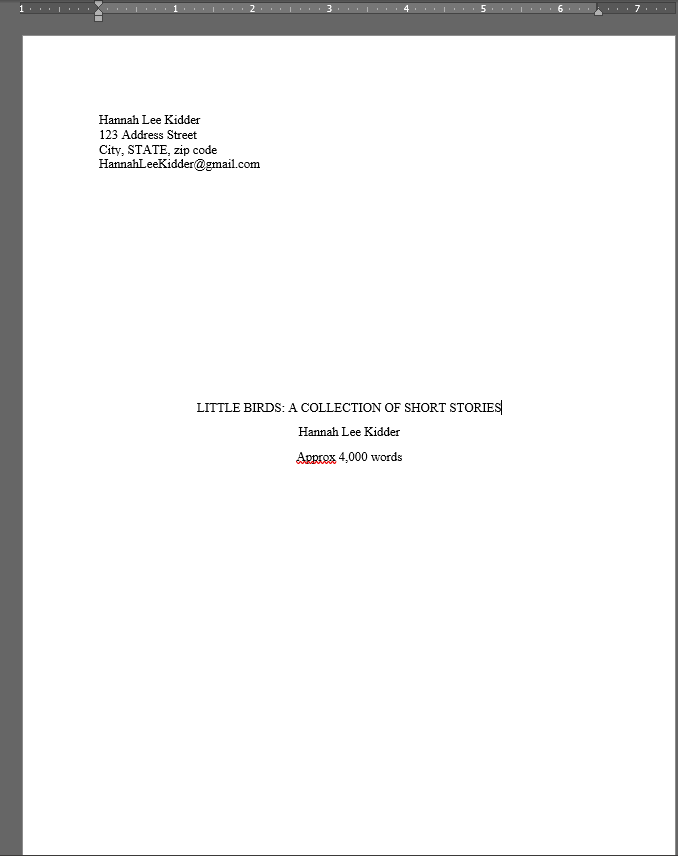
The manuscript title page is the first thing anyone sees. It needs to include key information in the right places.
What goes on a title page:
- Your contact information (top left corner, single-spaced, left-justified)
- Legal name
- Address
- Phone number
- Email address
- Book title (center-justified, one-third to halfway down the page; include your subtitle on the same line if you have one)
- Author name (center-justified, one double-spaced line below the title; use your pen name here if applicable, and your legal name in the contact block)
- Word count (rounded to the nearest thousand, one double-spaced line below the author name)
- Agent information (if you have a literary agent, their contact information goes in the upper left corner, and your contact information moves to the lower right)
Getting your title page right matters because it is the first thing an agent or editor looks at. Start strong.
Here is a manuscript example of a title page:
2. Page-by-page formatting
Every page in your manuscript should follow a consistent format. These manuscript formatting rules apply from page one of your story through to the final line.
Example of manuscript page formatting (standard):
- Paper size: 8.5 x 11 inches
- Margins: 1 inch on all sides
- Single space after periods (if you learned the two-space rule, do a find-and-replace to fix it throughout your document)
- Scene breaks: use a "#" symbol, not extra blank lines or other characters
- Alignment: left-justified throughout
- Paragraph indentation:
- Nonfiction: no indentation, with a blank line between paragraphs
- Fiction: half-inch first-line indentation, no blank lines between paragraphs
- To set indentation in Microsoft Word: Paragraph settings > Indentation > Special > First Line > 0.5 inch
- Running header (top right of every page except the title page): last name / abbreviated title / page number
- "THE END" centered on its own line after your final sentence — this signals to editors and beta readers that no pages are missing
3. Chapter formatting
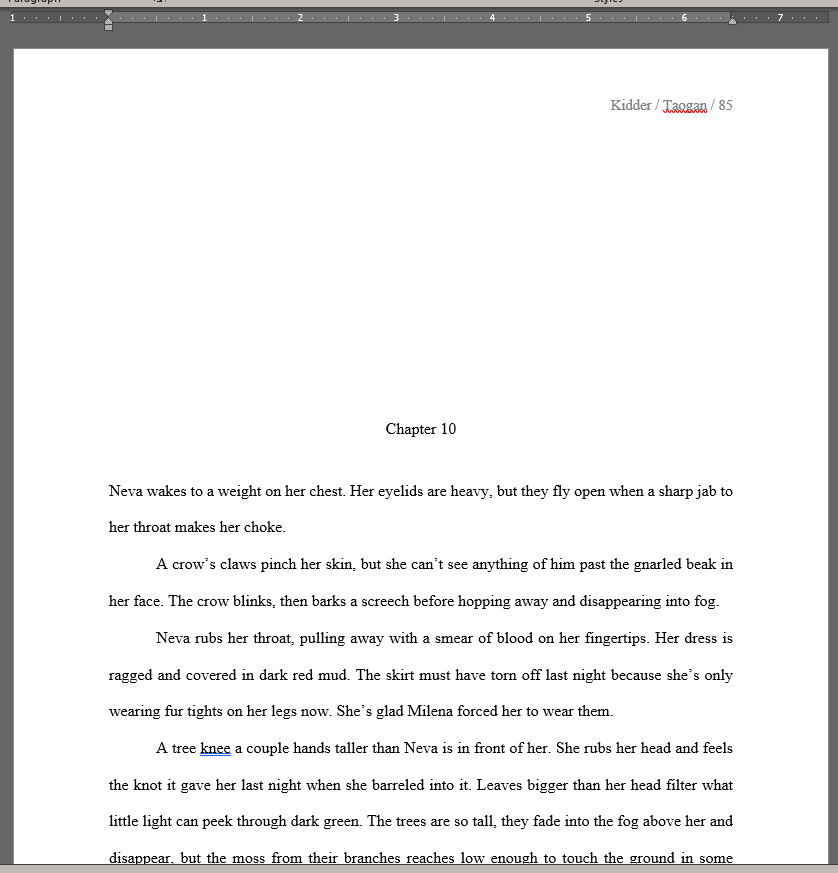
Chapters should never run together on the same page. Each new chapter needs its own page.
How to format chapter breaks:
- Start every new chapter on a new page (use a page break, not repeated returns)
- Center the chapter title or number one-third to halfway down the page
- Begin the chapter text one double-spaced line below the title
This structure makes your manuscript far easier to navigate and read. Readers, editors, and beta readers all benefit from clear chapter breaks. What does a manuscript look like in the chapters? Here is an example:
4. Font and type standards
Your font choice is not a place to be creative. Agents and editors expect simplicity. Unusual fonts slow down reading and signal inexperience.
Standard manuscript format type settings:
- Font: Times New Roman (Arial is acceptable in some cases; always check specific submission guidelines)
- Size: 12 point
- Color: black
- Spacing: double-spaced throughout
That is it. Simple, clean, and easy to read. That is the goal!
How to submit your manuscript
Submitting digitally
Most manuscript submissions today happen via email or submission portals.
The standard file format is .doc or .docx unless the agent or publisher specifies otherwise. Microsoft Word is preferred by most editors because its Track Changes feature makes reviewing easier.
For initial submissions, agents often ask you to paste the first pages or opening chapter directly into an email body. If they request the full manuscript, they will typically ask for a .doc or .docx attachment. Some submissions also require a query letter, author bio, or cover letter. Check the specific requirements before submitting.
Submitting by mail
Some publishers and agents still accept physical submissions. If you need to print your manuscript, follow these guidelines:
- Print on one side of the page only
- Use high-quality, bright white paper
- Use high-quality, dark ink for readability
Common manuscript format mistakes to avoid
Even strong writers slip up on these. Run through this checklist before you submit:
- Double spaces after periods (search and replace before submitting)
- Tabs used for paragraph indentation instead of proper indent settings
- Missing or incomplete title page
- Incorrect font or font size
- Scene breaks formatted with asterisks or blank lines instead of "#"
- Page numbers missing or starting from the title page
- Chapters running onto the same page as the previous chapter
- "THE END" missing from the final page
Manuscript format: what comes next
Formatting your manuscript correctly is a sign that you take your book seriously. It will not get you published on its own, but a poorly formatted manuscript can absolutely stop you from getting there.
If you are self-publishing, the traditional submission process does not apply, but getting your manuscript formatted cleanly still matters when you hand it off to an editor, proofreader, or book designer.
Most authors try to figure all of this out on their own. Some get it right. Many spend months going in circles without the right support.
At selfpublishing.com, we have helped over 7,000 authors go from blank page to published book. If you want a clear path and people in your corner, we would love to help.
Schedule a free consultation with our team here.
Frequently asked questions about manuscript format
What font should a manuscript be in?
Times New Roman at 12-point size is the industry standard. Some agents accept Arial, but always check submission guidelines before assuming.
Should a manuscript be double-spaced?
Yes. Double spacing is a non-negotiable element of standard manuscript format. It improves readability and gives editors room to mark up the text.
What is the correct manuscript format for a novel?
A novel manuscript uses 8.5 x 11-inch pages, 1-inch margins, 12-point Times New Roman, double spacing, first-line paragraph indentation of 0.5 inches, a running header on each page, and a properly formatted title page.
How do I format chapters in a manuscript?
Each chapter should start on a new page. Center the chapter title or number one-third to halfway down the page, then begin your text one double-spaced line below it.
Does manuscript format matter for self-publishing?
If you are self-publishing, you will not submit to literary agents, so strict manuscript format is less critical. That said, presenting a clean, well-structured document to your editor or book designer is always good practice.