

















TL;DR: A book publishing contract is a legal agreement that sets which rights you give a publisher, how much you earn, and when those rights come back to you. Before you sign, check nine terms: rights, advance and royalties, delivery, editing, schedule, marketing, reversion, subsidiary rights, and warranties. Have an agent or publishing attorney review it. If you self-publish, you skip the publisher contract entirely.
The email says a publisher wants your book. You read it twice, then a third time. Then the contract arrives: 30 pages of clauses written by the publisher's lawyers, a response deadline, and phrases like "indemnity" and "subsidiary rights" that you've never needed to know.
This is the moment where authors lose the most. Not because publishers are villains (most aren't), but because a book publishing contract is the one document that decides who controls your book, what you earn, and whether you ever get it back. Sign without reading it and your book can be tied up for decades.
This guide covers what a book publishing contract does, the nine terms worth checking line by line, how to get one, and when you don't need one at all. It's for authors holding an offer, authors getting ready to query agents, and authors deciding whether a publisher deal is worth chasing. selfpublishing.com has helped authors publish more than 7,000 books across 91+ countries, so we've seen both routes up close.
What does a book publishing contract do?
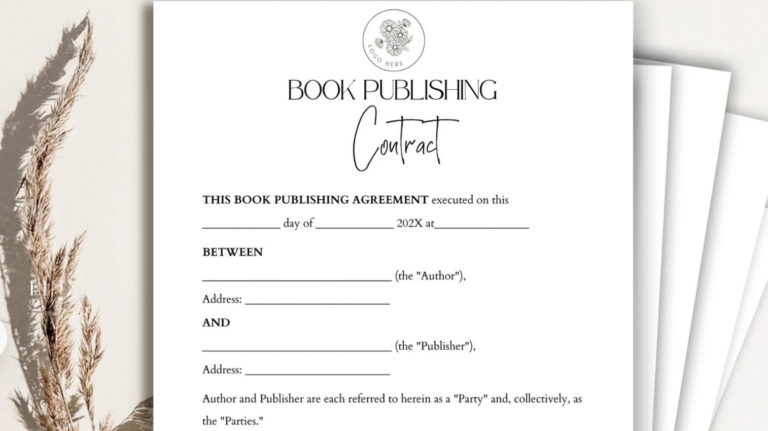
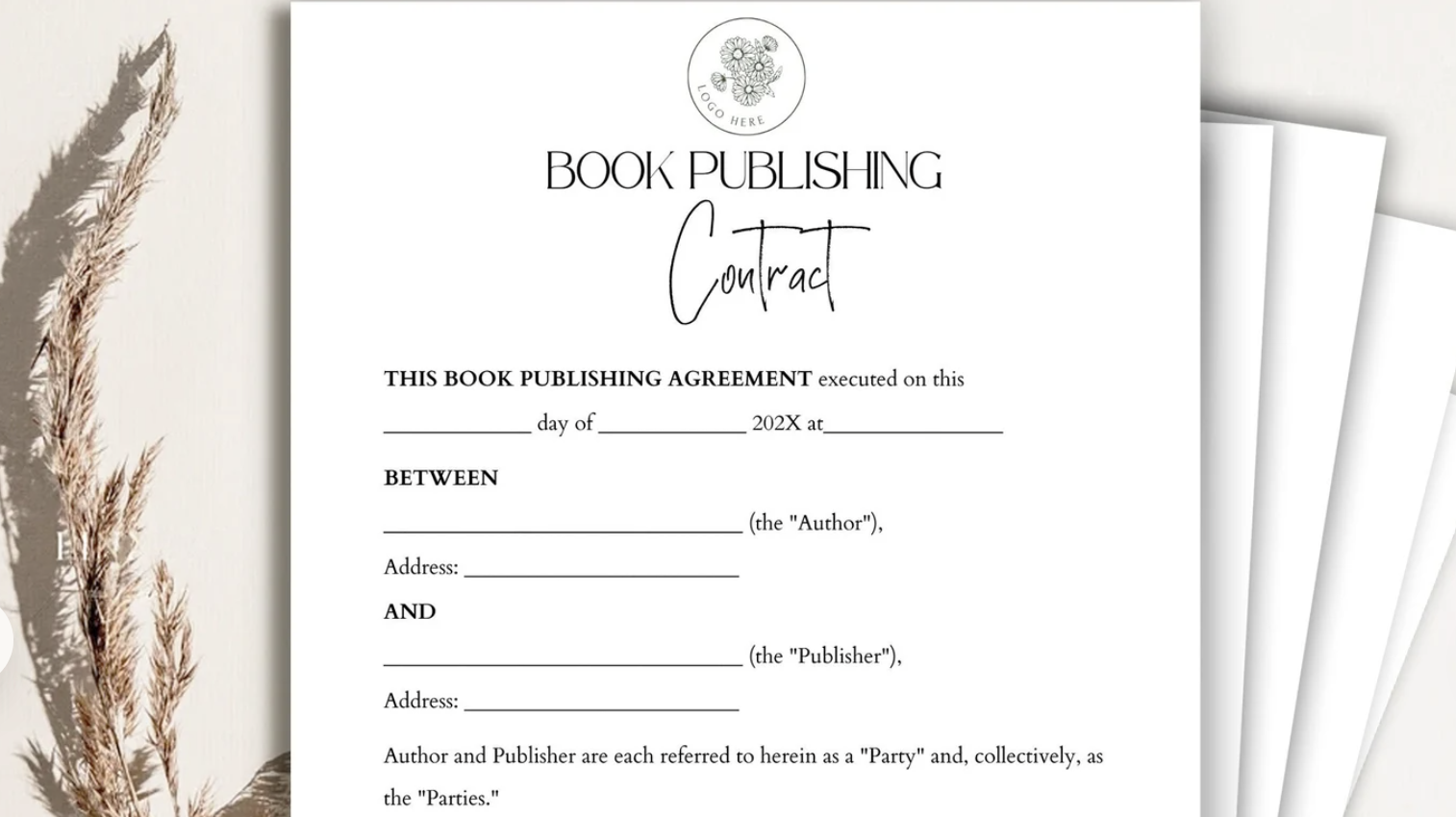
A book publishing contract is a legal agreement that sets which rights you give a publisher, how you get paid, and what each side owes.
A contract protects both sides. For the publisher, it secures the right to publish and sell your book after paying for editing, design, printing, and distribution. For you, it should spell out what you get in return.
Most book publishing contracts come from traditional deals, where an agent sells your book to a publisher. If that world is new to you, our guide to the Big 5 publishers explains who they are and why none of them read manuscripts without an agent.
A typical contract covers five things:
- Rights: the formats, territories, and languages you're granting
- Money: your advance, royalty rates, and payment schedule
- Publication: the timeline, formats, and distribution plan
- Your duties: manuscript deadlines and any promotion you agree to do
- The publisher's duties: editing, cover design, marketing, and distribution
Treat that list as a filter, too. If a contract is vague on any of the five, ask why.
Do self-published authors need a book publishing contract?
No. Self-published authors don't sign a publisher contract because they are the publisher. You still agree to platform terms and sign agreements with freelancers.
You are the publisher, so there's no one to cut a deal with. You keep your rights, your creative control, and your royalties. That's the appeal, and it's why so many authors we coach choose this route.
You do still agree to terms. When you upload to Amazon KDP, you give Amazon a non-exclusive license to sell your book, and you keep your copyright. Enroll in KDP Select and you also agree to at least 90 days of ebook exclusivity. Read what the box says before you check it. Our Amazon KDP guide covers each setting, and our look at the hidden challenges of self-publishing on Amazon covers the fine print most authors skip.
What you'll sign instead are agreements with the people who help you make the book:
- Editors and beta readers, often with a nondisclosure agreement so spoilers stay private
- Cover designers, where you want a written assignment or license so the artist can't later claim a cut of your sales
- Formatters and other freelancers, with clear payment terms so everyone gets paid
- Ghostwriters, where the contract should say who owns the finished manuscript (our guide on whether ghostwriting is legal covers the basics)
Copyright protection starts the moment you write. Registering it gives you the right to sue for infringement, and our guide on how to copyright a book walks you through it.
Who needs a book publishing contract?
Anyone who shares a book's rights or profits should have a written contract, including authors, publishers, agents, ghostwriters, and co-authors alike.
Think of it as a map of who's in the room. Authors want fair pay and a way to get their rights back. Publishers want to protect what they've invested. Agents want their commission written into the deal.
On that last point, the standard agent commission is 15% of domestic income and 20% of foreign income. If an agent asks for a reading fee, walk away. Real agents earn money when you do.
One quirk surprises people: the agency clause. If you part ways with your agent later, they usually keep earning commission on the deals they made, for as long as those contracts pay. Read that clause in your agent agreement as carefully as you read the publisher's.
Co-authors and ghostwriters need their own agreements too, with royalty splits and credit spelled out before anyone writes a word.
Nine terms to check in a book publishing contract
Check nine terms before you sign: rights granted, advance and royalties, delivery, editing, schedule, marketing, reversion, subsidiary rights, and warranties.
Publishers work from boilerplate, so you'll see these same nine terms in almost every contract. Some are negotiable and some aren't. Knowing which is which is most of the game.
1. Grant of rights
This is the engine of the contract. It lists exactly what you're handing over (print, ebook, audio, translation, film, and more), plus the territories and how long the grant lasts.
Watch for "all rights throughout the universe." The Authors Guild's model trade book contract recommends limiting the grant to the formats and territories the publisher will actually use. Anything you sign away, the publisher can sit on. Ask about cover approval too. Some authors negotiate final say, and many never get it.
2. Advance and royalties
An advance is money paid up front against your future royalties. It usually arrives in installments, such as on signing, on delivery of an acceptable manuscript, and on publication. If your book doesn't earn it back, you generally keep what you were paid unless you breach the contract. You just won't see another royalty check.
Here's the math. Say you get a $20,000 advance on a $28 hardcover with a 10% royalty. You earn $2.80 a copy, so the book has to sell about 7,143 hardcovers before you're paid again. Real contracts blend formats, but the logic holds.
| Format | Typical traditional royalty | Paid on |
|---|---|---|
| Hardcover | 10% to 15% | List price |
| Trade paperback | 6% to 8%, often tiered | List price |
| Mass-market paperback | 4% to 8% | List price |
| Ebook | 25% | Publisher's net receipts |
| Audiobook | Often 25% | Net receipts |
Typical ranges, not promises. Rates vary by publisher and by contract.
Check whether your royalty is paid on list price or on net receipts. The same percentage is worth far less on net, because discounts shrink the base before your cut is calculated.
Ebook royalties are a long-running sore spot. The Authors Guild has argued that 50% of net proceeds, not 25%, is the fair ebook rate. For comparison, self-publishing on KDP pays 35% to 70% depending on price and distribution choices. Our book royalties calculator shows what your own numbers could look like.
3. Manuscript delivery and acceptance
Your contract sets a delivery date and defines what counts as "acceptable." Vague wording here is risky, because a publisher that can reject your manuscript on a whim may be able to cancel the deal. The Authors Guild argues that acceptance shouldn't be a matter of whim.
Ask what happens to your advance if the manuscript is rejected. Ask for a revision window instead of an instant no. And build in room for illness and emergencies.
4. Editing and proofreading
The contract should say who edits, how many rounds of changes you get, and who has the final word on your text. Check whether you can review proofs before printing, and whether the publisher can change your title or text without asking you. Small line items like these decide whether the finished book still sounds like you.
5. Publication schedule
Ask for a firm publication window and a consequence if the publisher misses it. Without one, your book can sit in a drawer for years while your rights stay locked up. A good clause says the publisher must publish within a set number of months after accepting your manuscript, or you can end the deal and get your rights back.
6. Marketing and promotion
Promises like "the publisher will consult with the author on marketing" mean very little. Ask what's guaranteed: a launch plan, review copies, catalog placement, or a set budget.
Then be honest about your own role. Small presses in particular expect authors to carry most of the promotion, and even large houses tend to focus their budgets on a handful of lead titles.
7. Termination and reversion of rights
This clause matters most in year five, and almost nobody reads it in year one. It spells out when the contract ends and how your rights come back.
Many contracts last for the life of the copyright, which is your lifetime plus 70 years. The Authors Guild has argued that a publishing contract should not be forever. Out-of-print clauses used to be the escape hatch, but with ebooks and print on demand a book is never technically out of print. So ask for a trigger based on sales or royalties, such as fewer than a set number of copies a year, plus a clear process for requesting your rights back.
8. Subsidiary rights
Subsidiary rights cover everything beyond the main book: translations, audio, film and TV, serial excerpts, and merchandise. These can be worth more than the advance.
Ask who controls each right and what split you get. If the publisher has no realistic plan to sell a right, try to keep it. A publisher can only hold what you hand over.
9. Warranties and indemnities
You'll promise that the book is original, that you own it, and that it doesn't defame anyone or infringe on someone else's rights. That's reasonable. The indemnity is the part to watch, because it can make you responsible for the publisher's legal costs if a claim is made. Ask your agent or attorney whether it can be limited to final judgments rather than every accusation.
Three clauses authors often miss
- Option clause: gives the publisher a first look at your next book, sometimes for a set period.
- Noncompete clause: limits what you can publish elsewhere while this book is on sale.
- Accounting and audit rights: how often you get royalty statements (often twice a year) and whether you can check the publisher's books.
How to get a book publishing contract
To land a traditional book publishing contract, finish a polished manuscript, query agents in your genre, and let your agent pitch publishers.
Expect it to take months, sometimes years, and a great book still isn't a guarantee. Small presses are the exception, since many accept submissions directly. Our directory of book publishers is a good place to start looking.
1. Finish something ready to sell
For fiction, that means a complete, polished manuscript, because an agent who loves your opening pages will ask for the whole book. Nonfiction often sells on a proposal and sample chapters instead, so you may not need the full draft first. Either way, get professional editing before you query.
2. Research agents who represent your genre
Pitching a thriller to a romance agent wastes everyone's time. Pull books like yours off your shelf, read the acknowledgments, and look for the agent's name. You can also search "who is
's agent." Then check the agency's website for open submissions and exact guidelines. QueryTracker and Publishers Marketplace show who's actually selling what.3. Write a query letter that gets read
Keep it to one page: a hook, a short summary with your genre and word count, a line or two on why it will sell (comparable books help), and a brief bio. Follow each agent's submission instructions exactly. Going around them rarely ends well.
4. Meet agents and editors at conferences
Agents and editors attend writing conferences to find new voices. A pitch session doesn't guarantee anything, but face time can turn a cold query into a full request. Poets and Writers keeps a searchable list of writing conferences.
5. Build proof by self-publishing first
Self-publishing is a legitimate way to show that your book sells. Strong numbers and a real readership take much of the risk out of an agent's decision. It worked for Sam Skelly, who published Hungry for Happiness with selfpublishing.com before Hay House picked it up. Our guide on how to self-publish a book covers the full process, and our comparison of self-publishing vs traditional publishing can help you pick where to start.
Types of book publishing contracts, compared
Book publishing contracts fall into five types: traditional trade, small press, hybrid, vanity or assisted publishing, and self-publishing platform terms.
The key difference is who pays and who keeps control. A contract that looks like a publishing deal but asks you to pay for it belongs in a different category.
| Contract type | Who pays | Advance | What to watch |
|---|---|---|---|
| Traditional trade (large publishers) | Publisher | Yes | Breadth of rights, reversion, ebook royalty |
| Small or independent press | Publisher | Often small or none | Distribution reach, marketing falls on you |
| Hybrid publisher | Shared, and you often pay | No | Fees, rights terms, uneven quality |
| Vanity or assisted self-publishing | You | No | Upsells, withheld royalties, rights terms |
| Self-publishing platform terms | Free to use | No | Exclusivity, license scope, royalty tier |
Hybrid isn't automatically a scam, but it's often expensive. In our reviews, Advantage Forbes Books packages start at $25,000. Balboa Press, which we classify as a vanity publisher, sells packages from $1,099 to $14,999, and Trustpilot reviewers rate it 2.4 out of 5. Before you pay anyone, read our guide to hybrid publishing, and compare your options in our roundup of self-publishing companies.
Red flags in any book publishing contract
- The company charges you to "publish" but calls it a traditional deal
- No reversion clause, or one that can't realistically be triggered
- Pressure to sign fast, or a stream of upsells after you do
- Vague royalty reporting, or no statements at all
- Rights taken for formats the publisher doesn't produce
Money should flow toward the author.
Common mistakes authors make with a book publishing contract
The costliest mistakes are signing without independent review, focusing only on the advance, and accepting a contract with no real reversion clause.
- Signing without an agent or publishing attorney reading it first
- Chasing the biggest advance while ignoring reversion and the scope of rights
- Not checking whether royalties are paid on list price or net receipts
- Assuming nothing is negotiable. Publishers rarely move on every term, but author copies, remainder terms, and the scope of rights are often fair game.
- Mistaking a hybrid or vanity offer for a traditional deal
Before you sign: a five-step review
Read the whole contract, mark every clause that touches money, rights, or time, then have an agent or publishing attorney review it before you sign.
- Read all of it, including the boilerplate at the back.
- Mark every clause about money, rights, or time.
- Compare it against the Authors Guild model trade book contract.
- Get a professional review from your agent, a publishing attorney, or the Authors Guild, whose membership includes contract review.
- Ask for every change in writing before you sign.
If you're searching for a book publishing contract template or a PDF sample, treat it as a reference, not a document to sign. No single template fits every deal.
Frequently asked questions about book publishing contracts
What is a book publishing contract?
A book publishing contract is a legal agreement between an author and a publisher. It sets which rights the author grants, how much the author earns, what each side must deliver, and when the rights return to the author.
What should a book publishing contract include?
At minimum: the grant of rights, advance and royalties, delivery and acceptance terms, editing duties, a publication schedule, marketing commitments, termination and reversion, subsidiary rights, and warranties. Option, noncompete, and accounting clauses matter too.
Do I need a lawyer to review a book publishing contract?
Yes. Have a literary agent, a publishing attorney, or an Authors Guild contract review read it before you sign. A general attorney who doesn't know publishing can miss the clauses that matter most, like reversion and subsidiary rights.
How much do authors earn under a book publishing contract?
Typical traditional royalties run 10% to 15% of list price on hardcovers, 6% to 8% on trade paperbacks, and 25% of net receipts on ebooks, paid against an advance. Rates vary by publisher, and agents usually take 15% of domestic income.
Can you negotiate a book publishing contract?
Yes, within limits. Publishers use boilerplate and rarely rework every term, but the scope of rights, reversion, author copies, and subsidiary rights splits are commonly negotiated. A good agent handles this for you.
How long does a book publishing contract last?
Many last for the life of the copyright, which is the author's lifetime plus 70 years, unless a reversion clause returns your rights sooner. That's why a workable reversion clause matters more than most authors realize.
How do I get a book publishing contract?
Finish a polished manuscript or, for nonfiction, a strong proposal. Query literary agents who represent your genre, then let your agent submit to publishers. Small presses may accept direct submissions. Self-publishing first can also build the sales record that gets you noticed.
Is a hybrid publishing contract the same as a traditional one?
No. In a traditional deal, the publisher pays and you earn an advance and royalties. In a hybrid deal, you typically pay some or all of the costs. Legitimate hybrid publishers exist, but fees run high, so research the company first.
Want to keep your rights and your royalties?
Publisher deals are real, and for some authors they're the right call. Many authors want control over their book, their timeline, and their income instead.
If that sounds like you, we can help. selfpublishing.com coaches authors from blank page to published, with 1:1 coaching through writing, editing, cover design, formatting, and the KDP upload. Most of the authors we work with never need a publisher contract at all, because they publish under their own name and keep control of their book.
Book a free strategy call and we'll map out the route that fits your book.