


















TL;DR: Penguin Random House, HarperCollins, Simon & Schuster, Hachette Book Group, and Macmillan are the Big 5 publishers, the five publishing houses that control roughly 80% of US trade book revenue. Getting a deal with one requires a literary agent, since none accept unsolicited manuscripts. Below is what each house publishes, who owns them in 2026, and the 8-step path from manuscript to book deal.
If you've spent any time researching traditional publishing, you've run into the term "Big 5." These are the 5 houses that acquire the bulk of traditionally published books through literary agents, and knowing how each one operates matters whether you're pursuing a traditional deal or deciding self-publishing is the faster path to your reader.
But what are teh Big 5 publishing houses and how can you work with them? Read on to find out.
Who are the Big 5 publishers?
The Big 5 publishing houses are Penguin Random House, HarperCollins, Simon & Schuster, Hachette Book Group, and Macmillan. Together, they control roughly 80% of US trade book revenue, despite publishing only 10 to 20% of new titles each year. Because of this, they are often what people think of first when they talk about book publishing companies.
- Penguin Random House
- HarperCollins
- Simon & Schuster
- Hachette Book Group
- Macmillan
That revenue concentration, not title volume, is what makes them "big." A huge share of self-published and small-press books exist alongside them; the Big 5 simply dominate bestseller lists and industry visibility.
Why are there only 5 major publishers?
Decades of mergers and acquisitions consolidated dozens of independent publishing houses into 5 conglomerates, because buying a competitor is more profitable than competing with them.
You can see it in the names. Penguin Random House is the product of a 2013 merger between Penguin and Random House. HarperCollins formed when News Corp combined Harper & Row with William Collins. Hachette Book Group is the US arm of a French publishing conglomerate that expanded internationally through acquisition after acquisition.
Plenty of smaller and mid-size publishing houses still exist and publish great books. The Big 5 are simply the 5 largest by revenue for traditionally published, English-language trade books.
The Big 5 publishers, house by house
Penguin Random House
2024 global revenue: $5.3 billion (up 8.5% year over year) | Owner: Bertelsmann | US trade market share: 23.8%
Penguin Random House is the largest of the Big 5, formed by a 2013 merger of Penguin and Random House, and now wholly owned by German media company Bertelsmann.
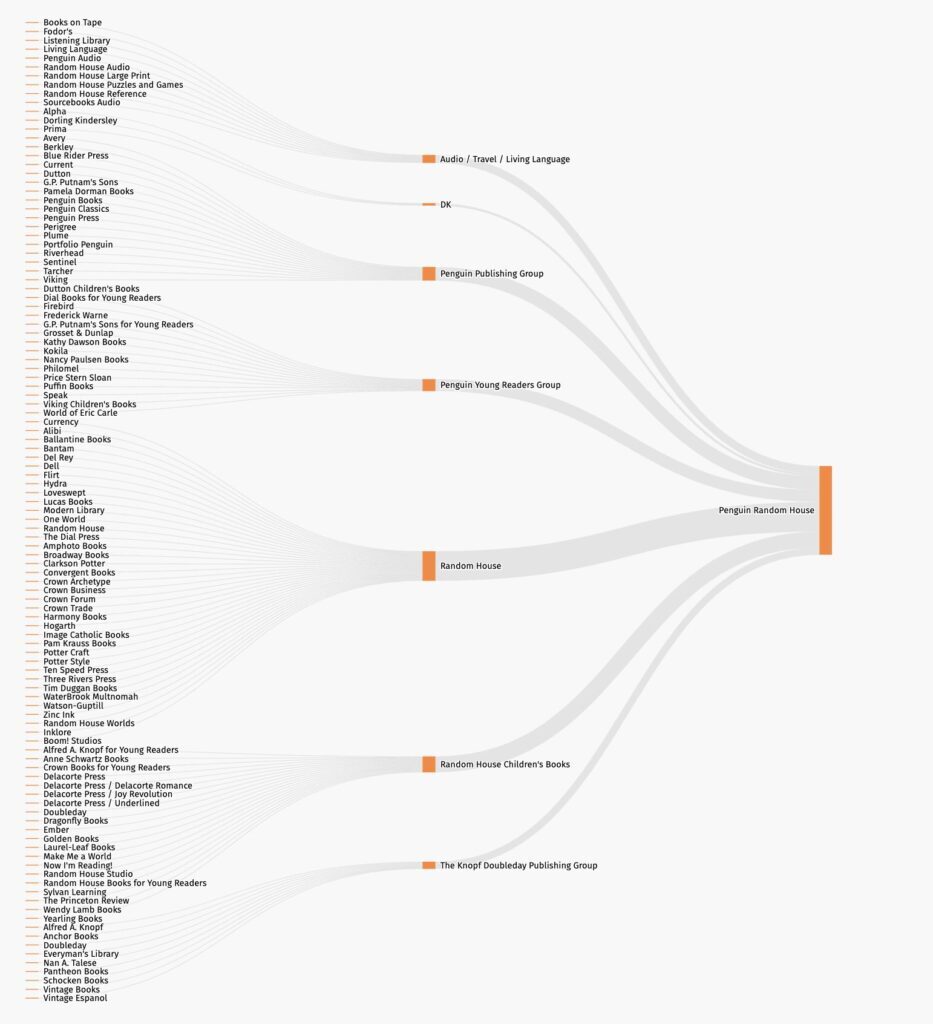
Image courtesy of https://almossawi.com/big-five-publishers/
History
Penguin was founded in 1935 by Sir Allen Lane to sell quality paperbacks at the price of a pack of cigarettes, democratizing access to books that had previously been hardcover-only luxuries. Random House was founded in 1927 by Bennett Cerf and Donald Klopfer and grew into a home for Nobel Prize-winning authors, acquiring Alfred A. Knopf and Pantheon Books in 1960. The 2 companies merged in 2013, and Bertelsmann became sole owner in 2020.
Notable imprints
Knopf, Viking, Crown, Bantam, Del Rey, Puffin Books, and Berkley, among dozens more.
What they publish
Literary fiction, genre fiction (romance, fantasy, sci-fi, thrillers), nonfiction (memoir, biography, self-help, business, history), and children's books. Their catalog spans everything from award-winning literary fiction to commercial bestsellers.
Top 3 bestselling titles
- The Girl with the Dragon Tattoo by Stieg Larsson
- Becoming by Michelle Obama
- The Fault in Our Stars by John Green
Notable literary agents
Kristin Nelson (Nelson Literary Agency), Ethan Ellenberg (Ethan Ellenberg Literary Agency), Suzie Townsend (New Leaf Literary & Media). Confirm any agent is open to queries before submitting; rosters change often.
HarperCollins
Owner: News Corp | Countries of operation: 18 | Titles published annually: 10,000+
HarperCollins is a News Corp subsidiary formed from the 1987 to 1989 acquisitions of Harper & Row and William Collins & Sons, publishing more than 10,000 titles a year across 18 countries.
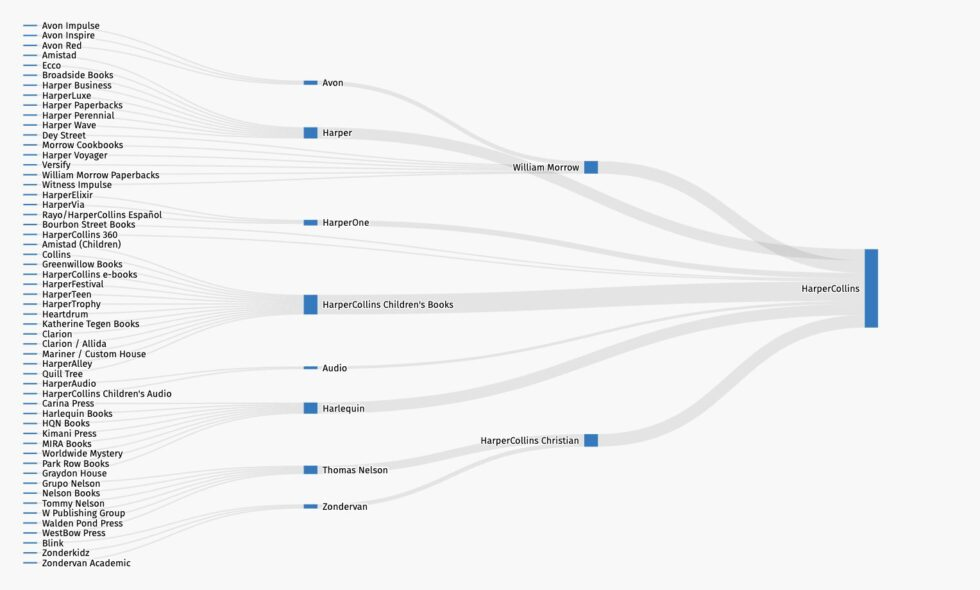
Imae courtesy of https://Almossawi.com/Big-Five-Publishers/
History
HarperCollins traces back to Harper & Brothers, founded in New York in 1817, and William Collins & Sons, founded in Scotland in 1819. Rupert Murdoch's News Corp acquired Harper & Row in 1987 and William Collins & Sons in 1989, merging them into HarperCollins. Later acquisitions added Zondervan, Avon Books, and Harlequin Enterprises to its catalog.
Notable imprints
Avon, Harlequin, William Morrow, Harper Voyager, and Amistad, among dozens more.
What they publish
Literary fiction, commercial fiction, romance, fantasy, nonfiction (business, memoir, self-help), and children's books, with a catalog that includes J.R.R. Tolkien, Agatha Christie, and Neil Gaiman.
Top 3 bestselling titles
- To Kill a Mockingbird by Harper Lee
- The Alchemist by Paulo Coelho
- The Hobbit by J.R.R. Tolkien
Notable literary agents
Jennifer Laughran (Andrea Brown Literary Agency), Mollie Glick (Creative Artists Agency), Donald Maass (Donald Maass Literary Agency).
Simon & Schuster
Owner: KKR (private equity) | Sale price: $1.62 billion (2023) | CEO: Greg Greeley (appointed March 2026)
Simon & Schuster is the only Big 5 house not owned by a media or education conglomerate. Private equity firm KKR bought it for $1.62 billion in 2023 after federal regulators blocked a planned sale to Penguin Random House.
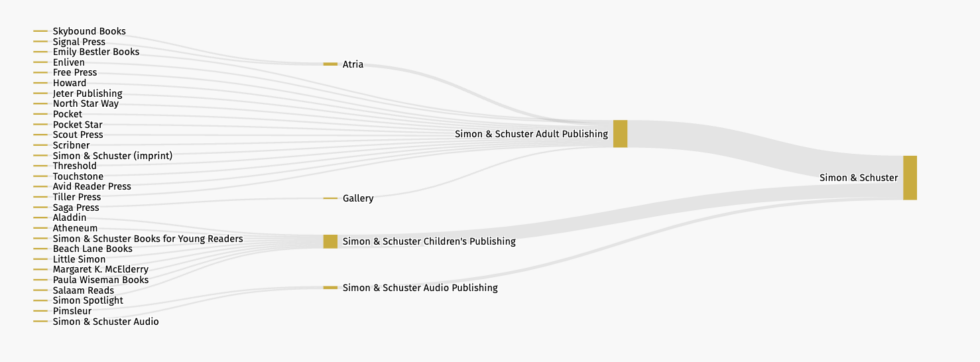
Image courtesy of https://Almossawi.com/Big-Five-Publishers/
History and ownership
Founded in 1924 by Richard L. Simon and M. Lincoln Schuster, the house started as a music publisher before pivoting to books. In 2020, Penguin Random House agreed to acquire it for roughly $2.2 billion, but a federal judge blocked the merger in 2022 on antitrust grounds, ruling it would have reduced competition and depressed author advances. Paramount Global then sold Simon & Schuster to KKR in 2023, making it a standalone private company for the first time since 1975. Jonathan Karp led the company through that transition before stepping down in August 2025 to launch a new venture; Greg Greeley became CEO in March 2026.
Notable imprints
Scribner, Atria, Gallery Books, and Pocket Books.
What they publish
Literary fiction, commercial fiction, and nonfiction (memoir, business, history, self-help), with a reputation for bold acquisitions, including political exposés and blockbuster thrillers.
Top 3 bestselling titles
- Carrie by Stephen King
- The 7 Habits of Highly Effective People by Stephen R. Covey
- Born a Crime by Trevor Noah
Notable literary agents
Janet Reid (New Leaf Literary & Media), Kristin Nelson (Nelson Literary Agency), Ethan Ellenberg (Ethan Ellenberg Literary Agency).
Hachette Book Group
Parent company: Lagardère Publishing, majority owned by Louis Hachette Group | Founded: 1826 (as Hachette Livre in France)
Hachette Book Group is the US arm of Hachette Livre, the French publisher founded in 1826, and today sits under Lagardère Publishing following Vivendi's 2024 corporate split into separate media entities.
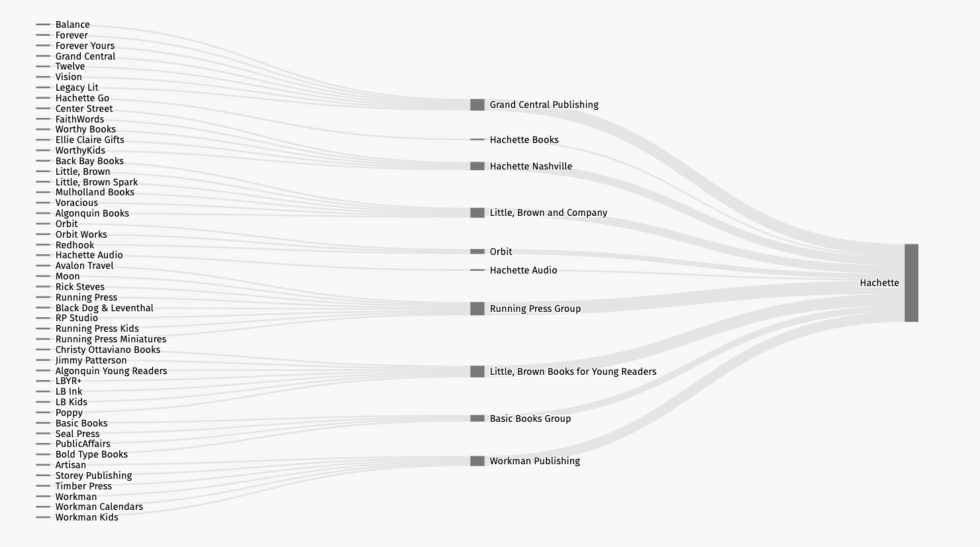
Image courtesy of https://Almossawi.com/Big-Five-Publishers/
History
Hachette Livre traces back to 1826 in France and expanded internationally over 2 centuries. It solidified its US presence in 2006 by acquiring Time Warner Book Group, bringing Little, Brown and Company and Grand Central Publishing under its umbrella. Hachette Livre's parent, Lagardère, is now majority owned by Louis Hachette Group, an entity controlled by French businessman Vincent Bolloré's family and spun out of Vivendi in late 2024.
Notable imprints
Little, Brown and Company, Grand Central Publishing, and Orbit, which many readers recognize more readily than the Hachette name itself.
What they publish
Literary fiction, commercial fiction, nonfiction (self-help, history, memoir), and children's books, with fiction driving the bulk of its revenue.
Top 3 bestselling titles
- Twilight by Stephenie Meyer
- The Nightingale by Kristin Hannah
- Malibu Rising by Taylor Jenkins Reid
Notable literary agents
Suzie Townsend (New Leaf Literary & Media), Mollie Glick (Creative Artists Agency), Donald Maass (Donald Maass Literary Agency).
Macmillan
Owner: Holtzbrinck Publishing Group (Germany) | Founded: 1843 in London
Macmillan is the smallest of the Big 5 by revenue, though its public figures aren't disclosed, and it's known for consistent growth driven by strong sci-fi, fantasy, and commercial fiction sales.
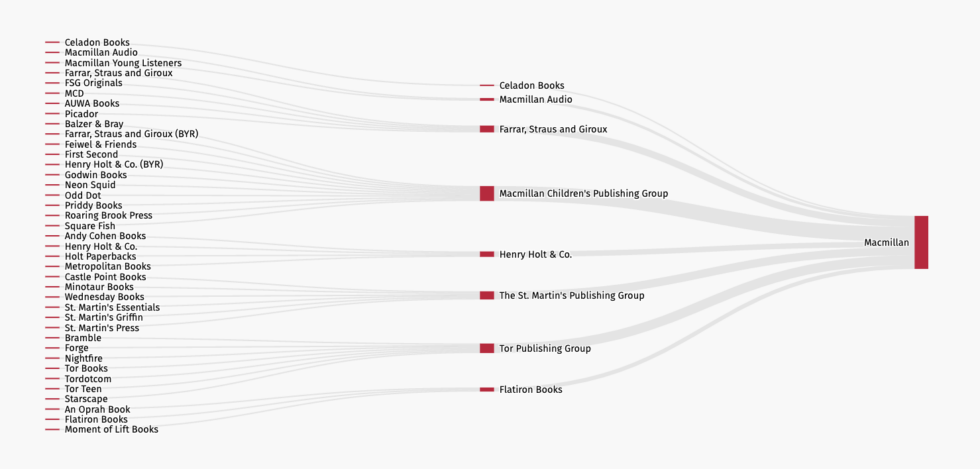
Image courtesy of https://almossawi.com/big-five-publishers/
History
Founded in 1843 in London by brothers Daniel and Alexander Macmillan, the house published Thomas Hardy and Rudyard Kipling before expanding internationally into India, Canada, Australia, and the US. It's now owned by Germany's Holtzbrinck Publishing Group.
Notable imprints
St. Martin's Press, Tor Books, Henry Holt & Company, and Farrar, Straus and Giroux. Tor is especially recognized for science fiction and fantasy, including A Game of Thrones.
What they publish
Literary fiction, science fiction, fantasy, and nonfiction (biography, history, politics), with a reputation for intellectually rigorous but commercially successful books.
Top 3 bestselling titles
- A Game of Thrones by George R.R. Martin
- The Night Circus by Erin Morgenstern
- Life of Pi by Yann Martel
Notable literary agents
Jennifer Laughran (Andrea Brown Literary Agency), Janet Reid (New Leaf Literary & Media), Ethan Ellenberg (Ethan Ellenberg Literary Agency).
How to get published by a Big 5 publisher
Getting a Big 5 deal requires a literary agent, a polished and marketable manuscript, and proof your book can sell, since none of the 5 houses accept unsolicited submissions directly from authors.
1. Write a high-quality, marketable book
Polish your manuscript before you approach anyone. For fiction, that means a compelling hook, developed characters, and a strong narrative arc. For nonfiction, it means clear expertise, a unique angle, and a defined target audience.
2. Research the right imprint for your genre
Each Big 5 house runs dozens of imprints with different specialties. Tor (Macmillan) focuses on sci-fi and fantasy; Atria (Simon & Schuster) focuses on commercial fiction. Study books similar to yours and note who published them.
3. Find a literary agent
Big 5 publishers require submissions to come through an agent. Use resources built for this:
- Manuscript Wish List (MSWL), where agents list what they're actively seeking
- Publishers Marketplace, which tracks recent deals and active agents
- Writer's Market and individual agency websites for submission guidelines
4. Write a strong query letter and proposal
A query letter is a one-page pitch. Nonfiction typically also requires a full book proposal with market analysis and sample chapters. Your query needs a compelling hook, a 2 to 3 sentence synopsis, your relevant credentials, and a specific reason you're querying that agent.
5. Submit and revise based on feedback
Follow each agent's submission guidelines exactly. If rejections come with feedback, use it to revise your query or manuscript before your next round of submissions.
6. Let your agent pitch editors
Once you have representation, your agent pitches editors at Big 5 imprints, negotiates advances and rights, and guides you through any revision requests.
7. Work the deal and the edit
If a publisher makes an offer, your agent negotiates contract terms. You'll then work with an editor on structural edits, cover design, and marketing plans, while the publisher handles printing and distribution.
8. Build your author platform
Big 5 publishers expect authors to bring their own audience to the launch. Grow a social media following, build an author website, and network with other authors and book bloggers well before your publication date.
Proof of sellability strengthens every step of this process. The Martian by Andy Weir was originally self-published before Crown Publishing, a Penguin Random House imprint, acquired it in 2014, a reminder that demonstrated demand is one of the most persuasive things you can bring to a query.
Traditional deal or self-publish: know both paths
A Big 5 deal gives you distribution, marketing muscle, and industry credibility, but it's a highly competitive, agent-gated process, and a very small fraction of traditionally published authors earn a full-time income from it. Self-publishing puts the timeline, the rights, and the royalties in your hands instead.
If you're weighing which path actually fits your goals, read our traditional publishing vs self-publishing blog.
If you decide you want to self-publish, selfpublishing.com has helped authors publish over 7,000 books, without needing a literary agent or a Big 5 deal. Feel free to book a free consultation call today to decide if we are the right fit for you.
Frequently asked questions
Do any of the Big 5 publishers accept unsolicited manuscripts?
No. All 5 require submissions through a literary agent. A small number of their imprints occasionally open unagented submission windows, but this is the exception, not the norm, and windows are typically short and specific.
Who are the "Big 4" in publishing?
There is no standing "Big 4." The term surfaces when a proposed merger, like Penguin Random House's blocked 2022 attempt to acquire Simon & Schuster, would have reduced the group from 5 houses to 4. As of 2026, the Big 5 remains 5 separate companies.
Is Bloomsbury one of the Big 5?
No. Bloomsbury is a well-known independent publisher, notably of the Harry Potter series in the UK, but it operates at a smaller revenue scale than the 5 conglomerates and isn't classified among them.
Who are the top 5 publishers by revenue?
Penguin Random House, HarperCollins, Hachette Book Group, Macmillan, and Simon & Schuster, in roughly that order by global revenue, though exact rankings shift slightly year to year and not all figures are publicly disclosed.
Can I query a Big 5 publisher directly without an agent?
Generally no. Nearly all Big 5 imprints require literary representation. Attempting to query editors directly typically results in an automatic rejection or no response at all.